

Brown-cheeked Rail vs Eurasian Coot
Rallus indicus versus Fulica atra
Play a quiz with Brown-cheeked Rail and Eurasian Coot
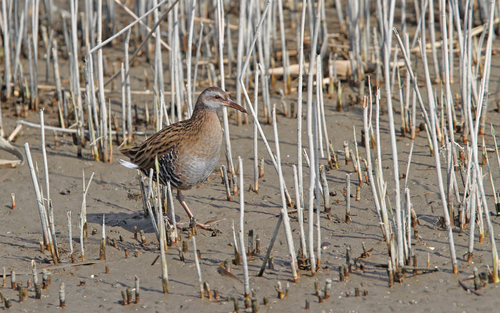 Brown-cheeked Rail
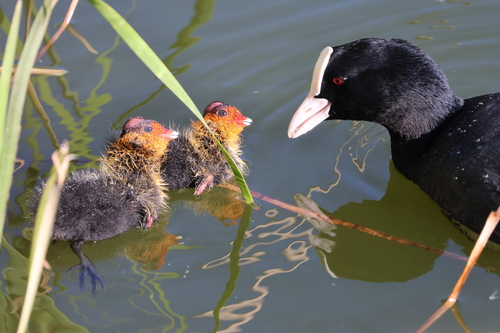 Eurasian Coot
In short
The most reliable field mark to separate Brown-cheeked Rail from Eurasian Coot is the coot's bold white bill and frontal shield, which stands out against its otherwise black plumage—features never shown by the rail. Brown-cheeked Rail is much smaller, slimmer, and more secretive, with brown-tinged underparts and a brown eyestripe, while Eurasian Coot is a chunky, dark waterbird with a slaty-black body and no brown tones. Juvenile coots are paler with a whitish breast and lack the white shield, but still differ in structure and behavior. In flight or when flushed, the rail appears weak-flying and secretive, while coots are strong, direct fliers. Mistakes often occur with immatures or in poor light, but structure and bill color are decisive.
Identification tips
- Bill and Frontal Shield: Eurasian Coot always shows a bright white bill and prominent white frontal shield, even in poor light; Brown-cheeked Rail has a duller, brownish bill with no shield. This is the single most decisive mark at any age.
- Size and Structure: Coot is much larger, stockier, and more robust, with a thick neck and rounded body. Brown-cheeked Rail is slim, chicken-sized, with a longer tail and more delicate build.
- Plumage Tone: Brown-cheeked Rail has brown-tinged underparts, a brown eyestripe, and a paler (not black) back; coot is slaty-black all over with no brown tones or facial stripes.
- Juvenile Confusion: Juvenile coots are paler with a whitish breast and lack the white shield, but still have a slaty body and never show the brown eyestripe or brownish underparts of the rail. Rails of all ages retain the brown facial stripe.
- Flight Style: Coots are strong, direct fliers, often flying long distances over water; rails are weak, fluttery fliers, dropping quickly back into cover.
- Behavior: Coots are often seen swimming in the open, sometimes in large flocks, and walk boldly on banks; rails are secretive, rarely swim far from cover, and are usually alone or in pairs.
- Feet and Toes: Coots have long, lobed toes with partial webbing, visible when walking or swimming; rails have long toes but no lobes or webbing.
- Habitat: Coots prefer open water and are common in urban parks and lakes; rails stick to dense reedbeds, marshes, and wetland edges, rarely venturing into open water.
- Voice: Brown-cheeked Rail's sharp 'kyu' and metallic 'shrink, shrink' calls are unlike the explosive, harsh calls of coot. Calls are useful if heard.
- Group Size: Coots are often in groups or flocks; rails are solitary or in pairs.
- Tail: Rails have a longer, more pointed tail, sometimes flicked up; coots have a short, rounded tail, rarely flicked.
- Swimming Posture: Coots sit high in the water and swim confidently; rails swim low, often with body partly submerged, and rarely for long.
- Seasonal Range: In southeast Asia and Japan, Brown-cheeked Rail is a winter visitor, while coot is often resident or a winter migrant in the same areas. Consider local abundance—coot is usually much more common.
- Nest Location: If seen on a nest, coots build large, open nests on water; rails nest deep in vegetation, rarely visible.
- Pitfalls: Poor light or distant views can obscure the coot's white shield, but structure and behavior remain distinctive. Immature coots without a shield may cause confusion, but always lack the brown tones and facial stripe of the rail.
Size
Eurasian Coot is dramatically larger and heavier than Brown-cheeked Rail. Coots measure 36–38 cm in length and weigh around 775 g (females) to 890 g (males) [wikidata], with a wingspan of 70–80 cm. Brown-cheeked Rail is much smaller at 23–29 cm in length and 75–190 g in weight [wikipedia]. This size difference is obvious in direct comparison: coots are stocky, duck-sized birds, while rails are slim and chicken-sized.
Plumage
Juvenile and immature plumage is most likely to cause confusion. Juvenile Eurasian Coots are paler than adults, with a whitish breast and lacking the adult's white facial shield; their body is still slaty and never brown-tinged. Brown-cheeked Rail of all ages shows paler upperparts than western Water Rail, a brown stripe through the eye, brown-tinged underparts, and white on the throat. Adult coots are uniform slaty-black with a glossy black head and a bright white bill and shield—never any brown or facial stripes. In flight, coots show broad, rounded wings and a short tail, while rails have narrower wings and a longer, more pointed tail. The rail's brown eyestripe and brownish underparts are present at all ages and seasons, while coot never shows these features.
Behaviour
Brown-cheeked Rail is secretive, skulking in dense marsh vegetation and rarely seen in the open; it is more likely to be flushed than seen swimming. When flushed, it flies weakly and drops quickly back into cover. Eurasian Coot is bold and often seen swimming in open water, walking on banks, or even in urban parks. Coots are strong swimmers with partial webbing on their toes and are much more likely to be seen in groups. Rails are solitary or in pairs and rarely swim far from cover.
Habitat
Brown-cheeked Rail prefers dense marshes, reedbeds, and wetland edges, often in remote or undisturbed areas. It breeds in northern Mongolia, eastern Siberia, northeast China, Korea, and northern Japan, wintering in southeast Asia. Eurasian Coot is found on open freshwater lakes, ponds, and rivers, often in urban parks and gardens, and is widespread across Europe, Asia, Australia, and North Africa. Coots are much more likely to be seen on open water, while rails stick to dense vegetation.
Voice
Brown-cheeked Rail has a sharp, piping 'kyu' courtship call and a series of metallic, slurred 'shrink, shrink' notes, which are longer and clearer than the calls of western Water Rail. Eurasian Coot is not described here for voice, but is known for loud, explosive 'kow-kow' and 'krik' calls. The rail's calls are distinctive and do not elicit response from coots or vice versa.