
Bronzy Hermit vs Long-billed Hermit
Glaucis aeneus versus Phaethornis longirostris
Play a quiz with Bronzy Hermit and Long-billed Hermit
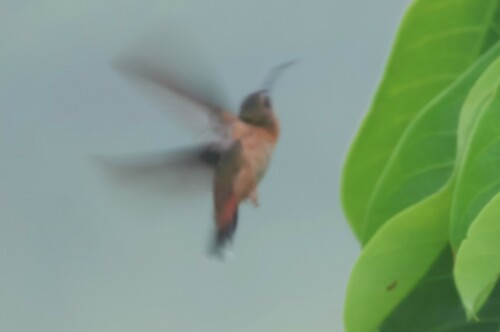 Bronzy Hermit
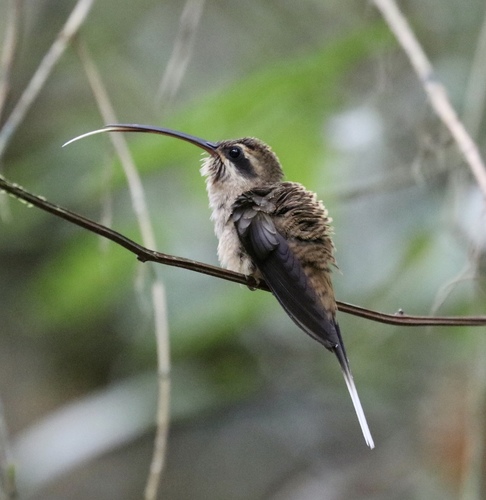 Long-billed Hermit
In short
The most reliable field mark between Bronzy Hermit and Long-billed Hermit is overall size and structure: Long-billed Hermit is much larger, with a proportionally much longer, more strongly decurved bill and a dramatically longer, more graduated tail with prominent white tips. Bronzy Hermit is compact, with a short tail and a more bronzy or coppery-green upperpart sheen. Both species have a white facial stripe, but the Long-billed Hermit's is bolder and the bird's jizz is lankier. In flight or perched, focus on tail length and bill shape for the quickest separation. Juvenile/immature-specific wing or tail patterns are not described in the sources for either species.
Identification tips
- Size is a major clue: Long-billed Hermit is much larger and longer than Bronzy Hermit. If the bird looks big for a hermit, especially with a long tail, suspect Long-billed.
- Tail length and shape: Long-billed Hermit has a dramatically long, graduated tail with prominent white tips on the central feathers; Bronzy Hermit has a short, squarish tail with white tips but never as long or graduated.
- Bill shape and length: Long-billed Hermit's bill is very long and strongly decurved; Bronzy Hermit's bill is shorter and less dramatically curved. Female Bronzy Hermits have a more curved bill than males, but never as long as Long-billed.
- Facial pattern: Both have a white facial stripe, but Long-billed Hermit's is broader and bolder, often giving a more striking facial contrast. Bronzy Hermit's face is dusky with a white 'moustache' (malar stripe), not as bold.
- Upperparts color: Bronzy Hermit shows a bronzy or coppery-green sheen above, while Long-billed Hermit is greenish-brown or dull metallic green, lacking the bronzy/coppery tones.
- Underparts: Bronzy Hermit has a deep buff throat and breast with a pale buff belly; Long-billed Hermit is brownish to grayish (sometimes ochraceous or whiter in some subspecies), never as buffy as Bronzy.
- Tail underside: Bronzy Hermit has a reddish base, blackish middle, and white tip below; Long-billed Hermit's tail is mostly dark with long white tips, especially on the central feathers.
- Uppertail coverts: Long-billed Hermit shows ochre banding on the uppertail coverts in some subspecies; Bronzy Hermit does not.
- Jizz in flight: Long-billed Hermit looks lanky and elongated with a trailing tail; Bronzy Hermit is compact and quick.
- Lek behavior: If you see a group of hermits singing and displaying long tails, it's Long-billed Hermit; Bronzy Hermit does not lek.
- Voice: A continuous 'sweeup' or 'tchee' series or sharp 'week!' call is Long-billed Hermit. Bronzy Hermit's voice is not described, so use this only for positive Long-billed ID.
- Habitat and elevation: In higher elevations or at forest edges/cloudforest, Long-billed Hermit is more likely. Bronzy Hermit prefers dense lowland/foothill forest understory.
- Sex differences: Both species have similar plumage between sexes, but bill length/curve can help: Long-billed Hermit males have longer, less curved bills; Bronzy Hermit females have more curved bills, but never as long as Long-billed.
- No useful juvenile/immature wing or tail pattern: Neither species has a described age-specific wing or tail mark, so focus on structure and adult plumage.
- When in doubt: If the bird is small, compact, bronzy, and short-tailed, it's Bronzy Hermit. If it's large, long-tailed, with a bold white face stripe and long bill, it's Long-billed Hermit.
Size
Long-billed Hermit is substantially larger: 13–16 cm in length and 5–7.5 g (male) or 4–6.5 g (female) in mass, compared to Bronzy Hermit's 9–10 cm and 3–6.5 g (male) or 3–6 g (female) [wikipedia][avonet]. This size difference is obvious in the field, especially when both species are present. Long-billed Hermit also appears longer-tailed and longer-billed, giving it a stretched, lanky look, while Bronzy Hermit is compact and short-tailed.
Plumage
- Juvenile/immature wing or tail pattern: No age-specific upperwing or tail patterns are described for either species in the sources, so focus on adult plumage and structure.
- Bronzy Hermit: Both sexes have bronzy or coppery-green upperparts, a deep buff throat and breast, and a pale buff belly. The face is dusky with a white 'moustache' (malar stripe). The tail is short, gray-green above with white tips, and the underside is reddish near the base, blackish in the middle, and white-tipped [wikipedia].
- Long-billed Hermit: Upperparts are greenish-brown to dull metallic green (depending on subspecies), underparts are brownish to grayish (sometimes ochraceous or whiter in some subspecies). The face has a bold white stripe, and the tail is very long and strongly graduated, with long white tips on the central feathers and ochre banding on the uppertail coverts. The overall effect is a much more elongated, boldly patterned tail and a less bronzy appearance than Bronzy Hermit [wikipedia].
- Sexes: Both species show similar plumage between sexes, but Long-billed Hermit males have longer, less curved bills than females; Bronzy Hermit females have a more curved bill than males.
Behaviour
Both species are typical 'trap-line' feeders, visiting a circuit of flowers for nectar and occasionally taking small arthropods. Long-billed Hermit males are known for lekking behavior, gathering in groups and singing for long periods while displaying their long tails. Bronzy Hermit does not display communal lekking in the sources. In flight, Long-billed Hermit appears more languid and elongated due to its long tail and bill, while Bronzy Hermit is more compact and agile.
Habitat
Both species overlap in Central America (Costa Rica, Panama, Colombia, etc.), but Long-billed Hermit has a wider elevational and habitat range, from lowland rainforest to cloudforest edges and gallery forests, up to 2,500 m in some areas. Bronzy Hermit is found in similar regions but is generally more restricted to lowland and foothill humid forests and edges. In areas of overlap, Long-billed Hermit is more likely in a wider range of forest types and elevations, while Bronzy Hermit is more tied to dense, humid forest understory.
Voice
Long-billed Hermit sings a continuous series of sharp, upslurred 'sweeup' notes or sparrow-like 'tchee..tchee..tchee..' depending on subspecies, and its call is a sharp, explosive 'week!' or thin 'seep,' often given in flight [wikipedia]. Bronzy Hermit's vocalizations are not described in the sources, so voice is only diagnostic if you hear the distinctive Long-billed Hermit song or call.