

Broad-billed Hummingbird vs Violet-crowned Hummingbird
Cynanthus latirostris versus Ramosomyia violiceps
Play a quiz with Broad-billed Hummingbird and Violet-crowned Hummingbird
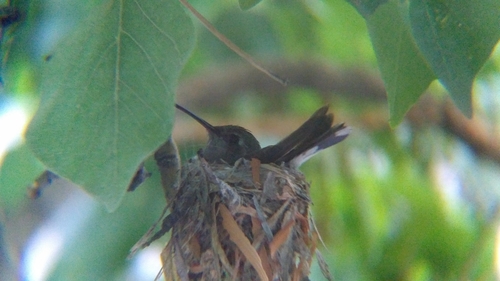 Broad-billed Hummingbird
 Violet-crowned Hummingbird
In short
The most reliable field mark to separate Broad-billed Hummingbird from Violet-crowned Hummingbird is the head and throat: Broad-billed males show a metallic blue throat and green crown, while Violet-crowned of both sexes have a striking violet-blue (or turquoise) crown and a pure white throat and underparts. Both species have a red bill with a black tip, but the Broad-billed's is shorter and brighter. In flight or perched, Broad-billed males show a dark, broad tail and green underparts, while Violet-crowned always shows a white belly and a coppery or green-bronze tail. Juvenile Broad-billeds resemble adult females but lack the white-tipped tail and blue gorget, while Violet-crowned juveniles are not described as distinct. Size and structure overlap but Violet-crowned is slightly larger and heavier.
Identification tips
- Head and Throat Color (Adult Males): Broad-billed males have a metallic blue throat (gorget) and green crown; Violet-crowned of both sexes have a vivid violet-blue or turquoise crown and a pure white throat and underparts. This is the single best mark in good light.
- Underparts: Violet-crowned always shows pure white underparts from throat to undertail, with only a faint olive wash on the flanks; Broad-billed is green below (male) or pale with green above (female), never pure white.
- Crown Color: Violet-crowned has a bright violet-blue or turquoise crown (both sexes), which is obvious in good light and contrasts with the green crown of Broad-billed.
- Tail Pattern: Broad-billed males have a broad, blackish-blue tail; females have white-tipped tail feathers. Violet-crowned has a coppery bronze or green-bronze tail, never blackish-blue, and no white tips.
- Bill: Both have a red bill with a black tip, but Broad-billed's is shorter and brighter red, especially in males. Violet-crowned's bill can appear longer and less intensely red.
- Eyestripe: Broad-billed females and juveniles show a white eyestripe behind the eye; Violet-crowned does not have a prominent eyestripe.
- Juvenile/Immature Marks: Juvenile Broad-billeds resemble adult females but lack white-tipped tail and blue gorget; Violet-crowned juveniles are not described as distinct but should show the white underparts and colored crown.
- Sexual Dimorphism: Broad-billed is strongly dimorphic—males and females look quite different. Violet-crowned is only slightly dimorphic; both sexes look very similar, with females just duller.
- Back Color: Broad-billed is metallic green above; Violet-crowned is dull grayish-brown to greenish-brown above, lacking the metallic sheen.
- Size: Violet-crowned is slightly larger and heavier, but this is subtle and not always reliable in the field.
- Tail Shape: Broad-billed's tail is broader and more squared; Violet-crowned's tail is more tapered and bronze-colored.
- Perched Posture: Both perch similarly, but Violet-crowned's white underparts and colored crown are often obvious even when sitting.
- Flight View: In flight, look for the flash of white underparts (Violet-crowned) vs. green or pale underparts (Broad-billed). Tail color and shape may also be visible.
- Habitat: Both use similar habitats; do not rely on location or context alone for separation.
- Pitfalls: Immature Broad-billeds can lack obvious male features and may be confused with female Violet-crowned, but the latter will always show a colored crown and pure white underparts.
Size
Violet-crowned Hummingbird is slightly larger and heavier: 10–11.5 cm in length and 5.1–5.8 g in weight, compared to Broad-billed Hummingbird's 8–10 cm and 3–4 g. Both have similar wingspans (around 13 cm for Broad-billed), but Violet-crowned appears a bit bulkier and longer overall. In the field, this difference is subtle and not always reliable for quick separation.
Plumage
- Juveniles/Immatures: Juvenile Broad-billed Hummingbirds resemble adult females (green above, pale below, white eyestripe), but juvenile males lack the adult male's blue gorget and do not have the white-tipped tail of adult females. Juvenile Violet-crowned Hummingbirds are not distinctly described but likely resemble adults, as both sexes are similar.
- Adult Males: Broad-billed males have a metallic green body, blue gorget, and blackish-blue broad tail. Violet-crowned males have a vivid violet-blue or turquoise crown, dull grayish to greenish-brown back, coppery or green-bronze tail, and pure white underparts from throat to undertail.
- Adult Females: Broad-billed females are metallic green above, pale below, with a white eyestripe and white-tipped tail feathers. Violet-crowned females are nearly identical to males but duller, still showing the violet/turquoise crown and pure white underparts.
- Bill: Both species have a red bill with a black tip, but Broad-billed's is shorter and brighter red, especially in males.
Behaviour
Both species are active, diurnal hummingbirds. Broad-billed Hummingbirds are described as especially active during the day, but there is no diagnostic behavioral difference noted between these two species in the sources provided. Both may be seen feeding at similar types of flowers and hovering or perching in open habitats.
Habitat
Both species occur in Mexico and the southwestern United States, often in similar habitats such as canyons, riparian woodlands, and gardens. There is no strong habitat separation in the field within their overlapping range, so habitat alone is not a reliable separator.
Broad-billed Hummingbird · Violet-crowned Hummingbird · My Tricky Birds