

Bristle-thighed Curlew vs Long-billed Curlew
Numenius tahitiensis versus Numenius americanus
Play a quiz with Bristle-thighed Curlew and Long-billed Curlew
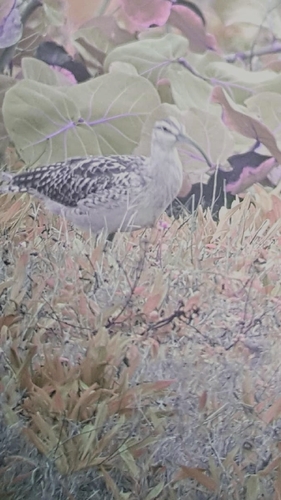 Bristle-thighed Curlew
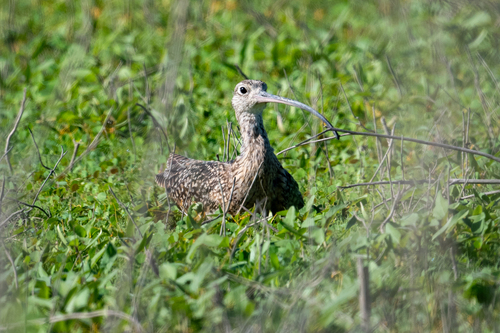 Long-billed Curlew
In short
The most reliable field mark to separate Bristle-thighed Curlew from Long-billed Curlew is overall size and bill length: Long-billed Curlew is much larger and has a dramatically longer, more sickle-shaped bill. In all plumages, Bristle-thighed Curlew shows a buffy or rust-colored tail and rump, and a paler, less-marked belly, while Long-billed Curlew is cinnamon below with a streaked crown and lacks the buffy rump. Both species have long, decurved bills and brown upperparts, but Bristle-thighed Curlew is more compact and has distinctive bristled feathers at the base of the legs. In flight or at rest, focus on the tail and rump color, underpart pattern, and bill proportions for confident separation.
Identification tips
- Bill length and shape: Long-billed Curlew has an extremely long, sickle-shaped bill (up to 22 cm), much longer than the head; Bristle-thighed Curlew's bill is long and decurved but noticeably shorter and more proportional to its head. This is the most consistent structural difference.
- Overall size: Long-billed Curlew is much larger and bulkier, with a longer neck and legs. If you see both together, the size gap is obvious; singly, Long-billed Curlew's size is still striking among shorebirds.
- Tail and rump color: Bristle-thighed Curlew shows a buffy or rust-colored tail and rump, often visible in flight or when preening. Long-billed Curlew's rump and tail are not distinctly buffy or rust-colored, blending with the rest of the upperparts.
- Underpart pattern: Bristle-thighed Curlew has a pale, unmarked belly and barely marked flanks, contrasting with the more cinnamon or warm buff underparts of Long-billed Curlew, which are more evenly colored and lack a pale belly.
- Upperpart spotting: Bristle-thighed Curlew has larger, paler buff spots on the upperparts; Long-billed Curlew's upperparts are more evenly brown and less boldly spotted.
- Crown pattern: Long-billed Curlew has a streaked crown, while Bristle-thighed Curlew's crown is less distinctly marked.
- Leg bristles: Bristle-thighed Curlew has bristled feathers at the base of the legs, a subtle feature but unique if seen well at close range.
- Jizz in flight: Long-billed Curlew looks especially long-necked and long-billed in flight; Bristle-thighed Curlew is more compact and less stretched out.
- Habitat and range: In North America, especially away from Alaska or Pacific islands, a curlew is almost certainly Long-billed. Bristle-thighed is highly range-restricted and rare outside its core areas.
- Sexual dimorphism: Female Long-billed Curlews are larger and have even longer bills than males, but both sexes are larger than Bristle-thighed Curlew.
- Contextual clues: If seen in large flocks in North American grasslands or coastal flats, Long-billed Curlew is expected; Bristle-thighed Curlew is solitary or in small groups, usually in remote Pacific locales.
- Plumage pitfalls: Both species have brown, spotted upperparts and long, decurved bills, leading to confusion at a distance. Focus on bill length, underpart color, and tail/rump color to avoid misidentification.
- Age/season: No detailed juvenile or immature-specific wing pattern differences are described for these two species, so rely on the above marks in all ages.
- Vocalizations: Not described in the provided sources; do not use for separation here.
- When in doubt: If the bird is smaller, with a buffy rump and tail, and a pale, unmarked belly, suspect Bristle-thighed Curlew; if larger, cinnamon below, and with a huge bill, it's Long-billed Curlew.
Size
Long-billed Curlew is the largest regularly occurring sandpiper in North America, measuring 50–65 cm in length with a wingspan up to 90 cm and a body mass around 700 g [wikidata]. Bristle-thighed Curlew is noticeably smaller, about 40–44 cm long with a wingspan of 84 cm. The size difference is especially obvious when both species are seen together, but even singly, Long-billed Curlew's bulk, long neck, and especially its extremely long, downcurved bill (up to 22 cm) are striking compared to the more moderate proportions of Bristle-thighed Curlew.
Plumage
There are no detailed age-specific upperwing pattern notes for either species, but key differences are visible in all plumages. Bristle-thighed Curlew has larger, buffy spots on the upperparts, a pale, unmarked belly, and a buffy or rust-colored tail and rump—these features are present in both adults and immatures. The flanks are barely marked. In contrast, Long-billed Curlew is cinnamon or warm buff below (not pale), with a streaked crown and more evenly colored upperparts. Its rump and tail are not distinctly buffy or rust-colored. The underparts of Long-billed Curlew are more uniformly colored, lacking the pale belly and buffy rump of Bristle-thighed Curlew. Both species have brown, spotted upperparts, but Bristle-thighed Curlew's spots are larger and paler.
Behaviour
Both species are ground-dwelling shorebirds with similar foraging behavior, probing mud or grass for invertebrates. Long-billed Curlew often appears lankier and more upright due to its longer legs and neck. In flight, Long-billed Curlew's large size and long bill are especially apparent. Bristle-thighed Curlew may appear more compact and less elongated. Courtship displays are only described for Long-billed Curlew, involving elaborate aerial maneuvers.
Habitat
Bristle-thighed Curlew breeds in Alaska and winters on remote Pacific islands, rarely seen outside this range. Long-billed Curlew breeds in central and western North American grasslands and winters coastally or in southern grasslands. If observed in North America away from Alaska, especially in open grasslands or coastal flats, Long-billed Curlew is vastly more likely. Bristle-thighed Curlew is highly specialized and rarely overlaps in range with Long-billed Curlew except as a rare vagrant.
Bristle-thighed Curlew · Long-billed Curlew · My Tricky Birds