

Bright-rumped Attila vs Brown-crested Flycatcher
Attila spadiceus versus Myiarchus tyrannulus
Play a quiz with Bright-rumped Attila and Brown-crested Flycatcher
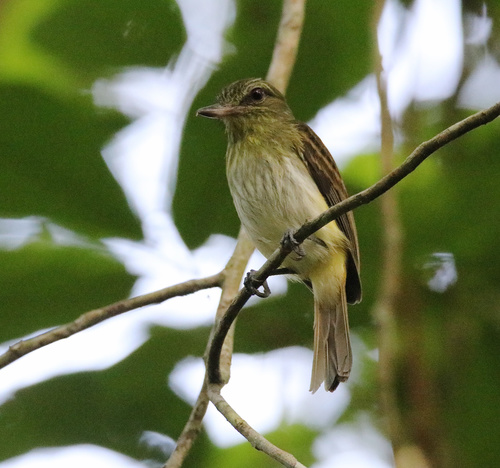 Bright-rumped Attila
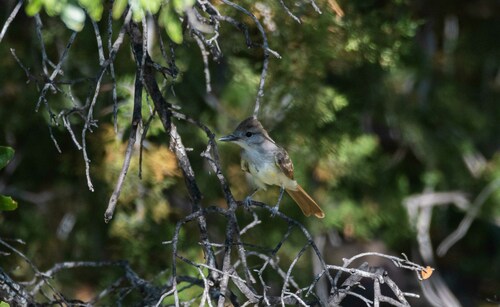 Brown-crested Flycatcher
In short
The most reliable field mark between Bright-rumped Attila and Brown-crested Flycatcher is the Attila’s unmistakable bright yellow rump, which stands out against its darker back and tail, especially when the bird is perched or flicks its tail. Both species show two pale wingbars and yellow underparts, but the Attila’s bold streaking on the breast and its red iris (in adults) are also distinctive. Brown-crested Flycatcher lacks the bright rump and instead shows a more uniform brownish or grayish upperparts with rufous in the tail and wings. Juveniles of both species can be tricky, but the Attila’s cinnamon-fringed crown and brown eyes help separate it from the flycatcher’s bushy grayish-brown crest and brown iris.
Identification tips
- Bright yellow rump (all ages): Only Bright-rumped Attila has a bright yellow rump, which is conspicuous when perched or flicking its tail. Brown-crested Flycatcher’s rump is the same color as its back.
- Breast streaking: Attila shows variable but often obvious dark streaking on the yellow breast and throat, especially in adults. Brown-crested Flycatcher’s underparts are clean yellow with a light gray throat and upper breast, lacking streaks.
- Wingbars and feather edging: Both species have two pale wingbars, but Attila’s are often broader and more contrasting, with paler feather edging on the dark brown wings. Flycatcher’s wingbars are paler grayish-brown to brownish-white, and the rufous edging is more prominent on the wings and tail.
- Tail pattern: Brown-crested Flycatcher shows rufous inner webs on all but the innermost tail feathers, visible in flight or when the tail is fanned. Attila’s tail is plain brown.
- Iris color: Adult Attila has a red iris (brown in juveniles), while Brown-crested Flycatcher always has a brown iris. This is best seen in good light and close views.
- Crown and crest: Attila’s head is big and rounded, with olive-green streaked with black and, in juveniles, cinnamon-fringed. Brown-crested Flycatcher has a bushy grayish-brown crest and a more elongated head profile.
- Bill shape: Attila has a heavier, hooked, and slightly upturned bill, while the flycatcher’s bill is straighter and more slender, sometimes with a paler base.
- Posture and jizz: Attila perches very upright and appears big-headed and compact. Flycatcher is more elongated, with a longer tail and a more horizontal stance.
- Voice: Attila’s song is loud, variable, and musical, often with repeated 'weery' notes and a 'woo-whit' ending. Flycatcher’s calls are sharper, drier, and less musical.
- Juvenile marks: Young Attila shows cinnamon-fringed crown and brown eyes; young flycatchers have a bushy crest and brown iris but lack the cinnamon crown.
- Habitat context: If seen in a shady garden, pasture, or disturbed area, Attila is more likely. If in open woodland or near large trees/cacti, especially if seen entering a cavity, suspect Brown-crested Flycatcher.
- Behavior: Attila may pursue prey on foot or follow army ants; flycatcher typically sallies from perches and rarely feeds on the ground.
- Sexes: Both species are sexually monomorphic in plumage, so sex is not a field mark.
- Size impression: Flycatcher can appear slightly larger and longer-tailed, especially in northern subspecies, but overlap is substantial.
- Pitfalls: Both have yellow underparts and pale wingbars, so focus on rump color, breast streaking, and bill/head structure for reliable separation.
Size
Both species are similar in length (about 18 cm), but Brown-crested Flycatcher can be slightly larger, especially in the northern subspecies (up to 23 cm and 54 g), while Bright-rumped Attila averages around 35–40 g. In the field, the Attila may appear more compact and upright, with a heavier, hooked bill and a big-headed look. Brown-crested Flycatcher often looks longer and slimmer, with a proportionally longer tail and a more slender, straight bill.
Plumage
Juvenile and immature birds: Bright-rumped Attila juveniles have a cinnamon-fringed crown and brown eyes, while Brown-crested Flycatcher juveniles resemble adults but with a bushier crest and brown iris. In all ages, Attila shows a bright yellow rump and variably streaked yellow breast, with two pale wingbars and paler feather edging on dark brown wings. Brown-crested Flycatcher of all ages lacks the bright rump; instead, it has a grayish-brown to olive-gray back, a bushy grayish-brown crest, and rufous edges on the tail and wings. Both species have yellow underparts, but Attila’s are more streaked, and the flycatcher’s are cleaner and brighter, with a light gray throat and upper breast. The Attila’s iris is red in adults (brown in young), while the flycatcher’s is always brown. The flycatcher’s tail shows rufous inner webs (except the innermost pair), which can be visible in good light or flight.
Behaviour
Bright-rumped Attila is often solitary, perches upright, and can be aggressive and noisy, sometimes pursuing prey on foot or following army ants. It tends to stay still when singing, making it hard to spot. Brown-crested Flycatcher is also often seen alone or in pairs, typically sallying from exposed perches to catch insects, and is less likely to forage on the ground. The Attila’s upright, big-headed posture contrasts with the flycatcher’s more elongated, crested silhouette.
Habitat
Both species overlap in much of Central and South America, but Bright-rumped Attila is more tolerant of disturbed habitats, occurring in forests, second growth, plantations, shady gardens, and even pastures with trees. Brown-crested Flycatcher is more closely tied to open woodlands, forest edges, and areas with large trees or cacti for nesting cavities. Attila is common from lowlands up to 2,100 m, while the flycatcher’s range is broader but more restricted by nesting requirements.
Voice
Bright-rumped Attila has a loud, variable song often described as 'beat-it, beat-it' or a series of plaintive 'ooo weery weery weery weery woo' notes, with highly variable structure and sometimes ending in a 'woo-whit.' It tends to sing from cover and is hard to see while vocalizing. Brown-crested Flycatcher’s voice is not described in detail here, but Myiarchus flycatchers typically give sharp, dry 'whit' or 'reep' calls and short, descending whistles, which are less musical and less variable than the Attila’s song.
Bright-rumped Attila · Brown-crested Flycatcher · My Tricky Birds