

Bridled Quail-Dove vs White-winged Dove
Geotrygon mystacea versus Zenaida asiatica
Play a quiz with Bridled Quail-Dove and White-winged Dove
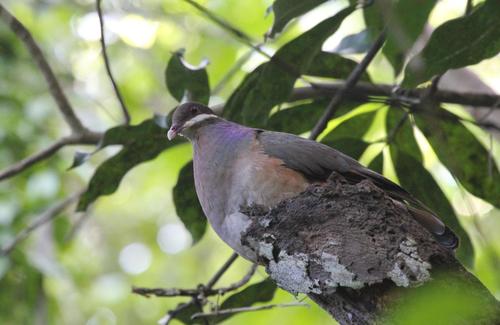 Bridled Quail-Dove
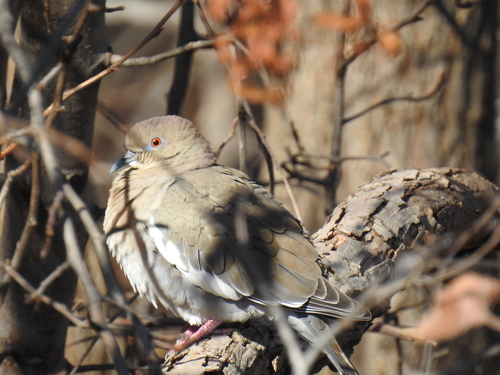 White-winged Dove
In short
The most reliable way to separate Bridled Quail-Dove from White-winged Dove is the presence of a bold white wing patch on the White-winged Dove, visible both in flight and at rest, which Bridled Quail-Dove lacks. Bridled Quail-Dove instead shows a bold white facial stripe below the eye and a small white throat patch, with no white on the wings. Juvenile White-winged Doves are duller but still show the white wing patch, while Bridled Quail-Dove juveniles are not described as having any white in the wing. Structurally, Bridled Quail-Dove is heavier and more robust, with a more terrestrial jizz, while White-winged Dove is slimmer and more arboreal. Both species can occur in the Caribbean, so context alone is not diagnostic.
Identification tips
- White wing patch (all ages): White-winged Dove always shows a bold white patch on the folded wing and as a white crescent in flight. Bridled Quail-Dove never shows white in the wing; look for cinnamon tones instead.
- Facial pattern: Bridled Quail-Dove has a bold white stripe below the eye and a small white throat patch, unique among Caribbean doves. White-winged Dove lacks this facial stripe but has a blue eyering and a dark mark on the lower face.
- Iridescence: Male Bridled Quail-Dove shows strong green to violet iridescence on the head and nape, while White-winged Dove is generally brownish-gray with only subtle iridescence (mainly in males, and mostly purple on the crown/neck/nape).
- Tail shape: White-winged Dove has a short, rounded tail; Bridled Quail-Dove’s tail is dark brownish gray but not as distinctly short or rounded.
- Leg color: White-winged Dove has bright pink/red legs and feet, especially in adults; Bridled Quail-Dove’s leg color is not described as distinctive.
- Eye color: Adult White-winged Doves have bright crimson eyes (blue eyering), while juveniles have brown eyes. Bridled Quail-Dove’s eye color is not specified, but the white facial stripe is more distinctive.
- Size and build: Bridled Quail-Dove is heavier and more robust (mean 211 g) than White-winged Dove (mean 153 g). Use this when both species are seen together or if the bird appears unusually bulky for a dove.
- Behavior: Bridled Quail-Dove is shy, terrestrial, and prefers dense forest floor; White-winged Dove is more arboreal, often in open or semi-open habitats, and less wary.
- Habitat: If seen in deep, shaded forest, especially on the ground, Bridled Quail-Dove is more likely. In open, urban, or edge habitats, White-winged Dove is expected.
- Juvenile confusion: Even juvenile White-winged Doves show the white wing patch, though they are duller overall. Bridled Quail-Dove juveniles are not described as having any white in the wing.
- Perched vs in flight: The white wing patch of White-winged Dove is visible both at rest and in flight; Bridled Quail-Dove never shows this feature.
- Sex differences: Both species have subtle sex differences, but these are not reliable in the field; focus on plumage and structure.
- Flock size: White-winged Doves often occur in flocks, especially when foraging or migrating; Bridled Quail-Dove is usually solitary or in pairs.
- Vocalization: Not described in the notes; do not rely on voice for separation with the information provided.
- Pitfalls: Mourning Dove and other similar doves may be confused with White-winged Dove, but the white wing patch is unique. Bridled Quail-Dove’s white facial stripe is not matched by any other Caribbean dove.
Size
Bridled Quail-Dove is significantly heavier (mean body mass ~211 g) than White-winged Dove (~153 g), making it bulkier and more robust in appearance. White-winged Dove is still large for a dove, but is slimmer and more elongated, especially in flight. The Bridled Quail-Dove’s heavier build is often noticeable when perched or walking on the ground, while White-winged Dove appears more upright and lighter on its feet.
Plumage
- Juvenile/immature birds: Juvenile White-winged Doves are duller and grayer than adults, lacking iridescence, but still show the distinctive white wing patch, which is visible both at rest and in flight. Juvenile Bridled Quail-Doves are not specifically described, but there is no mention of a white wing patch at any age; instead, they are mostly brown with cinnamon markings on the folded wing.
- Adults: Adult Bridled Quail-Doves are mostly brown with a bold white facial stripe below the eye, a small white throat patch, and iridescent green to violet on the head and nape (especially in males). Their folded wing shows some cinnamon but no white. Adult White-winged Doves are brownish-gray above and gray below, with a bold white wing patch (as a crescent in flight), a blue eyering, and a dark mark on the lower face. The tail of Bridled Quail-Dove is dark brownish gray and the belly is cream, while White-winged Dove has a short, rounded tail and brighter pink/red legs and feet. Both sexes of White-winged Dove look similar, with only subtle differences in iridescence and ear spot size.
Behaviour
Bridled Quail-Dove is more terrestrial, often seen walking or foraging on the ground in dense forest. Its movements are deliberate and it tends to be shy and secretive. White-winged Dove is more arboreal and frequently perches in trees, wires, or open areas. It is more likely to be seen in flocks, especially when foraging or migrating, and is less secretive, often allowing closer approach. In flight, White-winged Dove is strong and direct, showing the white wing patch; Bridled Quail-Dove is less likely to flush into open areas and is typically seen flying low and quickly into cover.
Habitat
Bridled Quail-Dove is a forest specialist, found in dense, shaded woodlands and forest understory, especially on Caribbean islands from Saint Lucia to Puerto Rico. It avoids open areas and is rarely seen away from deep cover. White-winged Dove is much more adaptable, occurring in a wide range of habitats from open woodlands, urban parks, and gardens to desert edges and agricultural areas, as well as Caribbean islands. It is much more likely to be seen in open or semi-open habitats, often in proximity to human activity.