

Brahminy Kite vs Sulphur-crested Cockatoo
Haliastur indus versus Cacatua galerita
Play a quiz with Brahminy Kite and Sulphur-crested Cockatoo
 Brahminy Kite
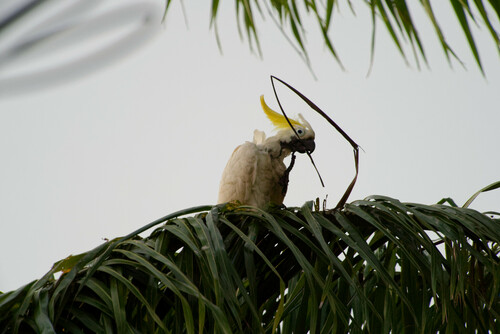 Sulphur-crested Cockatoo
In short
The most reliable field mark separating Brahminy Kite from Sulphur-crested Cockatoo is the kite's raptor shape and striking plumage: adults show a white head and breast sharply contrasting with a rich chestnut body and wings, while cockatoos are entirely white with a yellow crest and yellow-tinged underwings. In flight, even immature Brahminy Kites are brownish with a rounded tail and angled wings, never showing the all-white, broad-winged, short-tailed look of a cockatoo. Cockatoos have a heavy, parrot-like bill and a loud, screeching call, while kites have a hooked raptor bill and are much quieter. These two species differ so drastically in structure, flight style, and context that confusion usually arises only at great distance or in poor viewing conditions.
Identification tips
- Flight silhouette: Brahminy Kite shows long, angled wings and a rounded tail (never forked), typical of a raptor. Sulphur-crested Cockatoo has broad, rounded wings and a short, square tail, with a heavy body and parrot-like flight.
- Plumage contrast (adult kite): White head and breast sharply set off against rich chestnut body and wings; no white or yellow on the wings or tail. Cockatoo is all white with yellow crest and yellowish underwings/tail, never showing chestnut or black.
- Juvenile Brahminy Kite: Brown overall, paler than Black Kite, with a pale underwing carpal patch and rounded tail. Still never white or yellow; always a raptor shape.
- Crest: Sulphur-crested Cockatoo has a prominent, expressive yellow crest, often raised. Brahminy Kite lacks any crest.
- Bill shape: Kite has a hooked raptor bill, visible at close range. Cockatoo has a large, heavy, curved parrot bill, much thicker and blunter.
- Behavior: Kites soar and glide, rarely flapping for long. Cockatoos flap steadily, often in noisy flocks, and are much more likely to be seen perching in groups or feeding on the ground.
- Perched posture: Brahminy Kite perches upright, often alone or in pairs, looking alert and streamlined. Cockatoos perch more horizontally, often in groups, sometimes using their feet to manipulate objects.
- Vocalization: Cockatoos are extremely loud and raucous, with screeching calls. Brahminy Kites are mostly silent or give thin, weak whistles.
- Habitat: Kites are almost always near water—coasts, rivers, or wetlands. Cockatoos are common in wooded areas, parks, and urban settings, often far from water.
- Group size: Cockatoos are often in large, noisy flocks; Brahminy Kites are usually solitary or in pairs.
- Tail shape: Kite's tail is rounded; cockatoo's is short and square.
- Underwing pattern: Cockatoo shows uniform white with yellow wash; kite shows chestnut with black tips, and juveniles have a pale carpal patch but never yellow.
- Eye color: Only visible at very close range; cockatoo males have dark eyes, females more reddish, but this is rarely useful in the field.
- Urban context: Cockatoos are common in cities and parks; Brahminy Kites avoid urban areas.
- Feeding behavior: Cockatoos feed on the ground and manipulate food with their feet; kites hunt or scavenge from the air or perch.
Size
Both species are similar in length (Brahminy Kite 45–51 cm; Sulphur-crested Cockatoo 44–55 cm) [wikipedia], but their build and mass differ: the kite is lighter (320–673 g) and more slender, built for soaring, with long, angled wings and a rounded tail. The cockatoo is heavier-bodied, with a stockier build, broader wings, and a short, squared tail. The cockatoo's heavy bill and prominent crest also add to its bulkier appearance, especially when perched.
Plumage
Juvenile Brahminy Kites are brown overall, paler than Black Kites, with a rounded tail and a squarish pale patch at the underwing carpal, but never show white or yellow. Adults are unmistakable: white head and breast, rich chestnut body and wings, black wingtips. Sulphur-crested Cockatoos of all ages are white overall, with yellow wash on underwing and undertail, and a prominent yellow crest. The cockatoo never shows brown, chestnut, or black in the plumage. In flight, the kite's contrasting plumage and raptor shape are diagnostic, while the cockatoo's uniform white and broad wings stand out. No seasonal or sex-based plumage differences are significant for field separation between these two.
Behaviour
Brahminy Kites soar and glide with angled wings, often seen circling over water or wetlands, rarely flapping for long. They perch upright, often on exposed branches, scanning for prey. Sulphur-crested Cockatoos are social, noisy, and often seen in flocks, flying with deep, slow wingbeats or perching in trees, sometimes hanging upside down or using their feet to manipulate objects. Cockatoos are much more likely to be seen feeding on the ground or in urban parks, and their behavior is generally more conspicuous and animated.
Habitat
Brahminy Kites are usually found near coasts, rivers, and wetlands, rarely venturing far from water. They are not urban birds and avoid dense forests. Sulphur-crested Cockatoos prefer wooded habitats, including forests, woodlands, and urban parks, and can be very common in cities and suburbs. Seeing a bird in a city park or feeding on the ground with other parrots strongly favors cockatoo; soaring over a river or coastline points to Brahminy Kite.
Voice
Sulphur-crested Cockatoos are extremely loud, producing harsh, raucous screeches that carry over long distances. Brahminy Kites are generally quiet, with only occasional thin whistles, and are unlikely to be detected by voice alone. If you hear a loud, piercing call, it's almost certainly a cockatoo.