

Motmot

Bradfield's Hornbill vs Southern Yellow-billed Hornbill

Lophoceros bradfieldi versus Tockus leucomelas

Play a quiz with Bradfield's Hornbill and Southern Yellow-billed Hornbill
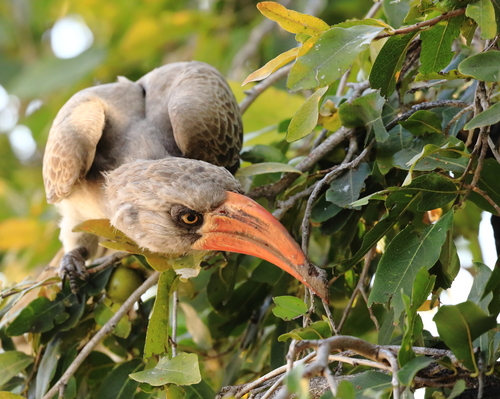
Bradfield's Hornbill (Lophoceros bradfieldi) Bradfield's Hornbill
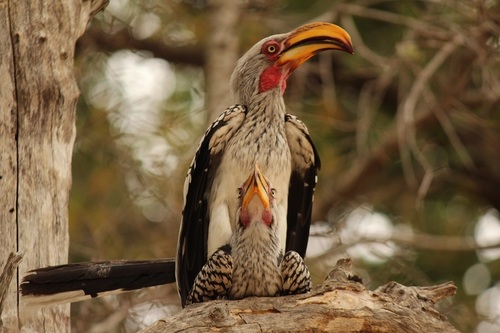
Southern Yellow-billed Hornbill (Tockus leucomelas) Southern Yellow-billed Hornbill

Media

Loading…

In short

The most reliable way to separate Bradfield's Hornbill from Southern Yellow-billed Hornbill is by bill color and facial skin: Bradfield's has a long, red bill with no casque and turquoise facial skin in females, while Southern Yellow-billed Hornbill shows a massive, bright yellow bill with a small casque (especially in males) and pinkish skin around the eyes. Both have black backs and wings with white bellies, but Southern Yellow-billed Hornbill is more heavily marked with white spots and stripes above. In the field, Southern Yellow-billed Hornbill is common and often seen foraging on the ground, while Bradfield's is much less frequently encountered and prefers mopane woodlands. Tail tip color (white in Bradfield's) and subtle differences in facial skin and bill structure are key for tricky perched or flying birds.

Identification tips

  1. Bill color and shape: Bradfield's Hornbill has a long, red bill with no casque, while Southern Yellow-billed Hornbill has a huge, bright yellow bill with a small casque (especially in males). This is the most immediate and reliable field mark for adults.
  2. Facial skin color (female Bradfield's): Female Bradfield's Hornbill shows distinctive turquoise facial skin, never seen in Southern Yellow-billed Hornbill, whose facial skin is pinkish around the eyes and malar stripe.
  3. Bill casque: Southern Yellow-billed Hornbill males have a small casque that covers most of the bill's length; Bradfield's Hornbill lacks a casque entirely. In females, the casque is less obvious but still present in Southern Yellow-billed Hornbill.
  4. Tail tip color: Bradfield's Hornbill has white-tipped tail feathers, which can be conspicuous when perched or in flight. Southern Yellow-billed Hornbill does not have this feature.
  5. Upperparts pattern: Southern Yellow-billed Hornbill is more heavily marked above, with abundant white spots and stripes on the black back and wings. Bradfield's is more uniformly black above.
  6. Belly and chest: Both have white bellies, but Southern Yellow-billed Hornbill's chest is lightly streaked with black, and the neck is gray with spots. Bradfield's has a cleaner white belly and no mention of chest streaking.
  7. Eye color: Both usually have yellow eyes, but Southern Yellow-billed Hornbill can sometimes show brown eyes. This is not a reliable separator but may help in rare cases.
  8. Facial skin (general): Southern Yellow-billed Hornbill has pinkish skin around the eyes and malar stripe; Bradfield's is not described as having this, except for the turquoise in females.
  9. Flight style: Southern Yellow-billed Hornbill alternates gliding and heavy wingbeats and is described as powerful in flight. Bradfield's flight style is not described, so this is only a minor supporting mark.
  10. Underwing coverts: Southern Yellow-billed Hornbill lacks underwing coverts, which may affect the look of the underwing in flight, but this is not described as a practical field mark.
  11. Foraging behavior: Southern Yellow-billed Hornbill is often seen foraging on the ground in open areas; Bradfield's is less often seen on the ground and is more arboreal in mopane woodland.
  12. Habitat and abundance: If the bird is in dry thornveld or broad-leafed woodland and is common, it is likely Southern Yellow-billed Hornbill. Bradfield's is much less common and more habitat-restricted.
  13. Sexual dimorphism: Male Southern Yellow-billed Hornbills have larger bills and more prominent casques than females, but both sexes have yellow bills. In Bradfield's, females are smaller and have turquoise facial skin, but both sexes have red bills.
  14. Juvenile/immature plumage: No distinctive juvenile or immature upperwing or flight pattern differences are described for these species, so do not rely on this for separation.
  15. Pitfalls: Both species have black backs and wings with white bellies and long tails, so do not rely on general color pattern alone. Always check bill color, facial skin, and tail tip color for a confident ID.

Size

Both are medium-sized hornbills with considerable overlap in length: Bradfield's Hornbill measures 50–57 cm, while Southern Yellow-billed Hornbill ranges from 48–60 cm in length. Southern Yellow-billed Hornbill averages about 189.5 g in mass [wikidata], but no direct mass data is available for Bradfield's. In practice, size is not a reliable separator, as both overlap and both sexes can be similar in size, though male Southern Yellow-billed Hornbills may appear bulkier due to their proportionally larger bill.

Plumage

No age-specific flight or upperwing pattern differences are described for either species, so focus is on adult and general plumage. Bradfield's Hornbill is mostly black above (back and wings), with a clean white belly and long tail tipped with white. The bill is red and lacks a casque, and the eyes are yellow. Females show turquoise facial skin, which is unique among these two. Southern Yellow-billed Hornbill is also black above and white below, but the upperparts are more heavily marked with white spots and stripes, especially on the back and wings. Its bill is bright yellow, very large, and has a small casque that is more prominent in males. The skin around the eyes and malar stripe is pinkish, and the eyes are usually yellow but can be brown. The neck is gray with spots, and the chest is lightly streaked with black. Both species have long tails, but only Bradfield's is described as having white tail tips. Southern Yellow-billed Hornbill lacks underwing coverts, which may subtly affect the appearance of the underwing in flight, but this is not described as a field mark.

Behaviour

Southern Yellow-billed Hornbill is often seen foraging on the ground for seeds, insects, spiders, and scorpions, and is generally conspicuous and approachable. Its flight is powerful, alternating glides and heavy wingbeats. Bradfield's Hornbill is less commonly seen and tends to stay in mopane woodlands and mixed thorn fields, feeding on fruits, large insects, nuts, and small reptiles. Both species perch in trees, but Southern Yellow-billed Hornbill is more likely to be seen walking on the ground in open areas.

Habitat

Bradfield's Hornbill is an uncommon resident of mopane woodlands and mixed thorn fields, mainly in northeastern Namibia, northern Botswana, southern Angola, and eastern Zimbabwe. Southern Yellow-billed Hornbill is common and widespread in dry thornveld and broad-leafed woodlands across southern Africa. If you are in a typical dry thornveld or open woodland, especially outside Bradfield's range, you are far more likely to see Southern Yellow-billed Hornbill.

Submit a better description

Use the same sections as the comparison. Your text is published immediately.

The most reliable way to separate Bradfield's Hornbill from Southern Yellow-billed Hornbill is by bill color and facial skin: Bradfield's has a long, red bill with no casque and turquoise facial skin in females, while Southern Yellow-billed Hornbill shows a massive, bright yellow bill with a small casque (especially in males) and pinkish skin around the eyes. Both have black backs and wings with white bellies, but Southern Yellow-billed Hornbill is more heavily marked with white spots and stripes above. In the field, Southern Yellow-billed Hornbill is common and often seen foraging on the ground, while Bradfield's is much less frequently encountered and prefers mopane woodlands. Tail tip color (white in Bradfield's) and subtle differences in facial skin and bill structure are key for tricky perched or flying birds.

  1. Bill color and shape: Bradfield's Hornbill has a long, red bill with no casque, while Southern Yellow-billed Hornbill has a huge, bright yellow bill with a small casque (especially in males). This is the most immediate and reliable field mark for adults.
  2. Facial skin color (female Bradfield's): Female Bradfield's Hornbill shows distinctive turquoise facial skin, never seen in Southern Yellow-billed Hornbill, whose facial skin is pinkish around the eyes and malar stripe.
  3. Bill casque: Southern Yellow-billed Hornbill males have a small casque that covers most of the bill's length; Bradfield's Hornbill lacks a casque entirely. In females, the casque is less obvious but still present in Southern Yellow-billed Hornbill.
  4. Tail tip color: Bradfield's Hornbill has white-tipped tail feathers, which can be conspicuous when perched or in flight. Southern Yellow-billed Hornbill does not have this feature.
  5. Upperparts pattern: Southern Yellow-billed Hornbill is more heavily marked above, with abundant white spots and stripes on the black back and wings. Bradfield's is more uniformly black above.
  6. Belly and chest: Both have white bellies, but Southern Yellow-billed Hornbill's chest is lightly streaked with black, and the neck is gray with spots. Bradfield's has a cleaner white belly and no mention of chest streaking.
  7. Eye color: Both usually have yellow eyes, but Southern Yellow-billed Hornbill can sometimes show brown eyes. This is not a reliable separator but may help in rare cases.
  8. Facial skin (general): Southern Yellow-billed Hornbill has pinkish skin around the eyes and malar stripe; Bradfield's is not described as having this, except for the turquoise in females.
  9. Flight style: Southern Yellow-billed Hornbill alternates gliding and heavy wingbeats and is described as powerful in flight. Bradfield's flight style is not described, so this is only a minor supporting mark.
  10. Underwing coverts: Southern Yellow-billed Hornbill lacks underwing coverts, which may affect the look of the underwing in flight, but this is not described as a practical field mark.
  11. Foraging behavior: Southern Yellow-billed Hornbill is often seen foraging on the ground in open areas; Bradfield's is less often seen on the ground and is more arboreal in mopane woodland.
  12. Habitat and abundance: If the bird is in dry thornveld or broad-leafed woodland and is common, it is likely Southern Yellow-billed Hornbill. Bradfield's is much less common and more habitat-restricted.
  13. Sexual dimorphism: Male Southern Yellow-billed Hornbills have larger bills and more prominent casques than females, but both sexes have yellow bills. In Bradfield's, females are smaller and have turquoise facial skin, but both sexes have red bills.
  14. Juvenile/immature plumage: No distinctive juvenile or immature upperwing or flight pattern differences are described for these species, so do not rely on this for separation.
  15. Pitfalls: Both species have black backs and wings with white bellies and long tails, so do not rely on general color pattern alone. Always check bill color, facial skin, and tail tip color for a confident ID.

Both are medium-sized hornbills with considerable overlap in length: Bradfield's Hornbill measures 50–57 cm, while Southern Yellow-billed Hornbill ranges from 48–60 cm in length. Southern Yellow-billed Hornbill averages about 189.5 g in mass [wikidata], but no direct mass data is available for Bradfield's. In practice, size is not a reliable separator, as both overlap and both sexes can be similar in size, though male Southern Yellow-billed Hornbills may appear bulkier due to their proportionally larger bill.

No age-specific flight or upperwing pattern differences are described for either species, so focus is on adult and general plumage. Bradfield's Hornbill is mostly black above (back and wings), with a clean white belly and long tail tipped with white. The bill is red and lacks a casque, and the eyes are yellow. Females show turquoise facial skin, which is unique among these two. Southern Yellow-billed Hornbill is also black above and white below, but the upperparts are more heavily marked with white spots and stripes, especially on the back and wings. Its bill is bright yellow, very large, and has a small casque that is more prominent in males. The skin around the eyes and malar stripe is pinkish, and the eyes are usually yellow but can be brown. The neck is gray with spots, and the chest is lightly streaked with black. Both species have long tails, but only Bradfield's is described as having white tail tips. Southern Yellow-billed Hornbill lacks underwing coverts, which may subtly affect the appearance of the underwing in flight, but this is not described as a field mark.

Southern Yellow-billed Hornbill is often seen foraging on the ground for seeds, insects, spiders, and scorpions, and is generally conspicuous and approachable. Its flight is powerful, alternating glides and heavy wingbeats. Bradfield's Hornbill is less commonly seen and tends to stay in mopane woodlands and mixed thorn fields, feeding on fruits, large insects, nuts, and small reptiles. Both species perch in trees, but Southern Yellow-billed Hornbill is more likely to be seen walking on the ground in open areas.

Bradfield's Hornbill is an uncommon resident of mopane woodlands and mixed thorn fields, mainly in northeastern Namibia, northern Botswana, southern Angola, and eastern Zimbabwe. Southern Yellow-billed Hornbill is common and widespread in dry thornveld and broad-leafed woodlands across southern Africa. If you are in a typical dry thornveld or open woodland, especially outside Bradfield's range, you are far more likely to see Southern Yellow-billed Hornbill.

Discard your changes?

You have unsaved edits. If you leave now, those changes will be lost.

Bradfield's Hornbill · Southern Yellow-billed Hornbill · My Tricky Birds