

Bornean Spiderhunter vs Orange-bellied Leafbird
Arachnothera everetti versus Chloropsis hardwickii
Play a quiz with Bornean Spiderhunter and Orange-bellied Leafbird
 Bornean Spiderhunter
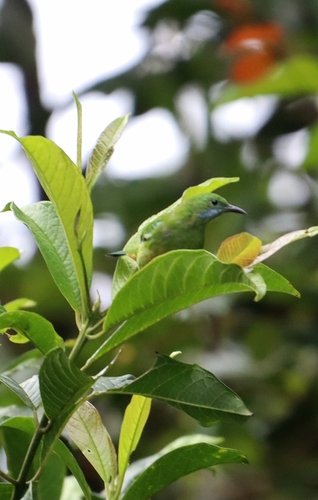 Orange-bellied Leafbird
In short
The most reliable way to separate Bornean Spiderhunter from Orange-bellied Leafbird is by overall plumage and structure: the leafbird is a vividly colored bird with a striking orange belly, green back, blue tail and flight feathers, and a distinctive black-and-blue throat patch, while the spiderhunter lacks these bold colors and is not described as brightly marked. The leafbird also has a slightly shorter, but still long, curved bill compared to the spiderhunter's typically very long, decurved bill. If you see a bird with a strong orange belly and blue tail, it's the leafbird; a more subdued, less colorful bird with a very long bill points to spiderhunter. Both species may feed on nectar and insects, but their appearance and structure are the best clues.
Identification tips
- Orange belly and blue tail (leafbird only): If you see a bird with a bright orange belly and blue tail or flight feathers, it's an Orange-bellied Leafbird. The spiderhunter does not show these colors at any age or sex.
- Black-and-blue throat patch (leafbird only): The leafbird has a distinctive black-and-blue patch over its throat and chest, which is absent in spiderhunter. This is a key mark in perched birds and is visible in both sexes.
- Overall green and blue coloration (leafbird): The leafbird's back is green, and its tail and flight feathers are blue, creating a vivid, multi-colored appearance. The spiderhunter lacks these bright colors and is more subdued overall.
- Very long, decurved bill (spiderhunter): Bornean Spiderhunter typically shows a much longer, more strongly decurved bill than the leafbird. If the bill looks exceptionally long and downcurved, spiderhunter is more likely.
- Shorter, curved bill (leafbird): While the leafbird's bill is also curved, it is shorter and stouter than the spiderhunter's, matching its more compact head and face.
- Range and location: If you are in Borneo, expect spiderhunter; in the Himalayas or northern Southeast Asia, expect leafbird. Range is a strong separator.
- Lack of bright colors (spiderhunter): If the bird lacks any orange, blue, or green and appears more drab, consider spiderhunter.
- No age-specific wing pattern: Neither species is described as having distinctive juvenile or immature upperwing or flight marks, so do not rely on wing pattern in flight for separation.
- Perched vs. foraging jizz: Both species may forage actively, but the spiderhunter may appear more elongated due to its long bill and possibly longer body proportions.
- Nest structure (rarely observed): If you see a suspended nest made from roots and fibers at the tip of a branch, it points to leafbird, but this is rarely a field mark.
- Sex differences: Both sexes of leafbird are brightly colored, though males are more intensely marked; spiderhunter does not show such sexual dimorphism in the notes.
- Feeding behavior: Both may be seen feeding on nectar and insects, so feeding behavior alone does not separate them.
- No vocalization cues: No distinctive calls or songs are described in the notes, so do not rely on voice for separation.
- Contextual clues: In mixed-species flocks, the leafbird's bright colors will stand out, while spiderhunter may blend in more with foliage.
- Check multiple features: Always use a combination of bill shape, belly and throat color, and overall brightness to confirm your ID, especially if the view is brief or partially obscured.
Size
Only the Orange-bellied Leafbird has a documented average mass (33 g [wikidata]); no measurement is available for Bornean Spiderhunter, but both are medium-sized passerines. In the field, size alone is not a reliable separator between these two, as their masses are likely similar and both can appear slender and active among foliage.
Plumage
The Orange-bellied Leafbird is unmistakable in adult plumage: look for a bright orange belly, vivid green back, blue tail and flight feathers, and a sharply defined black-and-blue throat patch. These colors are present in both sexes, though males are usually more intensely marked. The Bornean Spiderhunter, by contrast, is not described as brightly colored and lacks the orange, blue, and green combination. Juvenile or immature plumages are not detailed for either species in the notes, but the absence of bold coloration and throat pattern in spiderhunter is consistent across ages. No age-specific upperwing or flight pattern marks are described for either species, so rely on overall coloration and throat pattern at all ages.
Behaviour
Both species feed on nectar and insects, often foraging actively among foliage. The leafbird is noted for constructing suspended nests from roots and fibers at branch tips, but this is unlikely to be observed in the field unless at a nest. Both may be seen moving energetically through the canopy, but behavior alone is not a strong separator.
Habitat
The Orange-bellied Leafbird is native to the central and eastern Himalayas, Yunnan, and northern parts of Southeast Asia, while the Bornean Spiderhunter is, as its name suggests, endemic to Borneo. If you are birding in Borneo, spiderhunter is the local species; elsewhere in the Himalayas or northern Southeast Asia, leafbird is expected. Habitat overlap is minimal due to their different ranges.
Bornean Spiderhunter · Orange-bellied Leafbird · My Tricky Birds