

Bornean Peacock-Pheasant vs Malayan Peacock-Pheasant
Polyplectron schleiermacheri versus Polyplectron malacense
Play a quiz with Bornean Peacock-Pheasant and Malayan Peacock-Pheasant
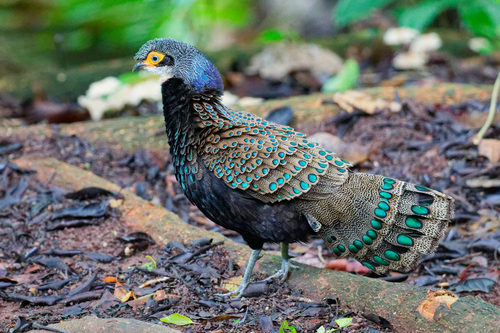 Bornean Peacock-Pheasant
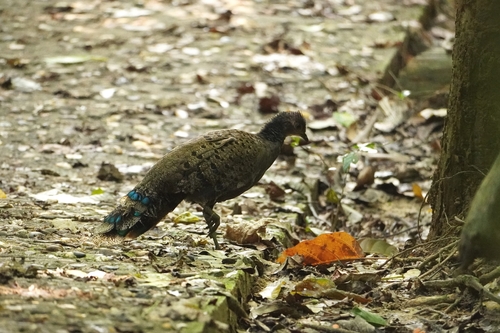 Malayan Peacock-Pheasant
In short
The most reliable field mark between Bornean and Malayan Peacock-Pheasants is the male's breast and neck: Bornean males show highly specialized, metallic blue-green sides to the breast and upper neck, sharply bordering a white throat and central breast, while Malayan males have a white throat extending down the center of the breast, surrounded by more diffuse pale brown and black-spotted plumage. Both species have prominent blue-green eyespots (ocelli) on the tail, but the Malayan's are bordered with buff and extend onto the upperwings and back, whereas the Bornean's are limited to the tail. Females are much harder to separate, with both being dull brown and less ornamented, but the Bornean tends to be slightly duller and lacks spurs. Both species are secretive, ground-dwelling birds of Southeast Asian lowland rainforest, but their ranges do not overlap: Bornean is strictly endemic to Borneo, Malayan to the Malay Peninsula. In the field, focus on the male's breast pattern and the distribution of eyespots for the best chance at a confident ID.
Identification tips
- Male breast and neck pattern: Bornean males have metallic blue-green sides to the breast and upper neck, sharply bordering a white throat and central breast; Malayan males have a white throat extending down the center of the breast, with less contrast to the surrounding plumage. This is the single most reliable field mark for adult males.
- Distribution of blue-green eyespots (ocelli): Malayan males have iridescent blue-green ocelli with buff borders on the upperwings, back, and tail; Bornean males have large blue-green ocelli only on the tail, with no buff border and none on the back or wings. This difference is visible in both perched and displaying birds.
- Overall plumage tone: Malayan is paler brown with a 'salt-and-pepper' effect from small black spots and bands; Bornean is rufous-brown with black spots, lacking the fine banding and overall paler look of Malayan.
- Crest shape: Malayan males have a loose, pointed, upturned dark blue-green crest; Bornean males have elongated crest and nape feathers, but the crest is less upturned and more rufous-brown.
- Facial skin color: Both have bare skin around the eye, but in Malayan it is usually pink, turning bright orange-red in courtship; Bornean has bare red skin, but the degree of color change in display is not described.
- Iris color: Both males have bluish or bluish-white irises, but Bornean females have brown irises, while Malayan females are not specified as different.
- Female tail and crest: Malayan females have a noticeably shorter tail and a vestigial crest; Bornean females are duller, lack spurs, and have less obvious patterning, but both are difficult to separate in the field.
- Spurs: Female Bornean Peacock-Pheasants lack spurs; Malayan females are not specified, but this may be a subtle difference if visible.
- Tail display: In courtship, Malayan males show ocelli on back and wings as well as tail; Bornean males only show ocelli on the tail.
- Flight jizz: Both species are reluctant to fly and are rarely seen in flight; no distinctive flight silhouette or wing pattern is described for either.
- Size and structure: Malayan is slightly heavier and bulkier, with a shorter tail in females, but these differences are subtle and not reliable in the field.
- Range: Any peacock-pheasant seen in Borneo is Bornean; any in Peninsular Malaysia is Malayan. There is no natural overlap.
- Habitat: Both prefer lowland primary rainforest, but Malayan can sometimes be found in secondary forest, while Bornean is strictly a primary forest specialist.
- Behavior: Both are shy and ground-dwelling, quickly running to cover; Bornean is particularly elusive and solitary, while Malayan may be seen in pairs during breeding season.
- Vocalization: Both species call during breeding, but calls are not described in detail and should not be relied on for separation.
Size
Both species are medium-sized peacock-pheasants, with males reaching about 50 cm in length, roughly half of which is tail. Malayan Peacock-Pheasant males are slightly heavier (565–700 g) [wikidata], while Bornean mass is not well documented but presumed similar. Females of both are smaller and shorter-tailed, with Malayan females measuring about 40 cm and weighing 450–550 g. Overall, size is not a reliable field separator, but Malayan may appear a touch bulkier and shorter-tailed, especially in females.
Plumage
-
Juvenile/immature plumage: No distinctive age-specific upperwing or flight marks are described for either species, so separation relies on adult-type features even in young birds.
-
Adult males: Bornean males have a striking contrast between metallic blue-green breast sides and a sharply defined white throat and central breast, with elongated crest and nape feathers. Their tail (22 feathers) is adorned with large blue-green ocelli, but these are not bordered with buff and are limited to the tail. Malayan males are paler brown overall, with small black spots and bands creating a 'salt-and-pepper' effect, and their iridescent blue-green eyespots are bordered with buff and present not only on the tail but also on the upperwings and back. The Malayan's crest is loose, pointed, and upturned, dark blue-green in color.
-
Adult females: Both are duller brown, with Malayan females showing a vestigial crest and eyespots only on the remiges and rectrices (tail and flight feathers), while the wing coverts and back have dark dots. Bornean females are even duller, lack spurs, and have less obvious patterning overall. Both have brown irises, but only Malayan females are described as having a noticeably shorter tail.
-
In display: Both species fan their tails to show off the ocelli, but the Malayan's display includes eyespots on the back and wings, while the Bornean's is restricted to the tail.
Behaviour
Both species are extremely shy, preferring to run for cover rather than fly when disturbed. Bornean Peacock-Pheasant is particularly elusive and solitary, often only detected by the cleared display arenas males maintain for courtship. Malayan Peacock-Pheasant males also clear display sites and perform ritualized displays, including stridulation (feather quill vibrations), and are generally monogamous, with males participating in chick rearing. In captivity, Bornean individuals are difficult to pair outside the breeding season, while Malayan are more flexible. Both are ground-dwelling and rarely seen in flight.
Habitat
Bornean Peacock-Pheasant is strictly endemic to lowland forests of Borneo, never found outside the island. Malayan Peacock-Pheasant inhabits lowland dipterocarp rainforest of the Malay Peninsula, mainly below 150 m elevation, and only rarely up to 300 m. While Malayan can use secondary forest, it prefers primary forest. There is no range overlap: any wild bird in Borneo is Bornean, and any in Peninsular Malaysia is Malayan.
Voice
Both species are described as vocal during the breeding season, with males calling from their display arenas, but no detailed differences in voice are provided in the available sources. Vocalizations are not currently a reliable field separator.
Bornean Peacock-Pheasant · Malayan Peacock-Pheasant · My Tricky Birds