

Motmot

Blyth's Reed Warbler vs Great Reed Warbler

Acrocephalus dumetorum versus Acrocephalus arundinaceus

Play a quiz with Blyth's Reed Warbler and Great Reed Warbler
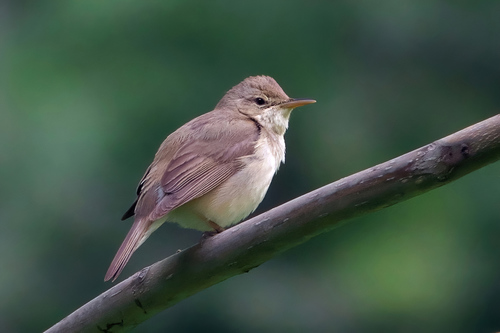
Blyth's Reed Warbler (Acrocephalus dumetorum) Blyth's Reed Warbler
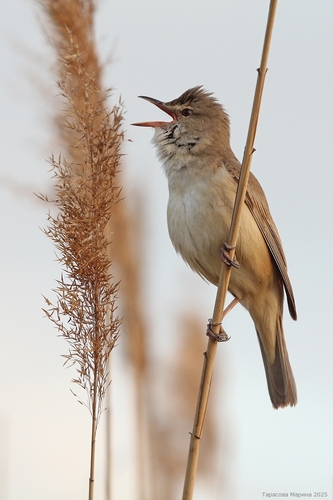
Great Reed Warbler (Acrocephalus arundinaceus) Great Reed Warbler

Media

Loading…

In short

The most reliable field mark between Blyth's Reed Warbler and Great Reed Warbler is size: Great Reed is much larger, almost thrush-sized, while Blyth's is a slim, small warbler. If seen in flight or perched, Great Reed's bulk, long wings, and strong bill are immediately obvious, while Blyth's Reed is daintier, with short, rounded wings and a long, fine bill. Both are plain brown above and pale below, but Great Reed shows a more prominent supercilium and a flattened forehead. Juvenile Great Reed Warblers are richer buff below, while Blyth's Reed remains plainer. Habitat and voice can help: Great Reed is almost always in reedbeds, often singing loudly, while Blyth's Reed prefers woodland edges and scrub.

Identification tips

  1. Size is the most immediate clue: Great Reed Warbler is nearly twice the length and weight of Blyth's Reed Warbler; if the bird looks thrush-sized or notably large for a warbler, it's Great Reed. This holds for all ages and seasons.
  2. Bill structure: Great Reed has a strong, thick, and pointed bill, matching its robust head; Blyth's Reed has a long, fine, but thick-based bill with a pale pinkish-brown base on the lower mandible. Bill color can be useful in good light.
  3. Supercilium (eyebrow): Great Reed Warbler shows a strong, long, and prominent whitish supercilium, especially in front of the eye; Blyth's Reed's supercilium is short, faint, and limited to between bill base and eye. This is reliable in adults and most immatures.
  4. Head shape: Great Reed has a flattened forehead and a heavy, blocky head profile; Blyth's Reed's head is slimmer and more rounded.
  5. Wing shape: Blyth's Reed has short, rounded wings, giving a compact look; Great Reed's wings are long and broad, matching its overall size.
  6. Plumage tone: Blyth's Reed is plain olive-brown above and off-white below, lacking warm or rufous tones; Great Reed is unstreaked brown above, but juveniles are richer buff below. Blyth's Reed always looks plainer and colder-toned.
  7. Leg and foot color: Blyth's Reed has pale pinkish-brown legs and feet, matching the base of the lower mandible; Great Reed's leg color is less distinctive but not as pale.
  8. Habitat context: In breeding season, a large warbler in a reedbed is almost certainly Great Reed; Blyth's Reed avoids pure reedbeds, preferring woodland edge, scrub, or gardens.
  9. Song: Great Reed's song is extremely loud, harsh, and far-carrying, often delivered from exposed perches in reeds. Blyth's Reed's song is quieter, more variable, and includes ticks and whistles; it is rarely as loud or as persistent.
  10. Behavior: Great Reed is bold, often perching upright and singing in the open; Blyth's Reed is more skulking and less likely to be seen out in the open.
  11. Juvenile plumage: Juvenile Great Reed is richer buff below, while Blyth's Reed remains plain and pale; this is helpful in late summer and autumn.
  12. Flight jizz: Great Reed appears heavy and slow in flight, with broad wings and a long tail; Blyth's Reed is quicker, more agile, and compact.
  13. Distribution: Blyth's Reed is expanding westward in Europe but remains much less common than Great Reed in western reedbeds; check local abundance on eBird if in doubt.
  14. Sexes: Both species are sexually monomorphic in plumage, so do not rely on sex for separation.
  15. When in doubt: If the bird is singing loudly from a reedbed and appears large, it's almost certainly Great Reed. If it's small, plain, and in woodland edge or garden, it's likely Blyth's Reed.

Size

Great Reed Warbler is dramatically larger: 16–21 cm in length and 22–38 g in weight, with a wingspan of 25–30 cm. Blyth's Reed Warbler is much smaller, 12–14 cm long and 8–16 g. In the field, Great Reed appears almost as big as a thrush, towering over Blyth's Reed. This size difference is reliable at any distance if you have a sense of scale, especially when both are seen near reeds or perches.

Plumage

No distinctive juvenile or immature upperwing pattern is described for either species, so separation relies on overall coloration and subtle details. Adult Blyth's Reed Warbler is plain olive-brown above with short, rounded wings and a short, faint whitish supercilium; underparts are plain off-white. Great Reed Warbler adults are unstreaked brown above, but with a much stronger, longer supercilium and a flattened forehead; underparts are dull buffish-white, and the bill is notably strong and pointed. Juvenile Great Reed Warblers are richer buff below, while juvenile Blyth's Reed remain rather plain. In all plumages, Blyth's Reed lacks the 'warm' tones and strong face pattern of Great Reed. The legs and lower mandible of Blyth's Reed are pale pinkish-brown, matching the base of the bill, while Great Reed's bill is simply strong and pointed.

Behaviour

Great Reed Warbler is often conspicuous, singing loudly from reed stems or moving clumsily through reeds, sometimes perching high and upright. Blyth's Reed Warbler is more secretive, moving through lower vegetation, woodland edges, or scrub, and is less likely to be seen out in the open. Both are insectivorous and territorial, but Great Reed's behavior is bolder and more obvious, especially during singing.

Habitat

Great Reed Warbler is strongly tied to reedbeds in breeding season, rarely found away from extensive stands of reeds, and in winter can be in reedbeds, bush thickets, rice fields, or forest clearings. Blyth's Reed Warbler prefers woodland edges, clearings, parks, gardens, and scrub, and is rarely found in pure reedbeds. If you find a large warbler singing from a reedbed, it's almost certainly Great Reed; a small, plain warbler in woodland edge or garden is likely Blyth's Reed.

Voice

Great Reed Warbler's song is very loud, harsh, and far-carrying, with chattering and croaking notes ("carr-carr-cree-cree-cree-jet-jet") and some mimicry. Blyth's Reed Warbler's song is more variable and quieter, mixing harsh ticks, chaks, and churrs with melodious whistles and mimicry. In the field, Great Reed's song dominates reedbeds, while Blyth's Reed is more subdued and less likely to be heard at long distance.

Submit a better description

Use the same sections as the comparison. Your text is published immediately.

The most reliable field mark between Blyth's Reed Warbler and Great Reed Warbler is size: Great Reed is much larger, almost thrush-sized, while Blyth's is a slim, small warbler. If seen in flight or perched, Great Reed's bulk, long wings, and strong bill are immediately obvious, while Blyth's Reed is daintier, with short, rounded wings and a long, fine bill. Both are plain brown above and pale below, but Great Reed shows a more prominent supercilium and a flattened forehead. Juvenile Great Reed Warblers are richer buff below, while Blyth's Reed remains plainer. Habitat and voice can help: Great Reed is almost always in reedbeds, often singing loudly, while Blyth's Reed prefers woodland edges and scrub.

  1. Size is the most immediate clue: Great Reed Warbler is nearly twice the length and weight of Blyth's Reed Warbler; if the bird looks thrush-sized or notably large for a warbler, it's Great Reed. This holds for all ages and seasons.
  2. Bill structure: Great Reed has a strong, thick, and pointed bill, matching its robust head; Blyth's Reed has a long, fine, but thick-based bill with a pale pinkish-brown base on the lower mandible. Bill color can be useful in good light.
  3. Supercilium (eyebrow): Great Reed Warbler shows a strong, long, and prominent whitish supercilium, especially in front of the eye; Blyth's Reed's supercilium is short, faint, and limited to between bill base and eye. This is reliable in adults and most immatures.
  4. Head shape: Great Reed has a flattened forehead and a heavy, blocky head profile; Blyth's Reed's head is slimmer and more rounded.
  5. Wing shape: Blyth's Reed has short, rounded wings, giving a compact look; Great Reed's wings are long and broad, matching its overall size.
  6. Plumage tone: Blyth's Reed is plain olive-brown above and off-white below, lacking warm or rufous tones; Great Reed is unstreaked brown above, but juveniles are richer buff below. Blyth's Reed always looks plainer and colder-toned.
  7. Leg and foot color: Blyth's Reed has pale pinkish-brown legs and feet, matching the base of the lower mandible; Great Reed's leg color is less distinctive but not as pale.
  8. Habitat context: In breeding season, a large warbler in a reedbed is almost certainly Great Reed; Blyth's Reed avoids pure reedbeds, preferring woodland edge, scrub, or gardens.
  9. Song: Great Reed's song is extremely loud, harsh, and far-carrying, often delivered from exposed perches in reeds. Blyth's Reed's song is quieter, more variable, and includes ticks and whistles; it is rarely as loud or as persistent.
  10. Behavior: Great Reed is bold, often perching upright and singing in the open; Blyth's Reed is more skulking and less likely to be seen out in the open.
  11. Juvenile plumage: Juvenile Great Reed is richer buff below, while Blyth's Reed remains plain and pale; this is helpful in late summer and autumn.
  12. Flight jizz: Great Reed appears heavy and slow in flight, with broad wings and a long tail; Blyth's Reed is quicker, more agile, and compact.
  13. Distribution: Blyth's Reed is expanding westward in Europe but remains much less common than Great Reed in western reedbeds; check local abundance on eBird if in doubt.
  14. Sexes: Both species are sexually monomorphic in plumage, so do not rely on sex for separation.
  15. When in doubt: If the bird is singing loudly from a reedbed and appears large, it's almost certainly Great Reed. If it's small, plain, and in woodland edge or garden, it's likely Blyth's Reed.

Great Reed Warbler is dramatically larger: 16–21 cm in length and 22–38 g in weight, with a wingspan of 25–30 cm. Blyth's Reed Warbler is much smaller, 12–14 cm long and 8–16 g. In the field, Great Reed appears almost as big as a thrush, towering over Blyth's Reed. This size difference is reliable at any distance if you have a sense of scale, especially when both are seen near reeds or perches.

No distinctive juvenile or immature upperwing pattern is described for either species, so separation relies on overall coloration and subtle details. Adult Blyth's Reed Warbler is plain olive-brown above with short, rounded wings and a short, faint whitish supercilium; underparts are plain off-white. Great Reed Warbler adults are unstreaked brown above, but with a much stronger, longer supercilium and a flattened forehead; underparts are dull buffish-white, and the bill is notably strong and pointed. Juvenile Great Reed Warblers are richer buff below, while juvenile Blyth's Reed remain rather plain. In all plumages, Blyth's Reed lacks the 'warm' tones and strong face pattern of Great Reed. The legs and lower mandible of Blyth's Reed are pale pinkish-brown, matching the base of the bill, while Great Reed's bill is simply strong and pointed.

Great Reed Warbler is often conspicuous, singing loudly from reed stems or moving clumsily through reeds, sometimes perching high and upright. Blyth's Reed Warbler is more secretive, moving through lower vegetation, woodland edges, or scrub, and is less likely to be seen out in the open. Both are insectivorous and territorial, but Great Reed's behavior is bolder and more obvious, especially during singing.

Great Reed Warbler is strongly tied to reedbeds in breeding season, rarely found away from extensive stands of reeds, and in winter can be in reedbeds, bush thickets, rice fields, or forest clearings. Blyth's Reed Warbler prefers woodland edges, clearings, parks, gardens, and scrub, and is rarely found in pure reedbeds. If you find a large warbler singing from a reedbed, it's almost certainly Great Reed; a small, plain warbler in woodland edge or garden is likely Blyth's Reed.

Great Reed Warbler's song is very loud, harsh, and far-carrying, with chattering and croaking notes ("carr-carr-cree-cree-cree-jet-jet") and some mimicry. Blyth's Reed Warbler's song is more variable and quieter, mixing harsh ticks, chaks, and churrs with melodious whistles and mimicry. In the field, Great Reed's song dominates reedbeds, while Blyth's Reed is more subdued and less likely to be heard at long distance.

Discard your changes?

You have unsaved edits. If you leave now, those changes will be lost.

Blyth's Reed Warbler · Great Reed Warbler · My Tricky Birds