

Blyth's Paradise-Flycatcher vs Ultramarine Flycatcher
Terpsiphone affinis versus Ficedula superciliaris
Play a quiz with Blyth's Paradise-Flycatcher and Ultramarine Flycatcher
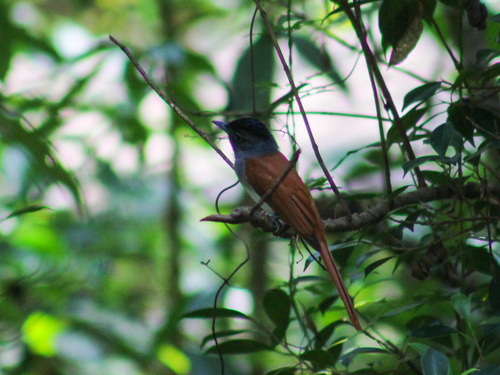 Blyth's Paradise-Flycatcher
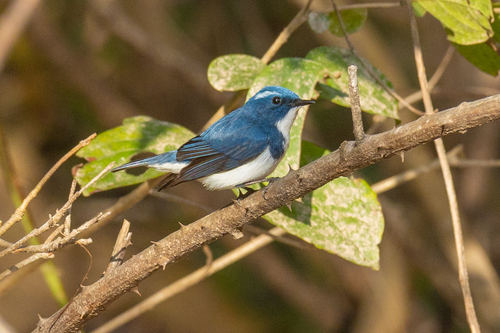 Ultramarine Flycatcher
In short
The most reliable field mark to separate Blyth's Paradise-Flycatcher from Ultramarine Flycatcher is overall structure and tail: Blyth's Paradise-Flycatcher is a slender, long-tailed bird with a small crest and, in adult males, spectacular tail streamers, while Ultramarine Flycatcher is a compact, short-tailed, stocky flycatcher with a bold white supercilium (in western populations) and no crest or tail streamers. Immature and female Blyth's Paradise-Flycatchers can be confused with other flycatchers, but never show the deep blue-and-white pattern or the crisp white brow of male Ultramarine Flycatcher. Habitat and behavior also help: Blyth's prefers lowland forests and edges, while Ultramarine is a montane breeder, often in open mixed forests. If you see a bird with a long, streamer-like tail and a blue eye-ring, it's Blyth's; a small, blue-and-white bird with a white brow and short tail is Ultramarine.
Identification tips
- Tail length and shape: Adult male Blyth's Paradise-Flycatcher has extremely long, streamer-like central tail feathers—almost twice the body length—never matched by Ultramarine Flycatcher. Females and immatures of Blyth's still have a longer, more graduated tail than the short, square tail of Ultramarine.
- Crest and head shape: Blyth's has a small, triangular crest (short and rounded), visible in most postures. Ultramarine Flycatcher lacks any crest and has a smooth, rounded head.
- Eye-ring: Blyth's Paradise-Flycatcher (both sexes) shows a distinct blue eye-ring, brightest in adult males, duller in females. Ultramarine Flycatcher does not have a blue eye-ring.
- Supercilium (white brow): Ultramarine Flycatcher (western subspecies, most common in the western Himalayas) shows a bold white supercilium above the eye, which is never present in Blyth's. Eastern Ultramarine populations may lack this, but still never show a blue eye-ring or crest.
- Plumage color: Blyth's males come in rufous or white morphs, but both have a dark head and blue eye-ring. Rufous morphs have a pale rufous undertail and a gradual transition to grey on the underparts. Ultramarine Flycatcher males are deep blue above, white below, with a sharp contrast between colors.
- White in tail: Ultramarine Flycatcher (western subspecies) shows white at the base of the outer tail feathers, visible in flight or when tail is spread. Blyth's Paradise-Flycatcher lacks this, and even white morphs have dark shafts and no white tail patches.
- Bill and structure: Blyth's has a slender, slightly decurved bill typical of paradise-flycatchers; Ultramarine has a shorter, stubbier bill in keeping with its stocky build.
- Size: Blyth's is larger and more slender, while Ultramarine is small and compact (about 8g, smaller than a sparrow).
- Behavior: Ultramarine often flicks its tail up and fluffs head feathers, especially when agitated or near the nest; Blyth's is more likely to sally for insects and display its tail.
- Habitat: Blyth's is found in lowland/foothill forests, gardens, and plantations; Ultramarine is a montane breeder in the Himalayas, wintering in central/eastern India. If seen above 2000m in breeding season, likely Ultramarine; below 1000m, likely Blyth's.
- Voice: Blyth's gives a ringing 'wiwiwiwiwiwiwi' song and nasal 'ji-jeh' calls; Ultramarine gives a 'trrr' note, especially near the nest.
- Sex and age pitfalls: Female and immature Blyth's can be confused with other flycatchers but never show the blue-and-white pattern or white brow of Ultramarine. Female Ultramarine may lack a strong supercilium but is always compact, short-tailed, and lacks blue eye-ring.
- White morph Blyth's: Even the palest Blyth's Paradise-Flycatcher shows dark wings and central tail shafts, and never the blue-and-white contrast or white brow of Ultramarine.
- Mixed flocks: Both may join mixed flocks, but context (montane vs lowland, tail length, and head pattern) remains reliable.
- When in doubt: Focus on tail length/shape, presence or absence of crest and eye-ring, and overall color contrast (blue-and-white vs rufous/white with dark head). These are consistent across ages and sexes.
Size
Ultramarine Flycatcher is notably smaller and stockier, weighing about 8 grams and being smaller than a sparrow. Blyth's Paradise-Flycatcher is larger and more slender, with a much longer tail—especially in adult males, where the central tail streamers can be nearly twice the body length. Even females and immatures of Blyth's are longer-tailed and slimmer than the compact Ultramarine Flycatcher.
Plumage
-
Juvenile/Immature/Non-breeding: There are no detailed notes on juvenile upperwing patterns for either species, so separation relies on overall coloration and structure. Immature Blyth's Paradise-Flycatchers resemble females, with rufous upperparts, dark head, and pale underparts, lacking any blue-and-white contrast or supercilium. Immature Ultramarine Flycatchers are not described in detail, but do not develop the long tail or crest of Blyth's and lack the blue eye-ring.
-
Adult males: Blyth's Paradise-Flycatcher males are either rufous or white morphs, always with a dark head, blue eye-ring, and (in breeding plumage) long central tail streamers. Ultramarine Flycatcher males are deep blue above with a prominent white supercilium (in western birds), white throat to belly, and short tail with white bases to outer feathers (western subspecies). No crest or tail streamers.
-
Females: Female Blyth's are rufous above with a dark head and blue eye-ring, lacking the white brow or blue-and-white contrast. Female Ultramarine Flycatchers are less vividly colored but still show a compact, short-tailed shape and may have a reduced or absent supercilium depending on subspecies, but never show the long tail or blue eye-ring of Blyth's.
-
Key pitfalls: Blyth's white morphs can appear pale but always have dark wings and central tail shafts, and never the blue-and-white pattern of Ultramarine. Ultramarine never shows a crest, blue eye-ring, or elongated tail.
Behaviour
Blyth's Paradise-Flycatcher is often seen sallying for insects from perches in the mid to upper canopy, sometimes in gardens or plantations, and can be quite conspicuous when males display their long tail streamers. They may join mixed flocks but are often seen alone or in pairs. Ultramarine Flycatcher is more arboreal, keeping to low trees and bushes, foraging among foliage, and often flicks its tail and fluffs head feathers, especially near the nest. It is usually solitary but may join mixed hunting parties in winter. The constant tail-jerking and fluffing are more typical of Ultramarine.
Habitat
Blyth's Paradise-Flycatcher prefers evergreen broadleaf forests, forest edges, secondary growth, gardens, and plantations, mainly in lowland and foothill regions. It is rarely found above the foothills. Ultramarine Flycatcher breeds in open mixed forests (oak, rhododendron, pine, fir) in the western and eastern Himalayas, usually between 1800–3200 m, and winters in central and eastern India, sometimes in orchards or hill station gardens. Habitat overlap is minimal except perhaps in winter, but Blyth's is a lowland/foothill species and Ultramarine is a montane breeder.
Voice
Blyth's Paradise-Flycatcher gives a ringing series of 'wiwiwiwiwiwiwi' notes as its song, and a nasal 'ji-jeh' or 'ji-jeh-jeh' call. Ultramarine Flycatcher's vocalizations are not described in detail in the notes, but it gives a 'trrr' note, often when agitated or near the nest. In the field, Blyth's song is more musical and ringing, while Ultramarine's call is shorter and less musical.
Blyth's Paradise-Flycatcher · Ultramarine Flycatcher · My Tricky Birds