

Blue-vented Hummingbird vs Blue-tailed Hummingbird
Saucerottia hoffmanni versus Saucerottia cyanura
Play a quiz with Blue-vented Hummingbird and Blue-tailed Hummingbird
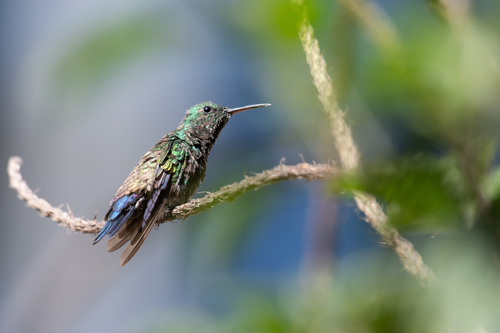 Blue-vented Hummingbird
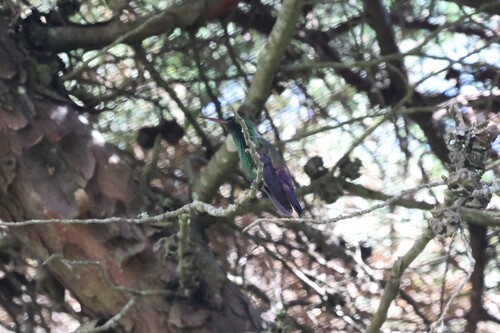 Blue-tailed Hummingbird
In short
The most reliable field mark to separate Blue-vented Hummingbird from Blue-tailed Hummingbird is the color and pattern of the tail and undertail coverts, especially in adult males: Blue-vented shows a pale steel-blue, slightly forked tail and greenish to steel-blue undertail coverts, while Blue-tailed has a dark metallic violet-blue tail and dull steel-blue undertail coverts. Juveniles and females are trickier, but Blue-vented tends to have a duller green belly and more grayish or buffy vent area, while Blue-tailed often shows a mix of whitish or buffy on the belly and undertail. Bill color also helps: Blue-vented has a coral-red mandible with a dark tip, while Blue-tailed has a mostly black bill with only a reddish base to the mandible. Both species overlap in Costa Rica and Nicaragua, so careful attention to these details is essential.
Identification tips
- Tail color and shape (adults): Blue-vented has a pale steel-blue, slightly forked tail; Blue-tailed's tail is dark metallic violet-blue and less obviously forked. This is most reliable in adult males but can help with females if seen well.
- Undertail coverts: Blue-vented shows greenish to steel-blue undertail coverts (males) or grayish-buff edged vent feathers (females); Blue-tailed has dull steel-blue or blue-black undertail coverts, sometimes with ferruginous edges in some subspecies. Females and immatures of Blue-tailed often have grayish undertail coverts.
- Belly and vent area (females/immatures): Blue-vented females have a duller green lower breast and belly, with grayish-buff vent; juveniles are dull green below with a grayish-brown belly. Blue-tailed females and young birds show more whitish or buffy on the belly and undertail, with underparts feathers often narrowly edged whitish.
- Throat pattern (females): Blue-vented females have throat feathers with white bars near the end; Blue-tailed females lack this feature and instead have more uniform green throats with some pale feather edges.
- Bill color: Blue-vented has a coral-red mandible with a dark tip and a blackish maxilla; Blue-tailed's bill is mostly black with only a reddish base to the mandible. This is subtle but can be diagnostic at close range.
- Rump and uppertail coverts: Blue-vented has a coppery to purplish rump and uppertail coverts; Blue-tailed's rump is dull purplish bronze and uppertail coverts are dark metallic bluish. In Blue-tailed, the rump is less purplish in females.
- Wing patch (adults): Blue-tailed shows a chestnut patch on the closed wing (primaries/secondaries), especially in the impatiens subspecies; Blue-vented lacks this feature. Look for a rufous or cinnamon flash when the wing is folded.
- Upperparts color: Both species are metallic green above, but Blue-vented males are more golden-green, while Blue-tailed males are deep metallic green. This difference is subtle and unreliable in poor light.
- Tail tips (females): Blue-vented females have purplish tips to the outer tail feathers; Blue-tailed females do not show this feature.
- Juvenile back/rump: Blue-vented juveniles have brownish edges to back and rump feathers, making them appear duller; Blue-tailed juveniles are not described in detail but likely lack this contrast.
- Song: If heard well, Blue-vented's repeated buzzy, squeaky phrases differ from Blue-tailed's short twitter, but both can be high-pitched and easily missed.
- Feeding height: Blue-vented tends to forage only up to the tops of small trees, while Blue-tailed uses all levels. This is a weak separator and best used as supporting context.
- Range: If outside Costa Rica or Nicaragua, Blue-tailed is much more widespread (from Mexico south), while Blue-vented is restricted to Costa Rica and Nicaragua. In overlap zones, do not rely on range alone.
- Subspecies variation (Blue-tailed): In northwestern/central Costa Rica, Blue-tailed (impatiens) is larger, darker green, and has a larger rufous wing patch, which can help in direct comparison with Blue-vented.
- Habitat: Both species occur in semi-open areas, but Blue-tailed is more likely in humid oak/pine forests and coffee plantations, while Blue-vented prefers drier habitats except in the dry season.
Size
Both species are very similar in size, but Blue-vented Hummingbird averages 8–11 cm in length and about 4.45 g in weight, while Blue-tailed Hummingbird is 9–10 cm and around 3.9–4.5 g. In practice, size is not a reliable field mark as their ranges overlap and their measurements are nearly identical. Any apparent difference in the field is likely due to posture or viewing angle rather than true size.
Plumage
- Juveniles/immatures: Blue-vented juveniles are darker overall, with a duller green below and a grayish-brown belly; their throat is darkish gray and the back/rump feathers have brownish edges. Blue-tailed juveniles are not described in detail, but females (which are similar to young birds) have underparts with narrow whitish margins and some dull buffy whitish on the belly, and undertail coverts are grayish.
- Adult males: Blue-vented shows golden-green upperparts, coppery to purplish rump, and dark glittering golden-green underparts with greenish to steel-blue undertail coverts. The tail is pale steel blue and slightly forked. Blue-tailed males have a deep metallic green crown and back, dull purplish bronze rump, dark metallic bluish uppertail coverts, and a dark metallic violet-blue tail. Underparts are bright metallic green with dull steel-blue undertail coverts. Primaries and secondaries are chestnut, forming a patch on the closed wing (not present in Blue-vented).
- Adult females: Blue-vented females are duller green below, with white bars near the end of throat feathers, grayish-buff edges to vent area feathers, and purplish tips to outer tail feathers. Blue-tailed females are also duller than males, with less purplish rump, underparts feathers with narrow whitish margins, some dull buffy whitish on the belly, and grayish undertail coverts. Subspecies variation in Blue-tailed can darken the overall appearance and increase the rufous/cinnamon wing patch.
Behaviour
Both species forage for nectar and insects, but Blue-vented tends to feed up to the tops of small trees and often defends feeding territories. Blue-tailed forages at all levels and is known to frequent Inga trees. Behavioral differences are subtle and not reliable for field separation.
Habitat
Both species inhabit semi-open landscapes, including scrublands, forest edges, secondary forest, and gardens. Blue-vented is found from southern Nicaragua to central Costa Rica, preferring dryish habitats except in the dry season when it moves to moister areas, and ranges from sea level to 1,800 m. Blue-tailed has a broader range (Mexico to Costa Rica) and occupies both humid and dry oak/pine forests, shade coffee plantations, and similar elevations. In areas of overlap (Costa Rica, Nicaragua), habitat is not a strong separator, but Blue-tailed may be found in a wider variety of forest types.
Voice
Blue-vented's song is a repeated buzzy, squeaky phrase ("tzi-tzee-tzup"), sometimes followed by lower notes, and calls are high, sharp "tsit" or dry "chit". Blue-tailed's song is a short twitter, with calls described as a hard, raspy "bzzzrt". While the vocalizations differ, both are high-pitched and can be difficult to separate in the field unless the song is clearly heard.
Blue-vented Hummingbird · Blue-tailed Hummingbird · My Tricky Birds