

Blue Petrel vs Antarctic Prion
Halobaena caerulea versus Pachyptila desolata
Play a quiz with Blue Petrel and Antarctic Prion
 Blue Petrel
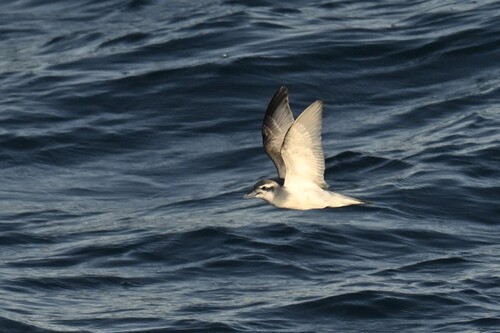 Antarctic Prion
In short
The most reliable field mark to separate Blue Petrel from Antarctic Prion is the head pattern: Blue Petrel shows a striking black cap with white cheeks, while Antarctic Prion has a pale face with a white eyebrow and lacks a strong cap. Both species have a dark 'M' across the upperwing, but Blue Petrel’s cap and white-tipped square tail are distinctive in flight or at rest. Structurally, Blue Petrel is bulkier with a heavier black bill, while Antarctic Prion is lighter and has a blue-grey bill. Both are similar in overall coloration and flight style, so careful attention to head and tail pattern is essential, especially at sea.
Identification tips
- Head pattern is the most reliable mark: Blue Petrel always shows a bold black cap contrasting with white cheeks; Antarctic Prion lacks a cap and instead has a pale face with a white eyebrow. This is visible in both perched and flying birds.
- Tail pattern: In flight, Blue Petrel has a square tail with a clear white tip, while Antarctic Prion’s tail is wedge-shaped with a black tip. Look for the white tip when the bird fans or spreads its tail.
- Bill color and shape: Blue Petrel’s bill is slender and black; Antarctic Prion’s is blue-grey and may appear slightly stubbier. This is subtle but can be seen at close range or in photos.
- Facial contrast: Blue Petrel’s white cheeks stand out against its dark cap, especially in side views. Antarctic Prion’s face is more uniformly pale with a white supercilium (eyebrow) but no sharp contrast.
- Upperwing pattern is NOT diagnostic: Both show a dark 'M' across the upperwing from tip to tip, so do not rely on this mark alone.
- Underpart color: Both are white below, but Blue Petrel may show dark patches at the sides of the neck. This is subtle and not always visible.
- Feet color: Antarctic Prion has blue feet, but these are rarely seen unless the bird is very close or landing.
- Size and structure: Blue Petrel is heavier and may look more robust, but size overlap is significant and not reliable unless birds are side by side.
- Bill structure: Blue Petrel’s bill is all black and slender, while Antarctic Prion’s is blue-grey. Bill color is best seen in good light or photos.
- Tail shape in flight: Blue Petrel’s tail is square with a white tip; Antarctic Prion’s is wedge-shaped with a black tip. Watch for tail shape and color when birds bank or land.
- Jizz in flight: Blue Petrel may appear more solid and purposeful; Antarctic Prion is lighter and may seem more buoyant. This is subtle and subjective.
- Habitat and range: Both occur together at sea; breeding range is not a field mark unless on land.
- Plumage seasonality: No significant seasonal or sex-based plumage differences are noted for either species; marks are reliable year-round.
- Voice: No field-diagnostic vocalizations are described for separation.
- Common pitfalls: The shared 'M' pattern on the upperwing is a classic source of confusion; always check the head and tail pattern before concluding ID.
Size
Blue Petrel is noticeably heavier (210 g vs. 156 g) and can appear more robust in direct comparison, though both are close in length (26–32 cm for Blue Petrel, 27 cm for Antarctic Prion) and wingspan (Blue Petrel: 62–71 cm; Antarctic Prion: 61–66 cm). In the field, size alone is subtle, but Blue Petrel may look slightly chunkier, especially in flight or when seen side-by-side with prions.
Plumage
- Juvenile/immature/adult flight (upperwing): Both species show a dark 'M' pattern across the upperwing, making this feature not diagnostic between them at any age.
- Head pattern: Blue Petrel of all ages has a bold black cap and white cheeks, creating a sharp contrast. Antarctic Prion lacks a cap, instead showing a pale blue-grey head with a white eyebrow and no strong cheek contrast.
- Tail: Blue Petrel sports a square tail with a white tip, while Antarctic Prion has a grey wedge-shaped tail with a black tip.
- Bill color: Blue Petrel has a slender black bill; Antarctic Prion has a blue-grey bill.
- Underparts: Both are white below with some dark at the neck sides for Blue Petrel, but this is subtle at sea.
- Feet: Only Antarctic Prion is noted to have blue feet, but this is rarely visible in the field.
Behaviour
Both species are pelagic, spending most of their lives at sea and only coming to land to breed. Their flight is similar: buoyant, gliding low over the waves, with rapid wingbeats interspersed with glides. Blue Petrel may appear slightly more robust and purposeful in flight, while Antarctic Prion can seem daintier. Feeding behavior is not diagnostic between these two in the field.
Habitat
Both species inhabit the Southern Ocean and breed on subantarctic islands, often near the Antarctic Convergence. Blue Petrel breeds at fewer, more southerly sites, but at sea their ranges overlap extensively. Habitat is not a reliable separator for field identification unless breeding colonies are known.