

Blue-headed Parrot vs Orange-winged Amazon
Pionus menstruus versus Amazona amazonica
Play a quiz with Blue-headed Parrot and Orange-winged Amazon
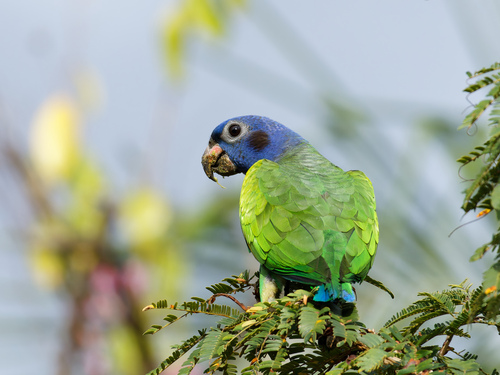 Blue-headed Parrot
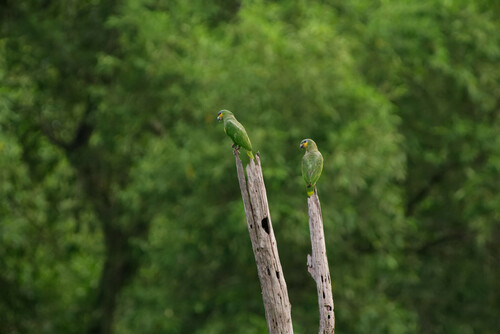 Orange-winged Amazon
In short
The most reliable field mark to separate Blue-headed Parrot from Orange-winged Amazon is the head and undertail coloration: Blue-headed Parrot has a distinctly blue head and neck with red undertail coverts, while Orange-winged Amazon shows a mostly green head with variable blue and yellow patches and lacks red under the tail. In flight, look for the Orange-winged Amazon’s orange wing and tail feathers, which are absent in Blue-headed Parrot. Structure also helps: Orange-winged Amazon is noticeably bulkier with a larger bill. Juvenile Blue-headed Parrots may lack full blue on the head, but never show orange in the wings or tail. Both species are noisy and gregarious, but their calls differ.
Identification tips
- Head color: Blue-headed Parrot always shows a blue head and neck (adults), while Orange-winged Amazon has a mostly green head with variable blue and yellow patches, never as solid or extensive as the pionus. Juvenile Blue-headed Parrots may have less blue, but never show orange in the wings or tail.
- Undertail coverts: Blue-headed Parrot has bright red undertail coverts, visible when perched or in flight. Orange-winged Amazon has green undertail coverts, never red.
- Wing and tail in flight: Orange-winged Amazon shows orange feathers in the wings and tail, especially obvious in flight or when stretching. Blue-headed Parrot lacks any orange in the wings or tail at all ages.
- Bill color: Blue-headed Parrot’s upper mandible is mostly black with reddish sides; Orange-winged Amazon’s bill is partly horn-colored and partly dark gray. This can be subtle at a distance, but is useful at close range.
- Size and structure: Orange-winged Amazon is larger, bulkier, and has a heavier, more robust bill. Blue-headed Parrot is more compact and slender by comparison.
- Juvenile confusion: Young Blue-headed Parrots may lack full blue on the head and show some reddish or pinkish feathers around the cere, but still have red undertail coverts and never show orange in the wings or tail. Juvenile Orange-winged Amazons look like adults but always show orange in the wings/tail.
- Sexes: Both species are sexually monomorphic; males and females look alike, so sex is not a useful field mark.
- Voice: Listen for the difference: Blue-headed Parrot gives light, squeaky calls, while Orange-winged Amazon is much louder and harsher.
- Habitat context: Both can be found in similar habitats, but Blue-headed Parrot is more closely tied to humid forest and riverine areas, while Orange-winged Amazon is more flexible and may be seen in drier or more open country.
- Perched posture: Orange-winged Amazon often appears heavier and more upright, while Blue-headed Parrot is more compact and less bulky.
- Bill shape: The Amazon’s bill is deeper and more hooked, especially noticeable when feeding.
- Flock composition: Mixed flocks can occur, but look for the combination of blue head and red undertail (pionus) versus orange in the wings/tail and variable head color (Amazon).
- Subspecies variation: Blue-headed Parrot has some regional variation (e.g., paler blue or pinkish throat in some subspecies), but all have blue on the head and red undertail. Orange-winged Amazon is monotypic, so variation is limited to individual head color patches.
- Pet birds: Both are common in captivity, but field marks remain the same; beware of feather wear or abnormal coloration in escapees.
- Pitfalls: Do not rely solely on green body color or general size; always check head, undertail, and wing/tail coloration for a confident ID.
Size
Orange-winged Amazon is significantly larger and heavier: about 33 cm long and 340 g, compared to Blue-headed Parrot’s 27–28 cm and 245 g [wikipedia][avonet]. The Amazon has a noticeably bulkier build and a more robust bill, which is apparent even at a distance. When perched side by side, the Amazon’s larger size and heavier jizz are obvious.
Plumage
- Juvenile/immature birds: Juvenile Blue-headed Parrots have less blue on the head and may show red or pinkish feathers around the cere, but still lack any orange in the wings or tail. Juvenile Orange-winged Amazons resemble adults, with green plumage and variable blue/yellow on the head, and always show orange in the wings and tail (especially visible in flight).
- Adults: Blue-headed Parrot is mainly green with a bright blue head, neck, and upper breast, and red undertail coverts. Orange-winged Amazon is green overall with variable blue and yellow on the head, but never as solidly blue as the pionus, and lacks red under the tail. The Amazon’s orange wing and tail feathers are diagnostic in flight or when wings are spread. Bill color also differs: Blue-headed Parrot has a mostly black upper mandible with reddish sides, while Orange-winged Amazon’s bill is partly horn-colored and partly dark gray.
Behaviour
Both species are social, often seen in flocks and roosting communally in trees. Both can be noisy, especially at dawn and dusk. Orange-winged Amazons are often bolder and more conspicuous, sometimes feeding in open areas or cultivated land. Blue-headed Parrots may be slightly more reserved, but both species are active and mobile, often flying between feeding and roosting sites.
Habitat
Both species occupy similar habitats: humid or semi-humid forests and semi-open country, including cultivated areas. Blue-headed Parrot is more closely tied to humid regions and riverine forests, while Orange-winged Amazon is widespread in lowland forests and semi-open areas, and is more likely to be seen in drier or more open habitats. Both occur in overlapping ranges in northern South America and Trinidad.
Voice
Both are noisy, but their calls differ: Blue-headed Parrot gives light, high-pitched squeaky 'sweenk' calls, while Orange-winged Amazon produces much louder, harsher, high-pitched screams. In a mixed flock or at a roost, the Amazon’s voice is more raucous and carrying, while the pionus is softer and less piercing.