

Motmot

Blue-grey Tanager vs Paradise Tanager

Thraupis episcopus versus Tangara chilensis

Play a quiz with Blue-grey Tanager and Paradise Tanager
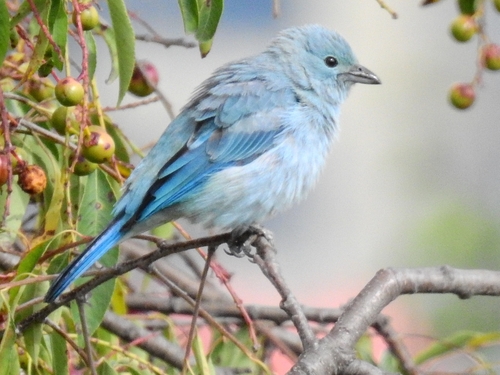
Blue-grey Tanager (Thraupis episcopus) Blue-grey Tanager
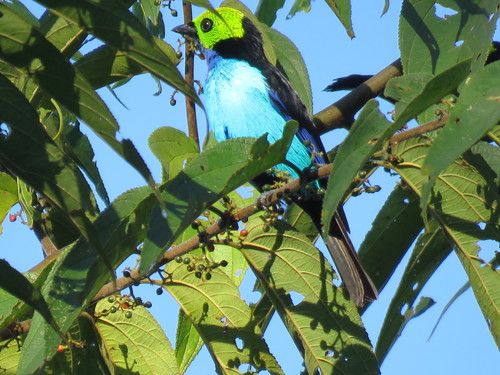
Paradise Tanager (Tangara chilensis) Paradise Tanager

Media

Loading…

In short

The most reliable way to separate Blue-grey Tanager from Paradise Tanager is by overall color pattern: Blue-grey Tanager is a fairly uniform light blue and blue-gray bird with a contrasting shoulder patch, while Paradise Tanager is a striking mix of black upperparts, sky blue underparts, and a bright green head, with a vivid yellow or red rump. Blue-grey Tanager is larger and heavier-bodied, with a thicker bill, and lacks the black back and green head of Paradise Tanager. Immature Blue-grey Tanagers are duller but never show the bold color blocks of Paradise Tanager. If you see a tanager with a black back and green head, it's Paradise; if the bird is mostly blue-gray with a blue shoulder, it's Blue-grey Tanager.

Identification tips

  1. Head color: Paradise Tanager always has a bright green head; Blue-grey Tanager has a light bluish or blue-gray head. No Blue-grey Tanager shows green on the head at any age.
  2. Back color: Paradise Tanager's back is solid black, contrasting sharply with the green head and blue underparts. Blue-grey Tanager has blue or blue-gray upperparts, never black.
  3. Underparts: Both have blue underparts, but Paradise Tanager's are a brighter sky blue, sharply set off by the black back and green head. Blue-grey Tanager's underparts are paler, more uniform with the head.
  4. Shoulder patch: Blue-grey Tanager shows a distinct shoulder patch (color varies by subspecies: lavender, blue, white, or dark blue), which can stand out in flight or perched. Paradise Tanager lacks any contrasting shoulder patch.
  5. Rump color: Paradise Tanager has a vivid yellow and red or all-red rump (depending on subspecies), a feature never shown by Blue-grey Tanager.
  6. Bill structure: Blue-grey Tanager has a noticeably thicker, stubbier bill; Paradise Tanager's bill is finer and more delicate.
  7. Juvenile/immature plumage: Young Blue-grey Tanagers are duller but still blue-gray, never showing black, green, or the vivid rump colors of Paradise Tanager. Immature Paradise Tanagers retain the black-and-green pattern.
  8. Size and shape: Blue-grey Tanager is larger and heavier-bodied (16–18 cm, 30–40 g) than Paradise Tanager (13.5–15 cm, 21 g), and may appear chunkier in the field.
  9. Habitat: In urban, open, or edge habitats, Blue-grey Tanager is much more likely. Paradise Tanager is strictly a forest canopy bird in the Amazon Basin.
  10. Behavior: Paradise Tanager is more likely to be seen high in the canopy, often with mixed flocks; Blue-grey Tanager is more versatile in height and habitat.
  11. Vocalizations: Listen for the squeaky twittering and 'tseee/tsuup' calls of Blue-grey Tanager; Paradise Tanager does not share this vocal style.
  12. Subspecies variation: Blue-grey Tanager's shoulder patch color varies by region, but never approaches the black-and-green-and-red/yellow combination of Paradise Tanager.
  13. Flight views: In flight, Blue-grey Tanager may show the shoulder patch as a flash of color, but never the bold rump or black back of Paradise Tanager.
  14. Sexes: Both species are sexually similar, so sex is not a useful field mark.
  15. Pitfalls: Immature Blue-grey Tanagers can appear washed out, but even then, the lack of black and green on head/back and the absence of a bright rump will rule out Paradise Tanager.

Size

Blue-grey Tanager is distinctly larger and heavier than Paradise Tanager. Blue-grey Tanager measures 16–18 cm in length and weighs 30–40 g, while Paradise Tanager is smaller at 13.5–15 cm and only 21 g. In the field, Blue-grey Tanager often appears chunkier and more robust, with a thicker bill, compared to the more delicate and compact Paradise Tanager.

Plumage

Juvenile and immature Blue-grey Tanagers are duller versions of the adult, with less vibrant blue tones, but still lack any black or green on the head or back. Adults have a light bluish head and underparts, darker blue upperparts, and a shoulder patch that varies in hue (lavender, blue, white, or dark blue depending on subspecies). Paradise Tanager, regardless of age, is much more vividly colored: adults have a light green head, black upperparts, sky blue underparts, and a yellow and red or all-red rump (depending on subspecies). The black back and green head are unique to Paradise Tanager and never appear on Blue-grey Tanager. No age of Blue-grey Tanager shows the Paradise's black-and-green combination, and no Paradise Tanager is ever mostly blue-gray. Both species have similar bill and leg color (dark/blackish), but Blue-grey Tanager's bill is thicker.

Behaviour

Both species are active, social, and often seen in pairs or small groups, but Paradise Tanager tends to move higher in the canopy and is more likely to join mixed-species flocks in humid forest. Blue-grey Tanager is more adaptable, often seen in open woodlands, gardens, and urban areas, sometimes lower in the vegetation. In flight, Blue-grey Tanager may appear heavier and more direct, while Paradise Tanager is quicker and more agile.

Habitat

Blue-grey Tanager is widespread and adaptable, found from Mexico to northern South America in a variety of habitats including open woodlands, gardens, and even urban parks. Paradise Tanager is restricted to humid tropical and subtropical forests of the Amazon Basin, usually in the canopy or forest edge. If you are in disturbed or urban habitat, Blue-grey Tanager is far more likely; if deep in Amazonian rainforest, Paradise Tanager is the expected species.

Voice

Blue-grey Tanager gives a squeaky twittering song with 'tseee' and 'tsuup' call notes. There is no detailed description of Paradise Tanager's voice in the notes, but it is not known for the same squeaky, twittering phrases. If you hear the characteristic Blue-grey Tanager calls, it supports that identification.

Submit a better description

Use the same sections as the comparison. Your text is published immediately.

The most reliable way to separate Blue-grey Tanager from Paradise Tanager is by overall color pattern: Blue-grey Tanager is a fairly uniform light blue and blue-gray bird with a contrasting shoulder patch, while Paradise Tanager is a striking mix of black upperparts, sky blue underparts, and a bright green head, with a vivid yellow or red rump. Blue-grey Tanager is larger and heavier-bodied, with a thicker bill, and lacks the black back and green head of Paradise Tanager. Immature Blue-grey Tanagers are duller but never show the bold color blocks of Paradise Tanager. If you see a tanager with a black back and green head, it's Paradise; if the bird is mostly blue-gray with a blue shoulder, it's Blue-grey Tanager.

  1. Head color: Paradise Tanager always has a bright green head; Blue-grey Tanager has a light bluish or blue-gray head. No Blue-grey Tanager shows green on the head at any age.
  2. Back color: Paradise Tanager's back is solid black, contrasting sharply with the green head and blue underparts. Blue-grey Tanager has blue or blue-gray upperparts, never black.
  3. Underparts: Both have blue underparts, but Paradise Tanager's are a brighter sky blue, sharply set off by the black back and green head. Blue-grey Tanager's underparts are paler, more uniform with the head.
  4. Shoulder patch: Blue-grey Tanager shows a distinct shoulder patch (color varies by subspecies: lavender, blue, white, or dark blue), which can stand out in flight or perched. Paradise Tanager lacks any contrasting shoulder patch.
  5. Rump color: Paradise Tanager has a vivid yellow and red or all-red rump (depending on subspecies), a feature never shown by Blue-grey Tanager.
  6. Bill structure: Blue-grey Tanager has a noticeably thicker, stubbier bill; Paradise Tanager's bill is finer and more delicate.
  7. Juvenile/immature plumage: Young Blue-grey Tanagers are duller but still blue-gray, never showing black, green, or the vivid rump colors of Paradise Tanager. Immature Paradise Tanagers retain the black-and-green pattern.
  8. Size and shape: Blue-grey Tanager is larger and heavier-bodied (16–18 cm, 30–40 g) than Paradise Tanager (13.5–15 cm, 21 g), and may appear chunkier in the field.
  9. Habitat: In urban, open, or edge habitats, Blue-grey Tanager is much more likely. Paradise Tanager is strictly a forest canopy bird in the Amazon Basin.
  10. Behavior: Paradise Tanager is more likely to be seen high in the canopy, often with mixed flocks; Blue-grey Tanager is more versatile in height and habitat.
  11. Vocalizations: Listen for the squeaky twittering and 'tseee/tsuup' calls of Blue-grey Tanager; Paradise Tanager does not share this vocal style.
  12. Subspecies variation: Blue-grey Tanager's shoulder patch color varies by region, but never approaches the black-and-green-and-red/yellow combination of Paradise Tanager.
  13. Flight views: In flight, Blue-grey Tanager may show the shoulder patch as a flash of color, but never the bold rump or black back of Paradise Tanager.
  14. Sexes: Both species are sexually similar, so sex is not a useful field mark.
  15. Pitfalls: Immature Blue-grey Tanagers can appear washed out, but even then, the lack of black and green on head/back and the absence of a bright rump will rule out Paradise Tanager.

Blue-grey Tanager is distinctly larger and heavier than Paradise Tanager. Blue-grey Tanager measures 16–18 cm in length and weighs 30–40 g, while Paradise Tanager is smaller at 13.5–15 cm and only 21 g. In the field, Blue-grey Tanager often appears chunkier and more robust, with a thicker bill, compared to the more delicate and compact Paradise Tanager.

Juvenile and immature Blue-grey Tanagers are duller versions of the adult, with less vibrant blue tones, but still lack any black or green on the head or back. Adults have a light bluish head and underparts, darker blue upperparts, and a shoulder patch that varies in hue (lavender, blue, white, or dark blue depending on subspecies). Paradise Tanager, regardless of age, is much more vividly colored: adults have a light green head, black upperparts, sky blue underparts, and a yellow and red or all-red rump (depending on subspecies). The black back and green head are unique to Paradise Tanager and never appear on Blue-grey Tanager. No age of Blue-grey Tanager shows the Paradise's black-and-green combination, and no Paradise Tanager is ever mostly blue-gray. Both species have similar bill and leg color (dark/blackish), but Blue-grey Tanager's bill is thicker.

Both species are active, social, and often seen in pairs or small groups, but Paradise Tanager tends to move higher in the canopy and is more likely to join mixed-species flocks in humid forest. Blue-grey Tanager is more adaptable, often seen in open woodlands, gardens, and urban areas, sometimes lower in the vegetation. In flight, Blue-grey Tanager may appear heavier and more direct, while Paradise Tanager is quicker and more agile.

Blue-grey Tanager is widespread and adaptable, found from Mexico to northern South America in a variety of habitats including open woodlands, gardens, and even urban parks. Paradise Tanager is restricted to humid tropical and subtropical forests of the Amazon Basin, usually in the canopy or forest edge. If you are in disturbed or urban habitat, Blue-grey Tanager is far more likely; if deep in Amazonian rainforest, Paradise Tanager is the expected species.

Blue-grey Tanager gives a squeaky twittering song with 'tseee' and 'tsuup' call notes. There is no detailed description of Paradise Tanager's voice in the notes, but it is not known for the same squeaky, twittering phrases. If you hear the characteristic Blue-grey Tanager calls, it supports that identification.

Discard your changes?

You have unsaved edits. If you leave now, those changes will be lost.

Blue-grey Tanager · Paradise Tanager · My Tricky Birds