

Blue-black Grassquit vs Morelet's Seedeater
Volatinia jacarina versus Sporophila morelleti
Play a quiz with Blue-black Grassquit and Morelet's Seedeater
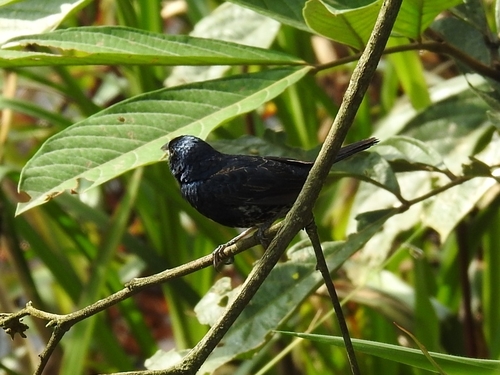 Blue-black Grassquit
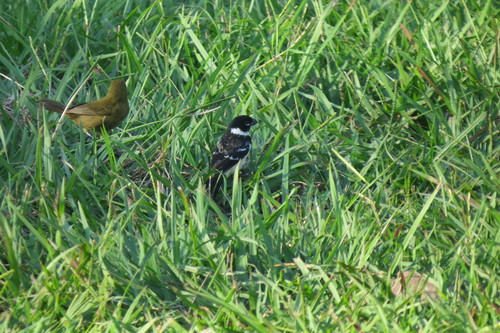 Morelet's Seedeater
In short
The most reliable field mark between Blue-black Grassquit and Morelet's Seedeater is the presence of a white underwing patch in flight on male Blue-black Grassquits, which is absent in Morelet's Seedeater. For perched birds, male Blue-black Grassquits are glossy blue-black overall, while male Morelet's Seedeaters show a blackish crown and face with a contrasting white crescent below the eye and a paler, olive-gray back. Females and immatures of both species are brownish and streaky, but Grassquit females are warmer brown with more streaking below, while Seedeater females are grayer-olive and less streaked. Bill shape and subtle wing bar differences can help, but beware of overlap in size and general structure.
Identification tips
- White underwing patch in flight (male Blue-black Grassquit only): If you see a small black bird flash white on the underwing while flying, it's a male Grassquit. No Seedeater shows this.
- Male overall color: Blue-black Grassquit males are glossy blue-black all over, lacking any pale or olive areas. Morelet's Seedeater males have a blackish head and face but an olive-gray back and buffy underparts, with a distinctive white crescent below the eye.
- White eye crescent (male Seedeater): Look for a bold white crescent below the eye on Morelet's Seedeater males, especially in nominate and sharpei subspecies. Grassquit males never show this mark.
- Wing bars: Both species can show pale wing bars, but they're usually fainter and less contrasting on Grassquit females and juveniles. Seedeater males have two buffy white wing bars that are more distinct, especially in fresh plumage.
- Bill shape: Grassquit has a longer, more conical bill, while Seedeater's bill is shorter, thicker, and more rounded on top. This is subtle but can help with good views.
- Female/immature underparts: Grassquit females/immatures have a warm buff throat and underparts with a band of dark streaks across the breast and flanks. Seedeater females/immatures are plainer below, lacking strong streaking.
- Female/immature upperparts: Grassquit females/immatures are warmer brown above with faint streaks, while Seedeater females/immatures are grayer-olive and less streaked.
- Tail color: Grassquit females have a brown tail with buff tips on outer feathers (quickly worn off), while Seedeater females have a gray tail with thin gray tips.
- Male wing pattern: Seedeater males show white at the base of most primaries and two buffy wing bars; Grassquit males have all-black wings with no white except the underwing patch (in flight).
- Display behavior: If you see a small blackish bird repeatedly leaping up from a perch with fluttering wings, it's a male Grassquit. Seedeaters do not perform this display.
- Habitat context: In Central America, both can occur together, but Grassquit is more likely in wetter, grassy, or weedy areas, while Seedeater prefers drier or more northern sites.
- Size: Grassquit is slightly smaller and more compact, but this is subtle and unreliable in the field.
- Iris and leg color: Both have brown irises and gray legs, so these are not useful for separation.
- Bill color: Male Seedeaters have a black bill; female Seedeaters have a brown maxilla and pale mandible. Grassquits have a blackish maxilla and pale gray to horn mandible in both sexes.
- Subspecies variation: Some Seedeater subspecies (mutanda) have a mostly black throat, but always with the white eye crescent and pale underparts, never all-over glossy black as in Grassquit males.
Size
Blue-black Grassquit is slightly smaller, measuring 8.7–10.9 cm in length and weighing 8–12 g, while Morelet's Seedeater is about 11 cm long and averages 8.7 g. In the field, this size difference is subtle and not always reliable for separation, as both are small, compact finch-like birds. Bill shape is more useful: Grassquit has a longish, conical bill, while Seedeater's bill is shorter, thicker, and has a rounded culmen.
Plumage
-
Juvenile/immature and female birds: Blue-black Grassquit females and juveniles are warm brown above with faint darker streaks on the crown, mantle, and back, and have buffy underparts with a band of darker streaks across the breast and flanks. Their wings are brown with faint, pale-tipped coverts forming two weak wing bars. Morelet's Seedeater females and immatures are grayish-olive to brownish-olive above, with gray wings and tail, and thinner, less obvious wing bars. They lack the strong breast streaking of Grassquit females, appearing plainer below.
-
Adult males: Blue-black Grassquit males are glossy blue-black all over, with a white patch on the underwing (axillaries and underwing coverts) visible in flight. Their wings and tail are flat black. Morelet's Seedeater males (sharpei) have a blackish crown, nape, and sides of the head, a white crescent below the eye, olive-gray back with black mottling, and buffy underparts. Their wings are black with white at the base of most primaries and two buffy white wing bars. The nominate morelleti male has a larger white eye crescent and a solid black breast band. The white underwing patch is absent in all Seedeaters.
-
In flight: The white underwing patch is diagnostic for male Grassquits. Seedeaters may show white at the base of primaries, but not on the underwing.
Behaviour
Blue-black Grassquit males are known for their distinctive display flights, often leaping repeatedly from a perch with fluttering wings, which can be a behavioral clue. Morelet's Seedeater does not perform this display and is more likely to be seen quietly feeding or perched. Both species forage in weedy fields and grasslands, but Grassquits are more likely to be seen in open, weedy, or grassy areas, sometimes in small groups.
Habitat
Both species occupy open, weedy, or grassy habitats, often at field edges, roadsides, or second-growth scrub. Blue-black Grassquit has a much broader range, found throughout most of Central and South America, including the Caribbean. Morelet's Seedeater is more restricted to areas from Texas south to Panama. Habitat overlap is possible in Central America, but Grassquit is more likely in wetter, lower elevation sites, while Seedeater can be found in drier or more northern areas.
Blue-black Grassquit · Morelet's Seedeater · My Tricky Birds