

Blue-and-yellow Macaw vs Scarlet Macaw
Ara ararauna versus Ara macao
Play a quiz with Blue-and-yellow Macaw and Scarlet Macaw
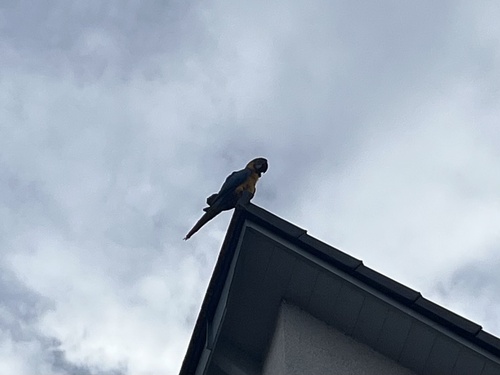 Blue-and-yellow Macaw
 Scarlet Macaw
In short
The most reliable field mark to separate Blue-and-yellow Macaw from Scarlet Macaw is overall body coloration: Blue-and-yellow Macaw shows a vivid blue back and wings with a yellow to orange underside, while Scarlet Macaw is mostly scarlet red with yellow and blue in the wings. Both are large, long-tailed macaws with pale facial skin, but the Blue-and-yellow Macaw’s greenish crown and black lower face contrast sharply with the Scarlet Macaw’s all-red head and pale upper mandible. Juveniles of both species resemble adults, so age-related wing pattern is not a strong separator. Size is similar, but Scarlet Macaw has a proportionally longer tail. In flight or perched, focus on the color blocks and facial pattern for the quickest separation.
Identification tips
- Overall color blocks: Blue-and-yellow Macaw is blue above and yellow/orange below; Scarlet Macaw is mostly scarlet red with yellow and blue in the wings. This is the fastest and most reliable field mark at any age or season.
- Head color: Blue-and-yellow Macaw has a lime-green forehead and crown, while Scarlet Macaw’s head is entirely scarlet red. This is especially useful on perched birds.
- Facial skin pattern: Both have bare white skin on the face, but Blue-and-yellow Macaw shows black feather lines forming a striped pattern, while Scarlet Macaw’s face is plainer with tiny white feathers. Look for the black lines on Blue-and-yellow Macaw in good light.
- Chin and lower face: Blue-and-yellow Macaw has a black chin and lower face, contrasting with its yellow underparts; Scarlet Macaw’s chin is red, blending with the rest of the head and body.
- Bill color: Blue-and-yellow Macaw has an all-black bill; Scarlet Macaw’s upper mandible is pale horn (ivory) with a black lower mandible. This is best seen at close range.
- Wing pattern (perched and in flight): Blue-and-yellow Macaw’s wings are blue above with no yellow in the coverts; Scarlet Macaw’s greater upperwing coverts are yellow, with blue flight feathers and sometimes green at the wing bend. In flight, Scarlet Macaw shows a striking red, yellow, and blue tricolor wing.
- Tail color: Blue-and-yellow Macaw’s tail is blue above, yellow below; Scarlet Macaw’s tail is red with blue tips and light blue rump and tail coverts.
- Eye color: Both adults have pale yellow irises, but juvenile Scarlet Macaw has dark eyes. This is subtle and rarely diagnostic in the field.
- Size and shape: Both are large, but Scarlet Macaw has a proportionally longer, more graduated tail, making it appear more elongated, especially in flight. This is a supporting mark, not primary.
- Habitat context: If seen in humid evergreen forest interior, Scarlet Macaw is more likely; Blue-and-yellow Macaw tolerates more open woodland and savannah, but both can overlap in lowland forests.
- Voice: Both are extremely loud and raucous; voice is not a reliable separator.
- Behavior: Both species are social, often in pairs or small groups, and use their beaks for climbing. Behavior is not a strong separator.
- No seasonal or sex differences: Both sexes are alike, and there is little seasonal variation in plumage for either species.
- Juvenile confusion: Juveniles of both species look like adults, so do not rely on immature plumage for separation. Only the eye color of juvenile Scarlet Macaw (darker) differs, but this is rarely useful at a distance.
- Common pitfalls: Do not confuse the yellow in Scarlet Macaw’s wing with the yellow underparts of Blue-and-yellow Macaw—on Scarlet, yellow is restricted to the upperwing coverts, not the body. The blue in Scarlet Macaw is limited to flight feathers and tail tips, never the back or crown.
Size
Both species are among the largest Neotropical parrots, with Blue-and-yellow Macaw reaching 81–91 cm (32–36 in) and 1.0–1.5 kg (2–3 lb), and Scarlet Macaw averaging about 84 cm (33 in) and 1 kg (2 lb 3 oz). Scarlet Macaw’s tail is proportionally longer, making it appear even more elongated, especially in flight. Overall mass and length overlap, so size alone is not diagnostic, but the Scarlet Macaw may look slightly more slender and tail-heavy.
Plumage
- Juvenile/immature plumage: Both species have juveniles that closely resemble adults, with no distinctive age-specific upperwing pattern or molt marks reported. Eye color is darker in juvenile Scarlet Macaw, turning pale yellow in adults, but this is subtle at a distance.
- Adults: Blue-and-yellow Macaw is unmistakable with a lime-green forehead, bright blue upperparts (back, wings, tail), and a rich yellow to orange underbody. The face is white with sparse black feather lines, and the chin is black. Scarlet Macaw is mostly scarlet red, with yellow greater upperwing coverts, blue flight feathers and tail tips, and a white facial patch with tiny white feathers. Some individuals show green in the wings. The upper mandible is pale horn, lower is black. The rump and tail coverts are light blue. Undersides of wings and tail are dark red with gold iridescence. The facial skin is bare and white in both, but Blue-and-yellow Macaw has black feather lines forming a striped pattern, while Scarlet Macaw’s face is plainer with tiny white feathers.
Behaviour
Both species are highly vocal, social, and often seen in pairs or small groups. Blue-and-yellow Macaws are known for their loud flock calls and can be destructive chewers. Scarlet Macaws are also noisy, with calls designed to carry over long distances. Both species use their powerful beaks for climbing and feeding. In captivity, both are long-lived and require large spaces. No major behavioral differences are noted that aid field separation.
Habitat
Blue-and-yellow Macaw prefers a range of habitats including varzea (seasonally flooded forest), open terra firme (unflooded forest), woodland, and savannah in tropical Central and South America, including Trinidad. Scarlet Macaw is more closely tied to humid evergreen forests, ranging from southeastern Mexico through much of tropical South America and Trinidad, but can also be found in lowland forests up to 1,000 m. Both may overlap in parts of their range, especially in forested lowlands and gallery forests, but Scarlet Macaw is more restricted to humid forest interiors.
Voice
Both species are extremely loud. Blue-and-yellow Macaw produces piercing screams and flock calls, often described as harsh and attention-grabbing. Scarlet Macaw also gives very loud, high and low-pitched, throaty squawks, squeaks, and screams that carry for kilometers. The quality of the calls is similar enough that voice alone is not a reliable separator in the field.