

Black-winged Kite vs Egyptian Vulture
Elanus caeruleus versus Neophron percnopterus
Play a quiz with Black-winged Kite and Egyptian Vulture
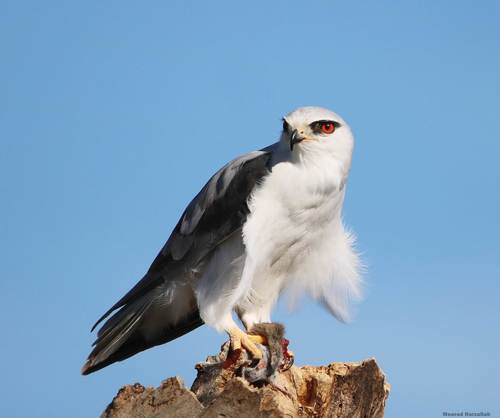 Black-winged Kite
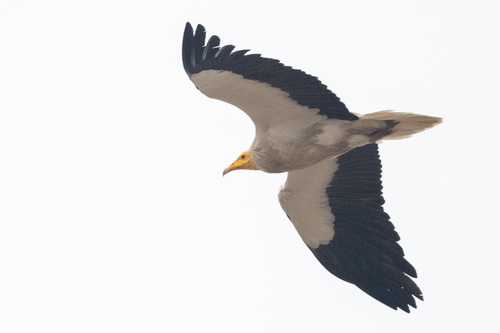 Egyptian Vulture
In short
The most reliable field mark to separate Black-winged Kite from Egyptian Vulture is the overall structure and flight profile: Black-winged Kite is a compact, small raptor with long, pointed wings and a short tail, while Egyptian Vulture is much larger, with a wedge-shaped tail and a distinctive white-and-black underwing pattern. Juvenile plumages differ sharply: young kites are reddish-brown above and on the breast, while juvenile Egyptian Vultures are dark brown with patchy white. In flight, the vulture's long, wedge-shaped tail and pale body with black flight feathers stand out against the kite's more uniform grey-and-white plumage and black wing patches. Bill shape and facial color are also key: the kite has a small, hooked bill and red eyes, while the vulture has a long, slender bill and bare yellow facial skin.
Identification tips
- Size and bulk: Egyptian Vulture is much larger and heavier than Black-winged Kite; this is usually obvious even at a distance. If both are seen together, the kite appears small and slender, while the vulture is robust and long-winged.
- Tail shape: In flight, Egyptian Vulture shows a distinctive wedge-shaped tail, while Black-winged Kite has a short, square tail. This is a reliable mark for all ages.
- Wing shape and flight style: Black-winged Kite has long, pointed wings and often hovers, kestrel-like, over fields. Egyptian Vulture soars on broad, pointed wings but does not hover; it circles on thermals with steady, buoyant flight.
- Juvenile plumage: Young kites are reddish-brown above and on the breast, with white and grey elsewhere; juvenile Egyptian Vultures are dark brown with patchy white and lack any rusty tones. Use this mark for birds not yet in full adult plumage.
- Adult underwing pattern: Egyptian Vulture adults have a striking black-and-white underwing, with black flight feathers contrasting sharply with white coverts and body. Black-winged Kite adults are mostly white below with black at the wing tips and shoulders, but lack the vulture's bold pattern.
- Facial features: Black-winged Kite has red eyes and a small, hooked bill, with feathered face. Egyptian Vulture has bare yellow facial skin extending to the throat, and a long, slender, hooked bill. This is visible at close range or with good optics.
- Bill shape: The kite's bill is short and compact, suited for catching small prey. The vulture's bill is longer, more slender, and slightly downcurved, adapted for scavenging.
- Leg color: Adult Egyptian Vultures have pink legs; juveniles have grey legs. Kite legs are less distinctive but are not pink.
- Perched posture: Black-winged Kite perches upright and alert, often on exposed branches or wires. Egyptian Vulture perches more hunched, with a heavier body and longer neck.
- Habitat context: Kites are most often seen over open grasslands or agricultural fields, hovering or perched. Vultures are more likely in arid or semi-arid regions, cliffs, or near carcasses and refuse.
- Soiled plumage: Adult Egyptian Vultures often appear dirty or rusty due to soil staining, especially on the head and body. Kites are always clean white and grey (except for the rusty juveniles).
- Eye color: Black-winged Kite has striking red eyes, visible at close range. Egyptian Vulture's eyes are less conspicuous, with the facial skin being the main feature.
- Sex and age: Both species are sexually monomorphic in plumage, but female Egyptian Vultures are slightly larger and breeding males may have deeper orange facial skin. This is subtle and rarely useful in the field.
- Seasonal context: Black-winged Kite is non-migratory but nomadic, responding to rodent populations; Egyptian Vulture is migratory in some regions, so timing may help in some areas.
- Confusion risk: The most common pitfall is mistaking a hovering kite for a vulture at great distance, or a pale vulture for a kite when seen from below. Always check tail shape, wing pattern, and overall size.
Size
Egyptian Vulture is dramatically larger and heavier than Black-winged Kite. With an average adult mass of nearly 2 kg [wikidata], the vulture dwarfs the kite, which is a small raptor (exact mass not given, but much lighter). In the field, the vulture's size is obvious both perched and in flight, with a much more robust body and longer wingspan. The kite is closer in size to a kestrel or small falcon, while the vulture is comparable to other large Old World vultures, though it is the smallest of its group.
Plumage
- Juvenile/immature birds:
- Black-winged Kite juveniles have reddish-brown feathers on the upperparts and breast, providing a warm, rusty wash that is absent in all ages of Egyptian Vulture. This color is derived from porphyrins and is thought to help with camouflage. The rest of the plumage is a mix of white, grey, and black, with the black restricted to the wing coverts and primaries.
- Juvenile Egyptian Vultures are blackish or chocolate brown overall, with black and white patches. They lack the clean white of adults and the rusty tones of young kites. The adult vulture plumage is only attained after about five years, so dark immatures are common.
- Adults:
- Black-winged Kite adults are strikingly pale, with white underparts, grey upperparts, and bold black patches on the wings (especially at the 'shoulder' and primaries). The eyes are red and the bill is small and hooked.
- Adult Egyptian Vultures are white overall but often appear dirty or rusty due to soil staining. The flight feathers are black, creating a strong contrast with the white coverts and body, especially visible from below. The tail is wedge-shaped and the facial skin is bare and yellow down to the throat. The bill is long and slender, with a hooked tip, and the legs are pink in adults.
- In flight:
- The kite shows long, pointed wings and a short, square tail, with a mostly white body and black wing patches.
- The vulture soars on broad, pointed wings with a wedge-shaped tail, and the underwing shows a bold black-and-white pattern.
Behaviour
Black-winged Kite is best known for its habit of hovering over open grasslands, much like a kestrel, and is often seen hunting rodents and large insects. It perches upright on exposed branches or wires. Egyptian Vulture, in contrast, is a soaring scavenger, typically seen circling high on thermals during the warmer parts of the day. It rarely hovers and is more likely to be seen on the ground at carcasses or soaring over open country. The vulture's flight is more buoyant and less direct than the kite's, and it relies on soaring rather than active hunting.
Habitat
Both species can be found in open country, but Black-winged Kite is more closely tied to open grasslands, plains, and sometimes grassy slopes, often near agriculture or livestock areas. Egyptian Vulture is more widespread, occurring from Iberia and North Africa through West Asia to India, and is often seen in arid or semi-arid regions, cliffs, and open landscapes where carcasses are available. The vulture is more likely to be seen around human settlements and refuse sites, while the kite prefers areas with abundant small prey and less human disturbance.