
Black-throated Bobwhite vs Spotted Wood-Quail
Colinus nigrogularis versus Odontophorus guttatus
Play a quiz with Black-throated Bobwhite and Spotted Wood-Quail
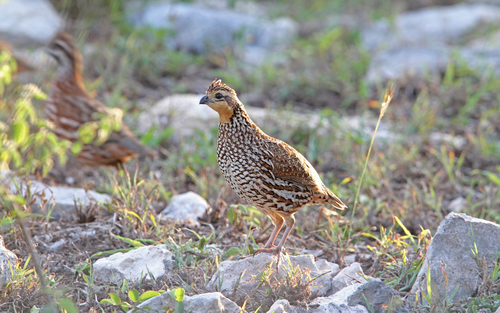 Black-throated Bobwhite
 Spotted Wood-Quail
In short
The most reliable field mark between Black-throated Bobwhite and Spotted Wood-Quail is the male bobwhite’s sharply defined black throat and white-edged face, versus the wood-quail’s more diffuse black-and-white streaked throat and orange crest. Immature Spotted Wood-Quail have buffy, smaller spotting below and a dusky (not black) throat, which can cause confusion with female or juvenile bobwhites, but the wood-quail’s larger size, bolder white spots on the underparts, and group foraging behavior are strong clues. Habitat is also a major separator: Black-throated Bobwhite favors lowland grasslands and shrubby areas, while Spotted Wood-Quail is a highland forest species. If you see a compact quail with a black throat and crisp white facial markings in open country, it’s almost certainly a bobwhite; a larger, orange-crested, white-spotted bird in mountain forest is a wood-quail.
Identification tips
- Check for an orange crest: Only Spotted Wood-Quail has a prominent orange crest, raised when excited. Black-throated Bobwhite never shows this feature, regardless of age or sex.
- Look at the throat: Adult male Black-throated Bobwhite has a sharply defined black throat bordered with white; female has a buff throat. Spotted Wood-Quail (both sexes) has a black throat streaked with white, but it is never as crisply bordered as in male bobwhite. Immature wood-quail have a dusky, not black, throat.
- Examine the underparts: Spotted Wood-Quail always shows bold white spots on olive or rufous underparts (adults), or smaller buffy spots (immature). Black-throated Bobwhite has white underparts with black scalloping (male) or white barred with rufous and black (female), never large white spots.
- Facial pattern: Male Black-throated Bobwhite has a white forehead, black crown, and black eyestripe, creating a striking, high-contrast face. Spotted Wood-Quail has a dark brown forehead and lacks such crisp facial patterning.
- Upperparts: Bobwhite upperparts are reddish-brown with white speckling and barring; wood-quail upperparts are dark brown with black and rufous flecking, appearing more uniform and less patterned at a distance.
- Size and shape: Spotted Wood-Quail is much larger and heavier (25 cm, 300 g) than Black-throated Bobwhite (20 cm). In the field, wood-quail appears bulkier, especially in groups. Use caution with lone birds or poor views.
- Group behavior: Wood-quail are almost always in groups of 4–10, moving together and very wary. Bobwhites are more often seen singly or in pairs.
- Habitat context: If you’re in highland forest above 1000 m, especially in dense bamboo or thickets, expect Spotted Wood-Quail. In open lowland grassland, shrub, or mangrove, expect Black-throated Bobwhite.
- Flight response: Spotted Wood-Quail typically flees on foot but may explode into a short, fast flight into cover if startled. Bobwhite is also a ground bird but is less strictly tied to dense cover.
- Juvenile confusion: Immature wood-quail have buffier, smaller spotting below and a dusky throat, which can look superficially like female or juvenile bobwhite. However, the wood-quail’s larger size and group behavior remain good clues.
- Vocalizations: If you hear a clear, whistled duet (‘coowit CAWwit coowit COO’), it’s Spotted Wood-Quail. Bobwhite’s calls are not described here, so use this only for positive wood-quail ID.
- Sex differences: Female bobwhite is paler below with a buff throat and more barred underparts; female wood-quail is like the male but with a duller crest.
- No overlap in range at most sites: While both species occur in Mexico and Central America, their habitat preferences rarely overlap. Use location and elevation as strong supporting evidence.
- No bold white spotting in bobwhite: If you see bold white spots on the underparts, it is never a Black-throated Bobwhite.
- No orange crest in bobwhite: Any hint of an orange crest rules out bobwhite completely.
Size
Black-throated Bobwhite is smaller and more compact, about 20 cm in length [wikipedia]. Spotted Wood-Quail is noticeably larger at 25 cm and much heavier (300 g) [wikipedia]. In the field, the wood-quail’s bulk and longer body are apparent, especially when seen together or with familiar objects for scale. The bobwhite’s smaller, more rounded appearance is a good clue, but beware lone birds where size is hard to judge.
Plumage
- Juvenile/Immature: Immature Spotted Wood-Quail have smaller, buffier white spotting below and a dusky (not black) throat, lacking the adult’s bold white spots and black-and-white throat streaking [wikipedia]. Female and immature Black-throated Bobwhite show a buff throat and white underparts barred with rufous and black, but never the bold white spotting of wood-quail.
- Adult Male: Black-throated Bobwhite males have a sharply defined black throat bordered by white, a white forehead, and a black crown and eyestripe. Their upperparts are reddish-brown with white speckling, and the underparts are scalloped white edged with black, with cinnamon lower belly [wikipedia]. Spotted Wood-Quail adults (both sexes) have a dark brown forehead, orange crest, and cheeks/throat black streaked with white. Underparts are olive or rufous, always boldly spotted with white.
- Adult Female: Female bobwhites have a buff throat, black and paler-speckled hindneck and mantle, and white underparts barred with rufous and black. Female wood-quail look like males but with a duller crest.
- Key Difference: Only Spotted Wood-Quail shows bold white spots on the underparts and an orange crest. Only male Black-throated Bobwhite has a sharply bordered black throat and white facial markings.
Behaviour
Spotted Wood-Quail is typically found in groups of 4–10, foraging together on the ground and often very shy, fleeing on foot or with a sudden burst of flight if startled [wikipedia]. They are most visible at dawn along forest tracks. Black-throated Bobwhite is also ground-dwelling but is more likely to be seen singly or in pairs, and is less strictly tied to dense cover. Both species scratch for seeds and insects, but the wood-quail’s group behavior and tendency to vanish into thick mountain undergrowth is distinctive.
Habitat
Habitat is a major separator. Black-throated Bobwhite is found in lowland habitats: dry shrubland, seasonally wet grasslands, coastal mangroves, and degraded open areas from Belize to Nicaragua [wikipedia]. Spotted Wood-Quail is restricted to highland forests and dense thickets, usually above 1000 m from southern Mexico to western Panama [wikipedia]. If you’re in open lowlands, it’s almost never a wood-quail; in dense mountain forest, it’s almost never a bobwhite.
Voice
Spotted Wood-Quail gives a clear, whistled duet: ‘coowit CAWwit coowit COO’, and contact calls are clear chirps and peeps [wikipedia]. Black-throated Bobwhite’s vocalizations are not described in the provided notes, so voice is only diagnostic if you hear the wood-quail’s distinctive duet.
Black-throated Bobwhite · Spotted Wood-Quail · My Tricky Birds