
Motmot

ノドグロコリン 対 マダラウズラ

Colinus nigrogularis 対 Odontophorus guttatus

ノドグロコリンとマダラウズラのクイズ
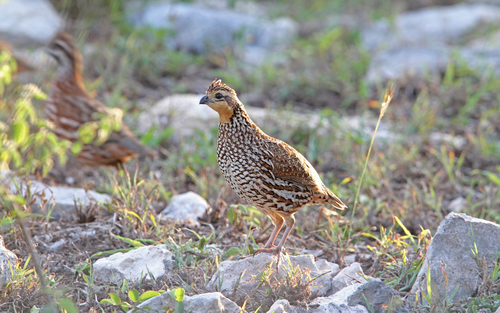
ノドグロコリン (Colinus nigrogularis) ノドグロコリン
マダラウズラ (Odontophorus guttatus) マダラウズラ

メディア

読み込み中…

要点

ノドグロコリンとマダラウズラの最も信頼できるフィールドマークは、オスのノドグロコリンの鮮明に定義された黒い喉と白い縁取りの顔に対し、マダラウズラのより拡散した黒と白の縞模様の喉とオレンジの冠です。未成熟のマダラウズラは、下部に淡い小さな斑点があり、暗い(黒ではない)喉を持っており、これが雌または幼鳥のノドグロコリンと混同されることがありますが、マダラウズラの大きなサイズ、下部の大胆な白い斑点、群れでの採餌行動は強い手がかりです。生息地も大きな分離要因です:ノドグロコリンは低地の草原や茂みのある地域を好み、マダラウズラは高地の森林種です。もし、開けた土地で黒い喉と鮮明な白い顔のマーキングを持つコンパクトなウズラを見たら、それはほぼ確実にノドグロコリンです;山の森林にいる大きなオレンジの冠を持つ白い斑点のある鳥はマダラウズラです。

識別のコツ

  1. オレンジの冠を確認する: マダラウズラだけが目立つオレンジの冠を持ち、興奮すると立ち上がります。ノドグロコリンは年齢や性別に関係なくこの特徴を示しません。
  2. 喉を見てください: 成熟したオスのノドグロコリンは、白で縁取られた鮮明な黒い喉を持っています;雌は淡い喉を持っています。マダラウズラ(両性)は白で縞模様の黒い喉を持っていますが、オスのノドグロコリンのように鮮明に縁取られることはありません。未成熟のマダラウズラは、暗い喉を持っています。
  3. 下部を調べる: マダラウズラは常にオリーブまたは赤褐色の下部に大胆な白い斑点を示します(成鳥)、または小さな淡い斑点(未成熟)。ノドグロコリンは、黒いスカロップ(オス)または赤褐色と黒で縞模様の白い下部(雌)を持ち、大きな白い斑点は決してありません。
  4. 顔の模様: オスのノドグロコリンは白い額、黒い冠、黒い目のストライプを持ち、目を引く高コントラストの顔を作ります。マダラウズラは暗い茶色の額を持ち、そのような鮮明な顔の模様が欠けています。
  5. 上面: ノドグロコリンの上面は赤褐色で白い斑点と縞模様があります;マダラウズラの上面は暗い茶色で黒と赤褐色の斑点があり、遠くから見るとより均一で模様が少なく見えます。
  6. サイズと形: マダラウズラはノドグロコリン(20 cm)よりもはるかに大きく重い(25 cm、300 g)です。フィールドでは、マダラウズラは特に群れで見たときに、より大きく見えます。孤立した鳥やサイズが判断しにくい場合には注意してください。
  7. 群れの行動: マダラウズラはほぼ常に4〜10羽の群れで行動し、一緒に移動し非常に警戒しています。ノドグロコリンはより頻繁に単独またはペアで見られます。
  8. 生息地の文脈: もし1000 m以上の高地の森林にいるなら、特に密な竹や茂みの中ではマダラウズラを期待してください。開けた低地の草原、茂み、またはマングローブではノドグロコリンを期待してください。
  9. 飛行反応: マダラウズラは通常、足で逃げますが、驚かされるとカバーに向かって短く速い飛行をすることがあります。ノドグロコリンも地上の鳥ですが、密なカバーに厳密に結びついているわけではありません。
  10. 幼鳥の混乱: 未成熟のマダラウズラは、淡い小さな斑点と暗い喉を持っており、これは雌または幼鳥のノドグロコリンに見えることがあります。しかし、マダラウズラの大きなサイズと群れの行動は良い手がかりです。
  11. 鳴き声: 明確で笛のような二重奏(‘coowit CAWwit coowit COO’)を聞いたら、それはマダラウズラです。ノドグロコリンの鳴き声はここでは説明されていないので、これはマダラウズラの確実な識別のためにのみ使用してください。
  12. 性差: 雌のノドグロコリンは下部がより淡く、淡い喉とより多くの縞模様のある下部を持っています;雌のマダラウズラはオスに似ていますが、冠が鈍いです。
  13. ほとんどの場所での範囲の重複はない: 両種はメキシコと中央アメリカに生息していますが、その生息地の好みはめったに重複しません。位置と標高を強力な支持証拠として使用してください。
  14. ノドグロコリンに大胆な白い斑点はない: 下部に大胆な白い斑点が見られる場合、それは決してノドグロコリンではありません。
  15. ノドグロコリンにオレンジの冠はない: オレンジの冠の兆候があれば、ノドグロコリンは完全に除外されます。

大きさ

ノドグロコリンは小さくてコンパクトで、約20 cmの長さです [wikipedia]。マダラウズラは25 cmで、はるかに大きく、重い(300 g)です [wikipedia]。フィールドでは、マダラウズラの体格と長い体が明らかで、特に一緒に見たり、スケールのために馴染みのある物体と一緒に見たりしたときに顕著です。ノドグロコリンの小さく、より丸みを帯びた外観は良い手がかりですが、サイズが判断しにくい孤立した鳥には注意してください。

羽色

行動

マダラウズラは通常、4〜10羽の群れで見られ、地面で一緒に採餌し、非常にシャイで、驚かされると足で逃げたり、突然の飛行で逃げたりします [wikipedia]。彼らは森林の小道で夜明けに最も目立ちます。ノドグロコリンも地上に生息していますが、単独またはペアで見られる可能性が高く、密なカバーに厳密に結びついているわけではありません。両種は種子や昆虫を掻き集めますが、マダラウズラの群れの行動と厚い山の下草に消える傾向は特徴的です。

生息環境

生息地は大きな分離要因です。ノドグロコリンは低地の生息地に見られます:乾燥した茂み、季節的に湿った草原、沿岸のマングローブ、ベリーズからニカラグアまでの劣化した開けた地域 [wikipedia]。マダラウズラは高地の森林と密な茂みに制限され、通常は南メキシコから西パナマまでの1000 m以上に生息します [wikipedia]。もし開けた低地にいるなら、ほとんどの場合マダラウズラではありません;密な山の森林では、ほとんどの場合ノドグロコリンではありません。

声

マダラウズラは明確で笛のような二重奏を出します:‘coowit CAWwit coowit COO’、接触音は明確なチュンチュンやピーピーです [wikipedia]。ノドグロコリンの鳴き声は提供されたメモには記載されていないため、声はマダラウズラの特徴的な二重奏を聞いた場合にのみ診断的です。

より良い説明を送る

比較と同じ項目を使ってください。文章はすぐに公開されます。

The most reliable field mark between Black-throated Bobwhite and Spotted Wood-Quail is the male bobwhite’s sharply defined black throat and white-edged face, versus the wood-quail’s more diffuse black-and-white streaked throat and orange crest. Immature Spotted Wood-Quail have buffy, smaller spotting below and a dusky (not black) throat, which can cause confusion with female or juvenile bobwhites, but the wood-quail’s larger size, bolder white spots on the underparts, and group foraging behavior are strong clues. Habitat is also a major separator: Black-throated Bobwhite favors lowland grasslands and shrubby areas, while Spotted Wood-Quail is a highland forest species. If you see a compact quail with a black throat and crisp white facial markings in open country, it’s almost certainly a bobwhite; a larger, orange-crested, white-spotted bird in mountain forest is a wood-quail.

  1. Check for an orange crest: Only Spotted Wood-Quail has a prominent orange crest, raised when excited. Black-throated Bobwhite never shows this feature, regardless of age or sex.
  2. Look at the throat: Adult male Black-throated Bobwhite has a sharply defined black throat bordered with white; female has a buff throat. Spotted Wood-Quail (both sexes) has a black throat streaked with white, but it is never as crisply bordered as in male bobwhite. Immature wood-quail have a dusky, not black, throat.
  3. Examine the underparts: Spotted Wood-Quail always shows bold white spots on olive or rufous underparts (adults), or smaller buffy spots (immature). Black-throated Bobwhite has white underparts with black scalloping (male) or white barred with rufous and black (female), never large white spots.
  4. Facial pattern: Male Black-throated Bobwhite has a white forehead, black crown, and black eyestripe, creating a striking, high-contrast face. Spotted Wood-Quail has a dark brown forehead and lacks such crisp facial patterning.
  5. Upperparts: Bobwhite upperparts are reddish-brown with white speckling and barring; wood-quail upperparts are dark brown with black and rufous flecking, appearing more uniform and less patterned at a distance.
  6. Size and shape: Spotted Wood-Quail is much larger and heavier (25 cm, 300 g) than Black-throated Bobwhite (20 cm). In the field, wood-quail appears bulkier, especially in groups. Use caution with lone birds or poor views.
  7. Group behavior: Wood-quail are almost always in groups of 4–10, moving together and very wary. Bobwhites are more often seen singly or in pairs.
  8. Habitat context: If you’re in highland forest above 1000 m, especially in dense bamboo or thickets, expect Spotted Wood-Quail. In open lowland grassland, shrub, or mangrove, expect Black-throated Bobwhite.
  9. Flight response: Spotted Wood-Quail typically flees on foot but may explode into a short, fast flight into cover if startled. Bobwhite is also a ground bird but is less strictly tied to dense cover.
  10. Juvenile confusion: Immature wood-quail have buffier, smaller spotting below and a dusky throat, which can look superficially like female or juvenile bobwhite. However, the wood-quail’s larger size and group behavior remain good clues.
  11. Vocalizations: If you hear a clear, whistled duet (‘coowit CAWwit coowit COO’), it’s Spotted Wood-Quail. Bobwhite’s calls are not described here, so use this only for positive wood-quail ID.
  12. Sex differences: Female bobwhite is paler below with a buff throat and more barred underparts; female wood-quail is like the male but with a duller crest.
  13. No overlap in range at most sites: While both species occur in Mexico and Central America, their habitat preferences rarely overlap. Use location and elevation as strong supporting evidence.
  14. No bold white spotting in bobwhite: If you see bold white spots on the underparts, it is never a Black-throated Bobwhite.
  15. No orange crest in bobwhite: Any hint of an orange crest rules out bobwhite completely.

Black-throated Bobwhite is smaller and more compact, about 20 cm in length [wikipedia]. Spotted Wood-Quail is noticeably larger at 25 cm and much heavier (300 g) [wikipedia]. In the field, the wood-quail’s bulk and longer body are apparent, especially when seen together or with familiar objects for scale. The bobwhite’s smaller, more rounded appearance is a good clue, but beware lone birds where size is hard to judge.

  • Juvenile/Immature: Immature Spotted Wood-Quail have smaller, buffier white spotting below and a dusky (not black) throat, lacking the adult’s bold white spots and black-and-white throat streaking [wikipedia]. Female and immature Black-throated Bobwhite show a buff throat and white underparts barred with rufous and black, but never the bold white spotting of wood-quail.
  • Adult Male: Black-throated Bobwhite males have a sharply defined black throat bordered by white, a white forehead, and a black crown and eyestripe. Their upperparts are reddish-brown with white speckling, and the underparts are scalloped white edged with black, with cinnamon lower belly [wikipedia]. Spotted Wood-Quail adults (both sexes) have a dark brown forehead, orange crest, and cheeks/throat black streaked with white. Underparts are olive or rufous, always boldly spotted with white.
  • Adult Female: Female bobwhites have a buff throat, black and paler-speckled hindneck and mantle, and white underparts barred with rufous and black. Female wood-quail look like males but with a duller crest.
  • Key Difference: Only Spotted Wood-Quail shows bold white spots on the underparts and an orange crest. Only male Black-throated Bobwhite has a sharply bordered black throat and white facial markings.

Spotted Wood-Quail is typically found in groups of 4–10, foraging together on the ground and often very shy, fleeing on foot or with a sudden burst of flight if startled [wikipedia]. They are most visible at dawn along forest tracks. Black-throated Bobwhite is also ground-dwelling but is more likely to be seen singly or in pairs, and is less strictly tied to dense cover. Both species scratch for seeds and insects, but the wood-quail’s group behavior and tendency to vanish into thick mountain undergrowth is distinctive.

Habitat is a major separator. Black-throated Bobwhite is found in lowland habitats: dry shrubland, seasonally wet grasslands, coastal mangroves, and degraded open areas from Belize to Nicaragua [wikipedia]. Spotted Wood-Quail is restricted to highland forests and dense thickets, usually above 1000 m from southern Mexico to western Panama [wikipedia]. If you’re in open lowlands, it’s almost never a wood-quail; in dense mountain forest, it’s almost never a bobwhite.

Spotted Wood-Quail gives a clear, whistled duet: ‘coowit CAWwit coowit COO’, and contact calls are clear chirps and peeps [wikipedia]. Black-throated Bobwhite’s vocalizations are not described in the provided notes, so voice is only diagnostic if you hear the wood-quail’s distinctive duet.

変更を破棄しますか?

保存していない編集があります。今離れると失われます。

ノドグロコリン · マダラウズラ · 苦手な鳥