
Black Tern vs White-winged Black Tern
Chlidonias niger versus Chlidonias leucopterus
Play a quiz with Black Tern and White-winged Black Tern
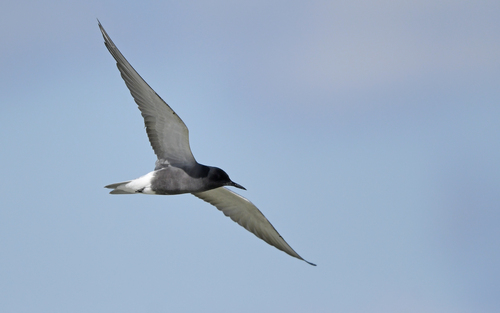 Black Tern
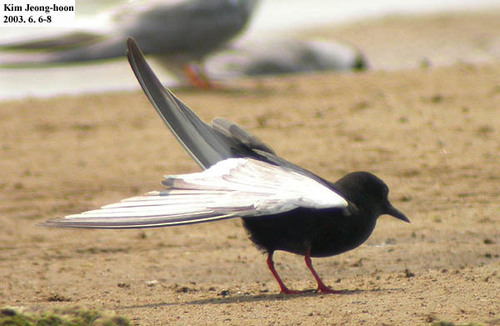 White-winged Black Tern
In short
The most reliable field mark between Black Tern and White-winged Black Tern, especially in juvenile and nonbreeding plumages, is the pattern of the upperparts and rump in flight: Black Tern juveniles and immatures show a brownish-grey rump and often have smudgy greyish-brown marks on the sides of the white breast, while White-winged Black Tern juveniles have a clear white rump and a dark brown 'saddle' across the mantle, with a pronounced white collar. Adults in breeding plumage are both mostly black below, but Black Tern has a dark grey back and less white in the wings, while White-winged Black Tern shows striking white wings contrasting with a black body and a paler grey (almost white) tail. Bill and leg color also differ: Black Tern has a longer, slender, blackish bill and dark legs, while White-winged Black Tern has a shorter, stubbier black bill and red legs. Both species are marsh terns, often found over freshwater, but their plumage differences are the most reliable way to separate them in the field.
Identification tips
- Juvenile/Immature Upperwing and Rump: In flight, look for a clear white rump and dark brown mantle 'saddle' on White-winged Black Tern juveniles, versus a brownish-grey rump and drab upperparts on Black Tern juveniles. This is the most reliable mark for young birds.
- Breast-side Markings (Juveniles): Black Tern juveniles often show smudgy greyish-brown marks on the sides of the white breast, which White-winged Black Tern lacks. If you see these smudges, it's Black Tern.
- White Collar (Juveniles): Both species can show a white collar, but it is broader and more pronounced in White-winged Black Tern, helping to isolate the dark mantle as a 'saddle.'
- Rump Color (All Ages): White-winged Black Tern always has a white rump, while Black Tern's rump is brownish-grey. This is visible in flight and is a key separator.
- Wing Pattern (Adults): In breeding plumage, White-winged Black Tern shows mostly white wings (especially outer wings), contrasting with a black body. Black Tern has a less contrasting wing, with more grey and less white.
- Tail Color: White-winged Black Tern has a light grey to almost white tail, while Black Tern's tail is light brownish-grey. Both tails look 'square,' so shape is less useful than color.
- Bill Structure: Black Tern's bill is longer, slender, and slightly decurved, nearly as long as the head. White-winged Black Tern's bill is shorter, stubbier, and distinctly shorter than the head. Bill color is blackish in both, but White-winged Black Tern's bill may appear slightly paler at the base in some lights.
- Leg Color: Black Tern has dark legs; White-winged Black Tern has short red legs, especially obvious in breeding plumage or when perched.
- Head Pattern (Nonbreeding/Immature): Both species show a dark triangular patch in front of the eye, but White-winged Black Tern in nonbreeding plumage has more white flecking on the crown and hindcrown, and a white forehead. Black Tern retains a darker cap and less white on the head.
- Face Color: White-winged Black Tern may show a yellowish tinge to the face, especially in juveniles, which Black Tern lacks.
- Underwing Pattern: White-winged Black Tern shows more black in the underwing-coverts in nonbreeding plumage; Black Tern's underwing is plainer.
- Flight Style: Black Tern's flight is more dynamic and erratic, while White-winged Black Tern is shallower and more leisurely, but this is subtle and best used as supporting evidence.
- Vocalization: Black Tern's high-pitched 'kik' may help in flocks, but voice is not a strong separator.
- Habitat/Range: If in North America, Black Tern is expected; White-winged Black Tern is rare. In Eurasia, both are possible, so rely on plumage.
- Hybrid Pitfall: Rare hybrids can show a mix of features (e.g., dark mantle with breast-side smudges); if a bird shows intermediate traits, consider hybridization but expect pure birds to fit the above patterns.
Size
Both species are very similar in size and structure, with Black Tern averaging about 60 g in body mass. Black Tern's bill is longer (about 27 mm, nearly as long as the head), slender, and slightly decurved, while White-winged Black Tern's bill is shorter (22–25 mm), stubbier, and decidedly shorter than the head. Overall, size is not a reliable field mark for separation.
Plumage
- Juvenile/First-winter/Immature:
- Black Tern: Shows a brownish-grey rump, drab upperparts with pale feather edgings, and smudgy greyish-brown marks on the sides of the white breast. The tail is light brownish-grey and looks 'square.' Juveniles have a broadish white collar and a dark triangular patch in front of the eye. The upperwing is generally uniform, lacking strong contrast.
- White-winged Black Tern: Juveniles have a clear white rump and a dark brown 'saddle' (mantle) sharply set off by a white collar and white rump. The mantle, tertials, and scapulars have narrow pale brown tips. The tail is light grey (almost white) and also appears 'square.' The face is tinged yellowish, and the dark triangular patch in front of the eye is present. The upperwing shows more contrast due to the white in the wings and rump.
- Adult Breeding Plumage:
- Black Tern: Black head, neck, and belly; dark grey back; white forewing; black or blackish-brown cap forming an almost complete hood; brownish-grey rump; light brownish-grey tail. The face is white with a large dark triangular patch in front of the eye.
- White-winged Black Tern: Black neck and belly; very dark grey back; white rump; light grey (almost white) tail; mainly white wings with the inner wing grayish and brown-tipped coverts. The head is black with a white forehead and flecked crown, and the face may be tinged yellowish.
- Nonbreeding/Adult Winter:
- Both species lose most of the black on the body, replaced by grey or white, but Black Tern retains a darker rump and less contrast in the upperwing, while White-winged Black Tern keeps a white rump and more white in the wings. White-winged Black Tern shows more white flecking on the crown and hindcrown.
Behaviour
Both species forage by flying over water and picking prey from the surface or catching insects in flight, rather than plunge-diving like Sterna terns. Black Tern's flight is described as slim, full, and dynamic, often erratic as it dives for food. White-winged Black Tern's flight is more shallow and leisurely. Both species are agile and buoyant in the air, but flight style differences are subtle and not always reliable for separation.
Habitat
Both Black Tern and White-winged Black Tern are marsh terns, typically found in or near freshwater wetlands, lakes, and marshes during the breeding season. Black Tern breeds in Europe, Western Asia, and North America, wintering on African and South American coasts. White-winged Black Tern has a broader Old World distribution, breeding across Europe, Africa, Asia, and even Australia. Habitat overlap is possible in Eurasia, but context alone is rarely diagnostic.
Voice
Black Tern gives a high-pitched 'kik' call, and large flocks can be quite noisy. No distinctive vocal differences are noted for White-winged Black Tern in the provided sources, so voice is not a reliable separator in the field.