

Black-tailed Gull vs Lewis's Woodpecker
Larus crassirostris versus Melanerpes lewis
Play a quiz with Black-tailed Gull and Lewis's Woodpecker
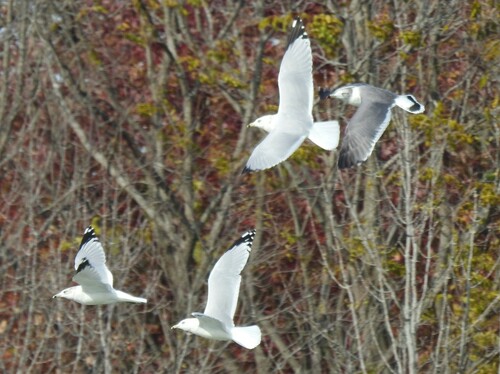 Black-tailed Gull
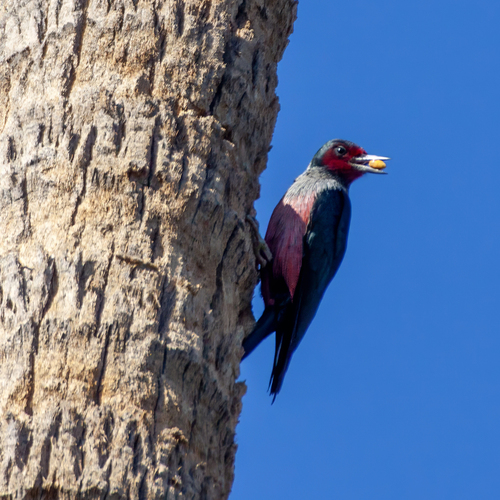 Lewis's Woodpecker
In short
The most reliable way to separate Black-tailed Gull from Lewis's Woodpecker is by overall structure and flight style: Black-tailed Gull is a large, long-winged seabird with a black tail and yellow legs, while Lewis's Woodpecker is a chunky, broad-winged woodpecker with a dark greenish-black back, red face, and pinkish belly. In flight, Black-tailed Gull shows typical gull proportions and flight, whereas Lewis's Woodpecker flies with slow, crow-like wingbeats and often perches upright on exposed branches. Even immature gulls never show the woodpecker's unique color combination or flight style. If you see a bird with a red face and pink belly, it's Lewis's Woodpecker; if you see a large, pale gull with a black tail and yellow legs, it's Black-tailed Gull.
Identification tips
- Flight style: Black-tailed Gull soars and glides with long, narrow wings typical of gulls; Lewis's Woodpecker flies with slow, steady, crow-like wingbeats and broad wings. If the flight reminds you of a crow, it's the woodpecker.
- Tail color: Adult Black-tailed Gull has a black tail, visible both perched and in flight; Lewis's Woodpecker has a black rump but not a distinctly black tail tip.
- Leg color: Black-tailed Gull has yellow legs as an adult; Lewis's Woodpecker's legs are dark and not easily seen, but never yellow.
- Bill: The gull has a thick, yellow bill with a red and black spot at the tip; the woodpecker has a straight, chisel-like bill, dark in color, never with colored spots.
- Plumage color: Lewis's Woodpecker is unmistakable with its dark greenish-black back and wings, red face, gray collar, and pinkish belly. Black-tailed Gull is pale gray and white with no red or pink on the face or belly.
- Size: Black-tailed Gull is much larger and bulkier than Lewis's Woodpecker. If the bird looks crow-sized or smaller, it's not the gull.
- Perching behavior: Lewis's Woodpecker often perches upright on exposed branches or snags; Black-tailed Gull rarely perches on trees and is usually seen standing on the ground, rocks, or floating on water.
- Habitat: If you are on a seashore, harbor, or island, expect Black-tailed Gull; if you are in open pine woodland or scattered trees inland, expect Lewis's Woodpecker.
- Voice: Listen for the cat-like 'mew' of the gull versus the harsh, woodpecker-like calls of Lewis's Woodpecker.
- Wing shape: In flight, the gull's wings are long and narrow; the woodpecker's are broad and rounded.
- Group size: Black-tailed Gull is often found in large, noisy flocks; Lewis's Woodpecker is usually solitary or in small groups.
- Feeding behavior: The gull often follows boats and scavenges; the woodpecker catches insects in the air and stores nuts in trees.
- Facial pattern: Only Lewis's Woodpecker has a red face and gray collar; the gull's face is plain and pale.
- Age confusion: Even immature Black-tailed Gulls never show the woodpecker's color pattern or structure; no age or season produces a close match.
- Context: If you see a bird with a red face and pink belly in a tree, it's Lewis's Woodpecker. If you see a large, pale gull with a black tail and yellow legs on a shoreline, it's Black-tailed Gull.
Size
Black-tailed Gull is much larger and heavier than Lewis's Woodpecker. The gull averages about 556.5 g in mass and 46 cm (18.1 in) in length, with a wingspan of 126–128 cm (49.6–50.4 in). In contrast, Lewis's Woodpecker is only 88–139 g, 26–28 cm (10.2–11 in) long, and has a wingspan of 49–52 cm (19.3–20.5 in). Even at a distance, the gull's size and long wings are obvious compared to the woodpecker's more compact, broad-winged look.
Plumage
There is no overlap in plumage between these two species at any age. Black-tailed Gull, even as a juvenile, is a typical pale gull with a black tail and yellow legs in adulthood; it takes four years to reach full adult plumage, but never acquires the dark greenish-black, red, and pink colors of Lewis's Woodpecker. Lewis's Woodpecker of all ages shows a unique combination of a dark greenish-black back and wings, a red face, gray collar, and pinkish belly, which is never matched by any gull. In flight, the woodpecker's wings are broad and dark, while the gull's are long, narrow, and pale with black tail. No age or season produces confusion in wing pattern or coloration.
Behaviour
Black-tailed Gull is a colonial, highly social seabird often seen soaring, gliding, or following ships and fishing fleets, and is rarely found perched upright on trees. It often gathers in large flocks and is comfortable around water. Lewis's Woodpecker, by contrast, is a solitary or loosely gregarious woodpecker that perches upright on exposed branches or snags, often sallying out to catch insects in the air. Its flight is slow and crow-like, with broad, rounded wings, and it rarely if ever lands on the ground or water.
Habitat
Black-tailed Gull is strictly coastal or found near large bodies of water in East Asia, often seen along shorelines, islands, and harbors. Lewis's Woodpecker is a bird of open pine woodlands and scattered trees in western North America, rarely if ever near water or in coastal settings. If you are inland in open woodland, you are far more likely to see Lewis's Woodpecker; if you are on a seashore or island, expect Black-tailed Gull.
Voice
Black-tailed Gull has a distinctive cat-like 'mew' call, which is unique among gulls and gives rise to its Japanese and Korean names. Lewis's Woodpecker has a harsh, varied call, but nothing resembling the gull's mewing sound. If you hear a mewing, cat-like call, it's the gull; if you hear a harsh, woodpecker-like chatter, it's Lewis's Woodpecker.