

Black Storm-Petrel vs Tristram's Storm-Petrel
Hydrobates melania versus Hydrobates tristrami
Play a quiz with Black Storm-Petrel and Tristram's Storm-Petrel
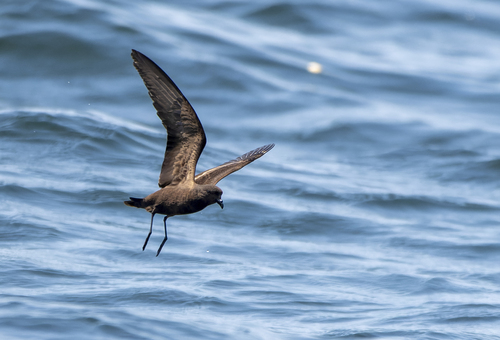 Black Storm-Petrel
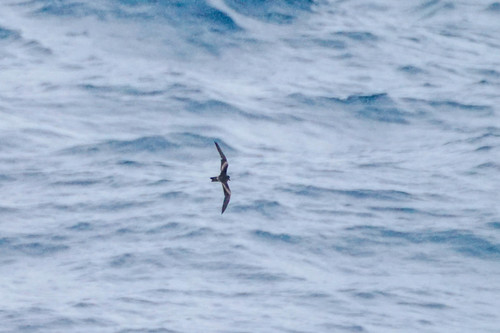 Tristram's Storm-Petrel
In short
The most reliable field mark to separate Black Storm-Petrel from Tristram's Storm-Petrel is size and wing structure: Tristram's is noticeably larger, with longer, more angular wings and a stouter bill. In flight, Tristram's often shows a slightly pale rump and a pale grey bar on the upperwing, while Black Storm-Petrel is uniformly dark. Both are all-dark storm-petrels, but Tristram's unique wing pattern and bulkier build are key. If you see a storm-petrel with a pale upperwing bar and a hint of a pale rump, especially if it looks big and long-winged, it's Tristram's; a smaller, more uniformly dark bird is Black.
Identification tips
- Pale upperwing bar (Tristram's only): Look for a pale grey bar across the upperwing in flight; Tristram's Storm-Petrel shows this at all ages, while Black Storm-Petrel never does.
- Pale rump (Tristram's only): Tristram's has a slightly paler rump, sometimes subtle, but Black is uniformly dark.
- Overall size: Tristram's is much larger and bulkier than Black; if you have a sense of scale, this is a strong clue.
- Wing shape: Tristram's wings are longer and more angular, giving a more gliding, less fluttery flight compared to Black's shorter, more rounded wings and quicker wingbeats.
- Bill structure: Tristram's has a stouter bill, but this is rarely diagnostic at sea unless seen very well.
- Uniform darkness (Black only): Black Storm-Petrel is all dark brownish-black above and below, lacking any pale on the rump or wings.
- Flight style: Tristram's glides more and appears more languid, while Black is more fluttery and agile.
- Geographic context: If seen in the northwestern Pacific or near the Hawaiian Islands, Tristram's is more likely; Black is more expected in the eastern Pacific.
- No strong seasonal or sex differences: Both species are similar across seasons and sexes in the field marks described.
- Juvenile/immature confusion: The pale upperwing bar and paler rump of Tristram's are present in all ages, so immatures are still separable from Black Storm-Petrel.
- No voice cues: Vocalizations are not described as useful for separation at sea.
- Colony attendance: Tristram's is strictly nocturnal at colonies, but this is not a field mark at sea.
- Beware lighting: In poor light, Tristram's pale wing bar and rump may be hard to see, so rely on size and structure as backup.
- No white rump: Neither species has a bright white rump, so don't confuse them with Leach's or other white-rumped storm-petrels.
- Direct comparison: If both species are present, Tristram's will stand out as the larger, longer-winged, paler-winged bird.
Size
Tristram's Storm-Petrel is significantly larger in every dimension: length (24.5–27 cm vs 23 cm), wingspan (54–57 cm vs 46–51 cm), and especially body mass (average 84 g vs 61.5 g). In the field, Tristram's looks bulkier and more elongated, with longer, more angular wings, while Black Storm-Petrel is more compact and lighter. This size difference is often apparent when seen together or with other storm-petrels for scale.
Plumage
Tristram's Storm-Petrel of all ages shows a mostly dark plumage but is distinctive for its slightly pale rump and a pale grey bar across the upperwing, especially visible in flight. This pale wing bar is a crucial mark and is not present in Black Storm-Petrel at any age. Black Storm-Petrel is uniformly dark brownish-black above and below, lacking any pale wing bar or rump. Both species are all-dark overall, but only Tristram's has the pale upperwing bar and paler rump. These marks are visible in both juvenile and adult Tristram's, and are best seen in good light or when the bird banks. Bill color and leg color are not described as useful in these notes.
Behaviour
Tristram's Storm-Petrel tends to appear more languid and gliding in flight, using its long, angular wings to cover more distance with fewer wingbeats. Black Storm-Petrel, being smaller and lighter, shows a quicker, more fluttery flight style. Both species are pelagic and rarely seen on land except at colonies. Tristram's is colonial and nocturnal at breeding sites, but these behaviors are not easily observed at sea.
Habitat
Both species are pelagic storm-petrels, but Tristram's is largely restricted to the north Pacific, especially tropical seas, and breeds on islands in the Northwest Hawaiian Islands and south of Japan. Black Storm-Petrel is found in the eastern Pacific. In areas of overlap, habitat is not a strong separator at sea, but Tristram's is more likely near its breeding islands in the northwestern Pacific.
Black Storm-Petrel · Tristram's Storm-Petrel · My Tricky Birds