

Black Robin vs North Island Robin
Petroica traversi versus Petroica longipes
Play a quiz with Black Robin and North Island Robin
 Black Robin
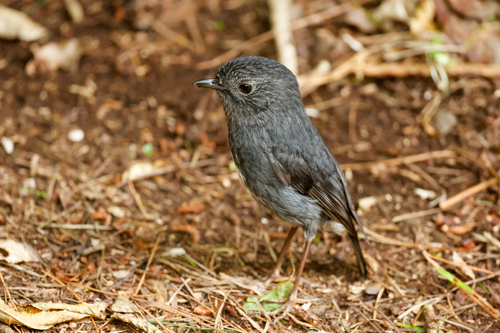 North Island Robin
In short
The most reliable field mark for separating Black Robin from North Island Robin is the extent and contrast of pale underparts: North Island Robin shows a distinct pale belly and breast patch (though smaller than its South Island relative), while Black Robin is overall much darker with little to no pale below. Both species are dark, dumpy robins, but North Island Robin often shows pale streaking on the upperparts and sometimes flashes a hidden white patch at the base of the bill. Males are darker than females in North Island Robin, adding some variability. In the field, look for the pale belly and subtle pale streaking to pick out North Island Robin; a uniformly dark bird with little contrast below is likely a Black Robin.
Identification tips
- Pale belly and breast patch: North Island Robin shows a distinct pale area on the belly and breast, though smaller than in South Island Robin. Black Robin is much more uniformly dark below. This is the single most useful field mark in all ages and sexes.
- Pale streaking on upperparts: North Island Robin often has fine pale streaks on the upperparts, especially visible in good light. Black Robin lacks this streaking and appears more uniformly dark.
- Hidden white feather patch at bill base: North Island Robin can flash a concealed white patch at the base of the bill during interactions. If you see this behavior, it points to North Island Robin; Black Robin does not show this feature.
- Sexual dimorphism in North Island Robin: Males are darker than females, so some North Island Robins may appear quite dark, but still usually show the pale belly patch. Black Robin does not show this sex-based variation.
- Uniform darkness in Black Robin: If the bird appears entirely dark, almost sooty, with no obvious pale below or streaking above, Black Robin is much more likely.
- No distinctive age-specific wing pattern: Neither species is described as having strong juvenile or immature upperwing or flight marks, so focus on underpart and upperpart coloration.
- Structure and posture: Both are round-bodied, upright robins with similar proportions; structure alone is not a reliable separator.
- Habitat and range: Any robin seen on the North Island mainland is a North Island Robin. Black Robin is only found on a few small Chatham Islands; location can be definitive.
- Behavioral clues: North Island Robin may flash the white bill-base patch in social situations, but otherwise, both species behave similarly.
- Pitfalls with dark North Island Robins: Some male North Island Robins can appear quite dark, especially in poor light, but usually retain the pale belly patch. Always check for this contrast before assuming Black Robin.
- No strong seasonal or age-based confusion: Available notes do not describe major seasonal or immature plumage changes that would cause confusion between these two species.
- Contextual clues: If you are in a managed sanctuary or offshore island, check signage and species lists—Black Robin is extremely range-restricted and unlikely to be encountered outside its known sites.
- Vocalizations: No diagnostic vocal differences are provided in the notes, so do not rely on song or call for separation.
- Direct comparison: If you have the rare opportunity to see both together (e.g., in a conservation context), the Black Robin will always appear darker and more uniform, lacking the pale belly and streaking of North Island Robin.
Size
Both species are similar in overall structure, being small, round-bodied robins with relatively short tails and upright postures. North Island Robin males are slightly larger than females, but the size difference between the two species is not strongly diagnostic in the field. Without direct side-by-side comparison, size is not a reliable separator.
Plumage
For all ages, North Island Robin is dark grey-black above with a noticeably paler area on the belly and breast, though this pale patch is smaller than in South Island Robin. There is also pale streaking on the upperparts, which can be subtle but is often visible at close range or in good light. At the base of the bill, North Island Robin has a concealed white feather patch that may be flashed in social interactions. Males are darker overall than females. In contrast, Black Robin is much more uniformly dark, with little to no pale on the underparts and lacking the pale streaking above. No distinctive age-specific upperwing or flight marks are described for either species, so perched views and underpart contrast are most useful. Juvenile or immature-specific plumage differences are not detailed in the available notes.
Behaviour
Both species are typical Petroica robins, often seen hopping on the ground or low perches, and both can appear confiding. North Island Robin may occasionally flash its white feather patch at the bill base during interactions, a behavior not described for Black Robin. Otherwise, their movements and foraging style are similar and not reliably separable in the field.
Habitat
North Island Robin is endemic to the North Island of New Zealand and is found in native forests and sometimes regenerating bush. Black Robin is restricted to a few small islands in the Chatham Islands group and is not found on the New Zealand mainland. Thus, location is a strong context clue: any robin seen on the North Island mainland is a North Island Robin, while Black Robin is only found in its tiny offshore range.