
Black Noddy vs Sooty Tern
Anous minutus versus Onychoprion fuscatus
Play a quiz with Black Noddy and Sooty Tern
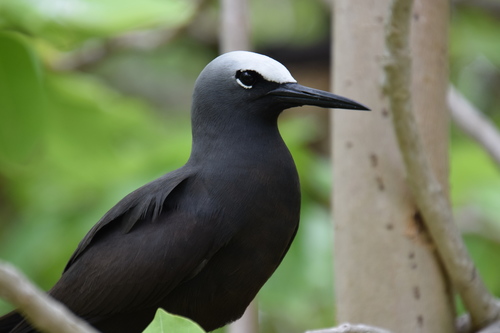 Black Noddy
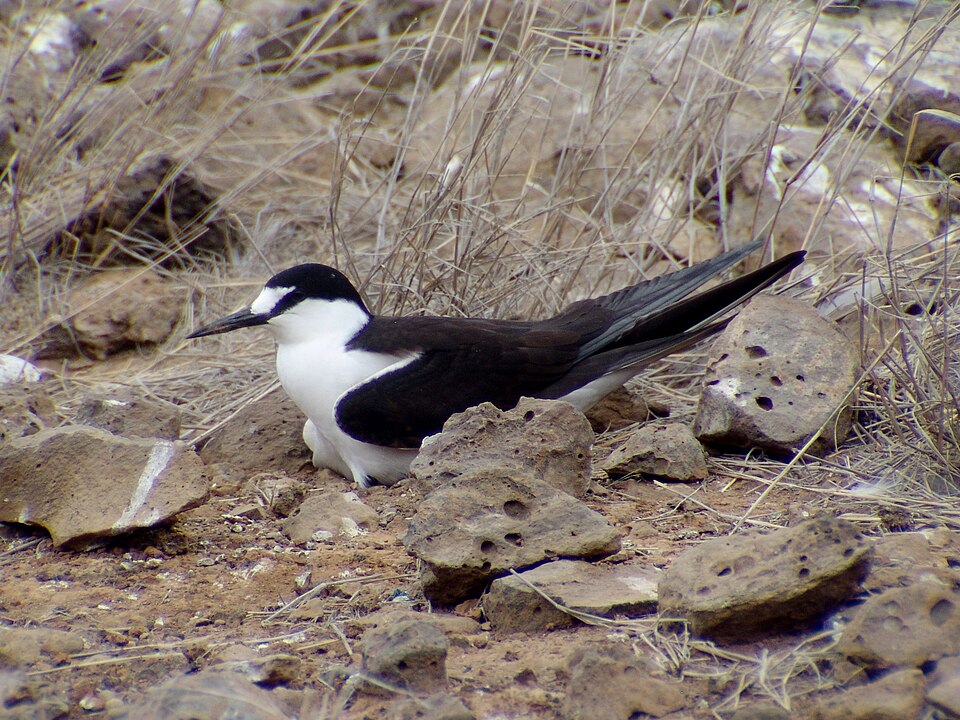 Sooty Tern
In short
The most reliable field mark to separate Black Noddy from Sooty Tern is the head pattern: Black Noddy shows a striking white cap and dark lores, while Sooty Tern has a white forehead but black lores and crown. In flight, Sooty Tern is larger, with longer wings and a deeply forked tail, and shows a sharp contrast between blackish upperparts and white underparts. Juvenile Sooty Terns are scaly above and much duskier below than any Black Noddy. Both species are black-and-white tropical terns, but structure, head pattern, and underpart color are key. Watch for the Black Noddy’s all-dark body with a pale cap, versus the Sooty Tern’s white belly and forehead.
Identification tips
- Head pattern is key: Black Noddy has a sharply defined white cap extending from the bill over the crown, with dark lores; Sooty Tern has a white forehead only, with black crown and lores. This is the most reliable mark at all ages.
- Lores color: Black Noddy’s lores are dark, blending into the face; Sooty Tern’s lores are also black, but the white of the forehead is more restricted and does not extend over the crown.
- Underparts: Black Noddy is dark below, matching the upperparts; Sooty Tern has white underparts, sharply contrasting with dark upperparts. This is obvious in flight and at rest for adults.
- Tail shape: Sooty Tern has a moderately deep fork in the tail, more pronounced than Black Noddy’s squared-off or only slightly notched tail. This is visible in flight or when perched with tail spread.
- Wing shape and flight: Sooty Tern has longer, more angular wings and a more powerful, direct flight; Black Noddy’s wings are shorter and more tapered, with a more buoyant, less forceful flight style.
- Juvenile plumage: Juvenile Sooty Tern is scaly above (pale fringes on dark feathers) and much duskier below, with only the lower belly whitish; Black Noddy juveniles do not show this scaly pattern or such extensive dark underparts.
- Bill and legs: Both have black bills and legs, but Black Noddy may show orange feet in some subspecies (usually not visible in the field). Bill shape is similar: long and pointed.
- Perched posture: Black Noddy often perches on branches, rocks, or even human structures near colonies; Sooty Tern is more likely to be seen on open ground or sand.
- Size: Sooty Tern is larger and bulkier, with a longer wingspan and heavier build. In mixed flocks or colonies, this is apparent.
- Vocalizations: Sooty Tern is noisy, with loud, repeated calls; Black Noddy is much quieter. If you hear a raucous 'wide-a-wake' or 'ker-wack-a-wack', it is Sooty Tern.
- Habitat context: Sooty Tern is almost always over open ocean or breeding on remote islands; Black Noddy may be seen closer to shore or in sheltered bays.
- Context of sighting: If seen inland, especially after storms, Sooty Tern is more likely, as Black Noddy is less prone to being storm-driven far from the coast.
- Tail edge: Sooty Tern’s tail has white outer edges, sometimes visible in flight; Black Noddy’s tail is all dark.
- White facial marks: Black Noddy has a small white crescent under each eye and a white spot above the eye, in addition to the cap; Sooty Tern lacks these facial spots.
- Confusion risk: In poor light or distant views, both may appear 'black-and-white', but focus on the extent and shape of white on the head and the color of the underparts for the best chance of correct identification.
Size
Sooty Tern is noticeably larger, measuring 36–45 cm in length with an 82–94 cm wingspan, compared to Black Noddy’s 35–37 cm length and 66–72 cm wingspan [wikipedia]. Sooty Tern is bulkier and longer-winged, and this difference is apparent in direct comparison or mixed colonies. Black Noddy is lighter (98–144 g) than Sooty Tern, which is heavier but exact mass is not provided. In the field, Sooty Tern’s longer, more angular wings and deeper forked tail further emphasize its size advantage.
Plumage
- Juveniles/immatures: Juvenile Sooty Tern is distinctive, being grey-black above and below with narrow pale fringes above (scaly look) and only the lower belly whitish; this is much duskier and more patterned than any Black Noddy, which does not show scaly upperparts or such extensive dark below [wikipedia].
- Adults: Black Noddy is all dark except for a sharply demarcated white cap (crown) and small white marks around the eye; the lores (between bill and eye) are dark, blending into the face. Sooty Tern has a white forehead but black crown and lores, so the white does not extend over the crown as in Black Noddy. Sooty Tern’s upperparts are black to blackish-brown, with white underparts and a white-edged, moderately forked tail. Black Noddy’s underparts are dark like the upperparts, lacking the Sooty Tern’s white belly and flanks. The bill and legs are black in both, but Black Noddy may show orange feet in some subspecies (not usually relevant in the field).
Behaviour
Both are highly pelagic terns, but Sooty Tern is especially oceanic, often remaining at sea for years and rarely coming to land except to breed. Black Noddy is also marine but may be seen roosting on cliffs or trees near colonies. In flight, Sooty Tern is more powerful and direct, with longer, more angular wings and a deeper forked tail, often flying higher and faster. Black Noddy appears more buoyant and less forceful, with shorter, more tapered wings and a less forked, more squared-off tail. Perched, Black Noddy often sits on branches or rocks, while Sooty Tern is more likely to be seen on open ground.
Habitat
Both species breed on tropical islands, but Sooty Tern is much more strictly pelagic, rarely seen inland except after storms. Black Noddy is also marine but may be found closer to shorelines, in trees, or on cliffs near breeding sites. Sooty Tern is almost always seen over open ocean or on remote islands, while Black Noddy can sometimes be found in more sheltered coastal areas. If seen inland, Sooty Tern is usually storm-driven.
Voice
Sooty Tern is very vocal, with a loud, piercing 'wide-a-wake' or 'ker-wack-a-wack' call, and a harsh alarm 'kvaark' [wikipedia]. Black Noddy is much quieter and less likely to be heard calling at sea or in flight. If you hear a raucous, repeated call, Sooty Tern is much more likely.