

Black Heron vs White-backed Night Heron
Egretta ardesiaca versus Calherodius leuconotus
Play a quiz with Black Heron and White-backed Night Heron
 Black Heron
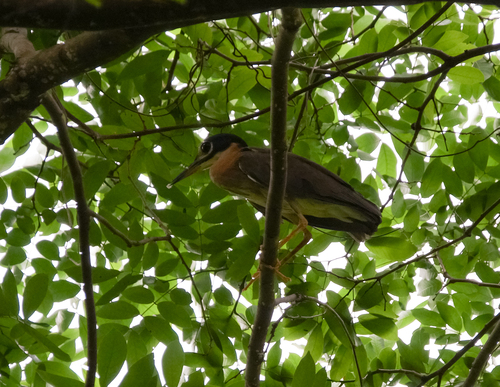 White-backed Night Heron
In short
The most reliable field mark to separate Black Heron from White-backed Night Heron is overall plumage: Black Heron is uniformly black with yellow feet, while White-backed Night Heron shows a striking white triangular patch on the back and a rufous neck and breast. Immature White-backed Night Herons have streaked breasts and white spots on the upperwing coverts, which Black Heron never shows at any age. In flight or at rest, Black Heron’s black plumage and unique canopy-feeding posture are distinctive, while White-backed Night Heron is bulkier, with a short crest and large red eyes. Both species are medium-sized African herons, but their structure, behavior, and plumage details make confusion avoidable with careful observation.
Identification tips
- Juvenile/immature separation: Immature White-backed Night Herons show a streaked breast and white spots on the upperwing coverts; Black Heron immatures are uniformly black with no streaks or spots. This is the most reliable mark for young birds.
- Overall plumage: Black Heron is entirely black, including the bill, with yellow feet. White-backed Night Heron has a black head with a short crest, rufous neck and breast, white throat, and a prominent white triangular patch on the back. These contrasts are obvious in good light.
- Back pattern: The white triangular patch on the back (from the scapulars) is unique to White-backed Night Heron and visible in both perched and flying birds. Black Heron never shows any white on the back.
- Head and face: White-backed Night Heron has large red eyes with white rings and pale yellow lores, plus a short crest or prominent feather display on the crown. Black Heron has a plain black head and bill, lacking any crest or facial color contrast.
- Leg and foot color: Black Heron has yellow feet (often visible when wading or in flight), while White-backed Night Heron has yellow legs but less emphasis on the feet. This is a supporting mark, not primary.
- Bill color: Black Heron’s bill is black; White-backed Night Heron’s bill color is not specified but is not described as black, so look for a contrast with the head.
- Behavior: Black Heron’s canopy feeding (wings held umbrella-like over the head) is unique and diagnostic. If you see this behavior, it is never White-backed Night Heron.
- Activity period: Black Heron is active by day, especially at sunset, while White-backed Night Heron is more crepuscular or nocturnal. Daytime sightings in open water favor Black Heron.
- Habitat context: Black Heron is more likely in open, shallow water or at the edges of lakes and ponds; White-backed Night Heron prefers more secluded wetlands and is less likely in open water during the day.
- Structure: Black Heron is more slender and elegant in posture, while White-backed Night Heron is bulkier with a shorter neck and a more hunched appearance typical of night herons.
- Crest: Only White-backed Night Heron shows a short crest or prominent crown feathers; Black Heron’s head is smooth except for breeding plumes (which are long and fine, not a crest).
- Breeding plumes: In breeding season, Black Heron shows long plumes on the crown and nape, but the rest of the plumage remains black. White-backed Night Heron’s breeding changes are not specified, but the white back patch is always present.
- Chick plumage: Only relevant if you see downy chicks; White-backed Night Heron chicks are olive-brown, while Black Heron chicks are not described but would not show the olive-brown down.
- Group size: Black Heron can be seen in large feeding flocks (up to 200), while White-backed Night Heron is more solitary or in small groups.
- Flight silhouette: While not explicitly described, Black Heron’s all-black wings and body will look very dark in flight, while White-backed Night Heron may show contrast with the white back patch and paler underparts if seen well.
Size
Black Heron is typically 42.5–66 cm in height, while White-backed Night Heron is 50–55 cm in length. This makes the White-backed Night Heron slightly longer on average, but there is overlap in size and both are considered medium-sized herons. Weight is only given for Black Heron (0.27–0.39 kg), but the difference is not likely to be obvious in the field. Structural differences, such as the Black Heron's more slender build and the White-backed Night Heron's bulkier appearance, are more useful than size alone for separation.
Plumage
Juvenile and immature birds are most easily separated by upperwing and breast pattern: Immature White-backed Night Herons have a streaked breast and white spots on the upperwing coverts, while Black Heron immatures are uniformly black without any streaking or spotting. Adults are also easily separated: Black Heron is entirely black, including the bill, with yellow feet and, in breeding plumage, long plumes on the crown and nape. White-backed Night Heron adults have a black head with a short crest, large red eyes with white rings, pale yellow lores, a white throat, rufous neck and breast, a prominent white triangular patch on the back (from the scapulars), and whitish-brown belly feathers. The legs are yellow. The white back patch is diagnostic for all ages except chicks. Chicks of White-backed Night Heron are olive-brown downy, but this is rarely seen in the field.
Behaviour
Black Heron is famous for its unique canopy feeding technique, where it uses its wings like an umbrella to shade the water and attract fish. This behavior is highly distinctive and not shown by White-backed Night Heron. Black Heron often feeds solitarily or in groups, sometimes in large flocks, and is active by day, especially around sunset. White-backed Night Heron, as its name suggests, is more crepuscular or nocturnal in habits, and is less likely to be seen actively feeding in the open during the day. Black Heron roosts communally at night, while White-backed Night Heron’s roosting behavior is less described but is typical of night herons (often solitary or in small groups).
Habitat
Both species occur in sub-Saharan Africa and can overlap in range, but Black Heron is more often found in shallow open waters, such as lake and pond edges, marshes, river edges, rice fields, and flooded grasslands. It is also found in coastal tidal flats and alkaline lakes. White-backed Night Heron shares some of these habitats but is generally less likely to be seen in open areas during the day, preferring more secluded or overgrown wetlands and being more active at dusk or night. Context of observation (open water by day vs. secluded wetland at dusk/night) can help support identification.