

Black-headed Gull vs Audouin's Gull
Chroicocephalus ridibundus versus Ichthyaetus audouinii
Play a quiz with Black-headed Gull and Audouin's Gull
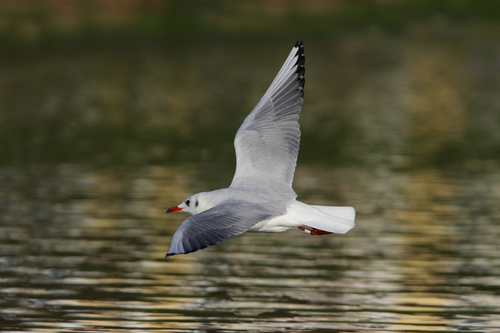 Black-headed Gull
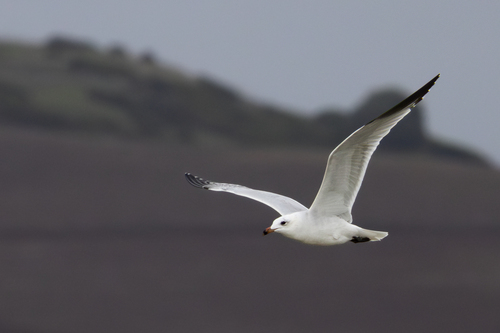 Audouin's Gull
In short
The most reliable field mark between Black-headed Gull and Audouin's Gull is the upperwing pattern in flight: Black-headed Gull (especially immatures and non-breeding adults) shows a prominent white leading edge to the outer wing and, in juveniles, a brown carpal bar and black tail band, while Audouin's Gull lacks these and instead has a more uniform grey upperwing with a 'string of pearls' pattern at the wingtip in adults. Structurally, Audouin's Gull is much larger, with a heavier build and a distinctive short, stubby red bill, compared to the more delicate, smaller Black-headed Gull with a finer red bill. In breeding plumage, Black-headed Gull has a chocolate-brown hood, while Audouin's Gull's head remains white. Habitat and behavior can also help: Black-headed Gull is common inland and in a wide range of habitats, while Audouin's is a rare, strictly coastal Mediterranean specialist.
Identification tips
- Upperwing pattern in flight (all ages): Black-headed Gull shows a prominent white leading edge to the outer wing (outer primaries), especially visible in flight. Audouin's Gull lacks this, instead showing a more uniform grey upperwing with small white spots ('string of pearls') at the wingtip in adults.
- Juvenile/first-winter tail and wing: Juvenile Black-headed Gulls have a strong black tail band and a brown carpal bar on the inner wing, both of which are retained into first-winter. Audouin's Gull juveniles do not show these features, instead having a more uniform appearance.
- Head pattern (breeding season): Adult Black-headed Gull has a chocolate-brown hood in summer (March–July), while Audouin's Gull always has a white head, never developing a hood.
- Head pattern (non-breeding): In winter, Black-headed Gull loses the hood, showing only two small dark spots behind the eye. Audouin's Gull remains white-headed year-round.
- Bill color and shape: Audouin's Gull has a short, stubby red bill, noticeably different from the finer, longer red bill of Black-headed Gull. This is a reliable mark at close range.
- Leg color: Audouin's Gull has grey-green legs, while Black-headed Gull has red legs (especially bright in breeding plumage).
- Size and structure: Audouin's Gull is much larger and bulkier, with longer wings and a heavier build. Black-headed Gull is noticeably smaller and more delicate, with a shorter neck and smaller head.
- Wingtip pattern (adult): Audouin's Gull adults have a 'string of pearls'—a row of small white spots—at the wingtip, rather than the large white mirrors seen in some other large gulls. Black-headed Gull has black wingtips with a white leading edge but lacks the 'pearls.'
- Tail pattern: Black-headed Gull juveniles and first-winters have a black tail band; adults have an all-white tail. Audouin's Gull tail pattern is not detailed here, but does not show a strong black band in any age.
- Habitat context: Black-headed Gull is common in a wide range of habitats, including inland waters and urban areas. Audouin's Gull is strictly coastal and Mediterranean—finding a gull inland or away from the Mediterranean almost always rules out Audouin's.
- Behavior: Black-headed Gull is often seen in large, noisy flocks, feeding opportunistically and scavenging. Audouin's Gull is more solitary or in small groups, specializing in fish and often feeding at night at sea.
- Seasonality: Black-headed Gull is present year-round in much of its range, with large winter influxes in milder areas. Audouin's Gull is much rarer and less likely to wander far from its breeding areas.
- Plumage variability: Black-headed Gull shows considerable variation in the extent of the brown hood in first-summer birds—some may show almost no hood, which can cause confusion with white-headed gulls like Audouin's, but other features (size, bill, wing pattern) will still separate them.
- Sexes: Both species show no significant plumage difference between sexes—do not rely on sex for identification.
- Pitfalls: Beware of distant views where the Black-headed Gull's hood can look black, or where size is hard to judge. Always use a combination of wing pattern, bill structure, and habitat for the most reliable ID.
Size
Audouin's Gull is significantly larger and heavier than Black-headed Gull. Black-headed Gull averages about 280.5 g [wikidata], and is a small gull overall. Audouin's Gull is described as a large gull, closer in size to European Herring Gull, and appears bulkier and longer-winged in the field. This size difference is usually obvious when the two are seen together, but can be harder to judge at a distance or without direct comparison.
Plumage
- Juvenile/First-winter: Black-headed Gull juveniles show a mottled brown pattern over the body, a distinct black tail band, and a brown carpal bar on the inner wing, which is retained into first-winter. Audouin's Gull juveniles are not described in detail here, but lack the strong carpal bar and tail band, instead showing a more uniform grey-brown upperwing and back.
- First-summer/Second-winter: Black-headed Gull in first summer may show a partial brown hood and some retained brown in the wings and tail. Audouin's Gull takes four years to reach adult plumage, so immatures may show some brown tones but do not acquire a hood.
- Adult breeding: Black-headed Gull has a chocolate-brown (not black) hood, white underparts, pale grey upperparts, and black wingtips with a white leading edge. Audouin's Gull has a white head, pale grey upperparts, and a distinctive 'string of pearls' (small white spots) at the wingtip, with a short red bill and grey-green legs.
- Adult non-breeding: Black-headed Gull loses the hood, retaining only two dark spots behind the eye, while Audouin's Gull remains white-headed year-round.
Behaviour
Black-headed Gull is highly gregarious, often forming large flocks both when feeding and roosting, and is not strictly coastal—commonly found inland, in fields, lakes, and urban areas. Audouin's Gull is much less gregarious, usually found in smaller groups or alone, and is strictly coastal and pelagic, rarely seen far from the sea. Audouin's is a specialist fish eater, often feeding at night out at sea or patrolling close to beaches, sometimes dangling its legs to slow down. Black-headed Gull is more opportunistic, feeding on a wide range of food and often seen scavenging.
Habitat
Black-headed Gull is widespread and abundant across much of Europe and Asia, breeding in colonies in reedbeds, marshes, and on islands in lakes, and is common in a variety of inland and coastal habitats, including urban areas. Audouin's Gull is rare and highly localized, restricted to the Mediterranean, western Saharan Africa, and the Iberian Peninsula, breeding mainly on small islands and remaining strictly coastal. It is rarely seen inland or away from the sea.