

Black-crowned Sparrow-Lark vs Arabian Lark
Eremopterix nigriceps versus Eremalauda eremodites
Play a quiz with Black-crowned Sparrow-Lark and Arabian Lark
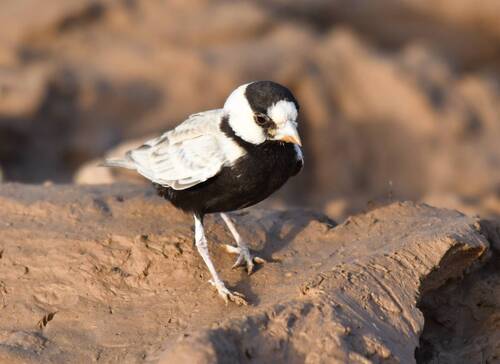 Black-crowned Sparrow-Lark
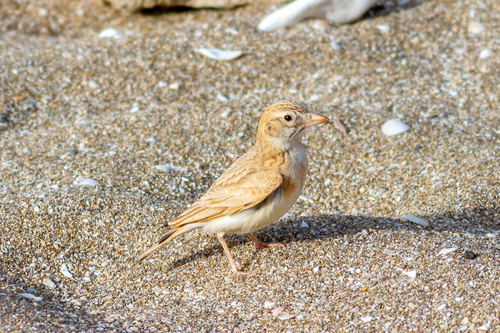 Arabian Lark
In short
The most reliable field mark is the male Black-crowned Sparrow-Lark’s striking black-and-white head pattern and black underparts, which are never matched by Arabian Lark. Females and juveniles of Black-crowned Sparrow-Lark are much plainer but still show black underwing coverts in flight, while Arabian Lark always lacks strong head contrasts and has a distinctive pink, swollen bill and blackish outer tail feathers visible in flight. If you see a sandy-brown lark with a plain face and a bulky pink bill, it’s Arabian Lark; if you see bold black-and-white on the head or black underwings, it’s Black-crowned Sparrow-Lark. Both species occur in arid, open country but differ subtly in structure and movement.
Identification tips
- Male Black-crowned Sparrow-Lark is unmistakable: Look for a bold black crown, white forehead and cheeks, and black underparts with a white patch at the sides of the breast. No Arabian Lark shows this pattern at any age or season.
- Female and juvenile Black-crowned Sparrow-Lark show black underwing coverts in flight: Even when perched, these birds are sandy-brown and plain, but in flight, the black underwing is diagnostic. Arabian Lark never shows black underwings.
- Arabian Lark has blackish outer tail feathers visible in flight: This is a key mark for all ages and sexes, especially when the bird flushes. Black-crowned Sparrow-Lark’s tail is also dark but less contrasting and edged buff.
- Bill shape and color: Arabian Lark has a large, swollen, uniformly pink bill, while Black-crowned Sparrow-Lark’s bill is slimmer and horn-colored. This is best seen at close range or in good light.
- Facial pattern: Black-crowned Sparrow-Lark females and juveniles have pale patches around the eye and neck, but never a dark moustache. Arabian Lark has a dark moustache-like stripe and otherwise plain face.
- Upperpart streaking: Female and juvenile Black-crowned Sparrow-Lark have faint streaking on the crown, while Arabian Lark’s upperparts are plain sandy-brown with only faint pale patterning.
- Structure: Arabian Lark appears stockier and more robust, especially due to its bill. Black-crowned Sparrow-Lark is more delicate overall.
- Behavior: Black-crowned Sparrow-Lark may be seen in large flocks, especially outside breeding season, and sometimes shelters in shade or burrows. Arabian Lark is usually solitary or in pairs, running in short bursts on the ground.
- Habitat: Both prefer arid, open country, but Arabian Lark is more strictly a desert specialist, while Black-crowned Sparrow-Lark can be found in dry savanna as well.
- Vocalizations: Listen for a short, sweet series of notes from Black-crowned Sparrow-Lark versus the gentle burbling phrases and soft whistles of Arabian Lark.
- Perched versus flight views: In perched views, rely on head pattern and bill shape; in flight, check underwing (black in Black-crowned Sparrow-Lark, never in Arabian Lark) and tail (blackish outer feathers in Arabian Lark).
- Seasonal context: Large flocks suggest Black-crowned Sparrow-Lark outside breeding season; Arabian Lark is rarely seen in large groups.
- Sex differences: Only male Black-crowned Sparrow-Lark is boldly pied; females and juveniles are much plainer but still show black underwings.
- Juvenile confusion: Juvenile Black-crowned Sparrow-Lark has buff-tipped head feathers and black underwing coverts, while juvenile Arabian Lark is plain with a dark moustache and blackish outer tail feathers.
- When in doubt: If you cannot see the underwing or bill clearly, try to flush the bird gently to check for black underwing (Black-crowned Sparrow-Lark) or blackish outer tail feathers (Arabian Lark).
Size
Both species are similar in overall size, with Black-crowned Sparrow-Lark measuring about 11.5–12.5 cm in length [wikipedia]. Arabian Lark is described as stocky and large-billed, but no precise measurement is given for direct comparison. In the field, Arabian Lark may appear slightly bulkier due to its swollen bill and robust build, but size alone is not a reliable separator.
Plumage
- Juveniles and Females: Juvenile and female Black-crowned Sparrow-Lark are sandy-brown above with faint streaking and pale facial patches, but always show black underwing coverts in flight. Arabian Lark juveniles and adults are sandy-brown above, paler below, with faint pale patterning and a dark moustache stripe, but lack any black on the underwing; instead, look for blackish outer tail feathers in flight.
- Adult Males: Male Black-crowned Sparrow-Lark is unmistakable with a black crown, white forehead and cheek patches, black underparts, and a white patch at the sides of the breast. Arabian Lark never shows such bold head or underpart contrast; its face is plain except for a dark moustache, and its underparts are pale with faint markings.
- Bills: Arabian Lark has a uniformly pink, swollen bill, while Black-crowned Sparrow-Lark’s bill is horn-colored and slimmer.
- Tail: Both species have dark outer tail feathers, but this is more prominent in Arabian Lark, especially in flight. Black-crowned Sparrow-Lark’s tail is blackish with buff edges and grey central feathers.
Behaviour
Black-crowned Sparrow-Lark often forms flocks, sometimes very large outside the breeding season, and is known to seek shade or even shelter in burrows during midday heat. It may fly with legs dangling or perch with wings drooped to cool off. Arabian Lark is more often seen alone or in pairs during breeding, forming only small groups otherwise. On the ground, Arabian Lark moves in short bursts, running and stopping abruptly, and is generally less gregarious than Black-crowned Sparrow-Lark.
Habitat
Both species inhabit arid, open landscapes. Black-crowned Sparrow-Lark ranges widely from North Africa through the Middle East to northwestern India, favoring dry savanna and semi-desert. Arabian Lark is more restricted to the deserts of the Arabian Peninsula, from Syria and Jordan through Saudi Arabia to Oman. Overlap is possible in the Middle East, but Arabian Lark is more strictly a desert specialist.
Voice
Black-crowned Sparrow-Lark’s song is a short series of simple, sweet notes, delivered from a perch or during a flight display. Arabian Lark’s song is a series of gentle burbling phrases, given from the ground or in display flight, with calls including a low rattle and a soft two-note whistle. While both can sing in flight, Arabian Lark’s vocalizations are softer and more complex, whereas Black-crowned Sparrow-Lark’s are simpler and sweeter.