

Black-crowned Night Heron vs Little Egret
Nycticorax nycticorax versus Egretta garzetta
Play a quiz with Black-crowned Night Heron and Little Egret
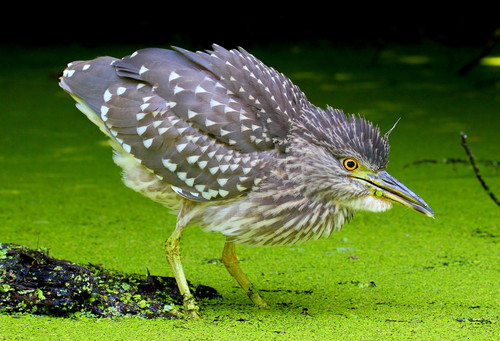 Black-crowned Night Heron
 Little Egret
In short
The most reliable field mark to separate Black-crowned Night Heron from Little Egret is overall color and structure: adult night herons are stocky, short-necked, and have a black crown and back with pale grey wings, while Little Egrets are slim, long-necked, and entirely white (except for black legs and bill, and yellow feet). Immature night herons are brownish with pale spots, never white, so any all-white heron is not a juvenile night heron. In flight, Little Egret shows a long, slender neck and legs trailing well beyond the tail, while Black-crowned Night Heron appears compact and hunched, with shorter legs and neck. Bill color is also key: night herons have a heavy black bill, while Little Egrets have a slender black bill. If you see yellow feet, it's a Little Egret; if you see a black crown and back, it's a Black-crowned Night Heron.
Identification tips
- Juvenile/immature plumage: If the bird is brownish with pale spots and streaks, it's a juvenile Black-crowned Night Heron. All-white birds, regardless of age, are Little Egret.
- Overall color: Adult Black-crowned Night Heron has a black crown and back, pale grey wings, and white underparts. Little Egret is pure white all over.
- Bill shape and color: Night heron has a short, thick, black bill; Little Egret has a long, slender, black bill.
- Leg color: Adult night herons have short yellow legs (turning salmon-pink in breeding season), while Little Egret has long black legs with bright yellow feet (feet may turn red in peak courtship).
- Neck and posture: Night herons are short-necked and hunched when perched; egrets are long-necked and upright.
- Head plumes: Both species have head plumes in breeding season, but night heron's are shorter and fewer (2–4 slender white plumes), while Little Egret's are long, wispy, and more prominent.
- Flight silhouette: Night heron looks compact, with short neck and legs barely extending past the tail. Little Egret is slim, with long neck retracted in flight but still longer than night heron's, and legs and feet trailing well beyond the tail.
- Eye color: Adult night herons have red eyes; Little Egret has yellow eyes.
- Feet: If you see yellow feet, it's a Little Egret. Night heron's feet are never yellow in the field.
- Behavior: Night herons are often motionless, especially by day, and more active at dusk or night. Little Egrets are active, foraging in daylight, often running or stirring water with their feet.
- Habitat: Little Egret is more likely in open, sunlit, shallow water; night heron prefers cover, wooded edges, or roosting in trees.
- Vocalization: Night heron gives harsh 'quok' calls, especially at dusk or in colonies; Little Egret is typically quiet.
- Breeding season changes: Night heron's legs may turn salmon-pink and skin around eyes blue at the start of nesting; Little Egret's lores and feet may turn red during courtship.
- Size and jizz: Night heron is heavier and stockier; egret is lighter, more graceful, and longer-legged.
- Common pitfalls: Do not mistake a hunched egret for a night heron—look for color and leg length. Juvenile night herons never appear white, and Little Egret never shows brown, streaked, or spotted plumage.
Size
Black-crowned Night Heron is slightly heavier (636 g vs. 532 g) and appears noticeably stockier and more compact than Little Egret. The night heron's body is bulkier, with a shorter neck and legs, while Little Egret is more delicate, with a slender build, longer neck, and legs that extend well past the tail in flight. Both are medium-sized herons, but the egret's longer proportions make it look larger and more graceful, especially when standing or flying.
Plumage
- Juvenile/immature birds: Black-crowned Night Heron immatures are dull grey-brown above with pale teardrop spots and streaked underparts, with orange eyes and dull yellowish-green legs. They never appear all-white. Little Egret juveniles are white like adults, but with greenish-black legs and duller yellow feet, and may show some greyish or brownish feathers, but never the brown, streaky, or spotted look of a young night heron.
- Adults: Black-crowned Night Heron adults have a striking black crown and back, pale grey wings, white underparts, and red eyes. Little Egret adults are entirely white, with black bill, black legs, and yellow feet. During breeding, both species grow head plumes, but the egret's are longer and more obvious. Night herons have shorter, slender white plumes on the back of the head.
- In flight: Little Egret shows all-white wings and body, with long black legs and yellow feet trailing behind. Black-crowned Night Heron shows pale grey wings, white underparts, and a short, thick profile with legs barely extending beyond the tail.
Behaviour
Black-crowned Night Heron is typically crepuscular or nocturnal, often seen hunched and motionless at the water's edge, or flying with slow, deep wingbeats and a compact outline. Little Egret is active by day, often seen actively stalking, running, or shuffling its feet in shallow water to flush prey, sometimes with wings raised. Egrets are more likely to forage in open, exposed areas and may be seen feeding with other waders. Night herons are more secretive, often roosting in trees or dense vegetation during the day.
Habitat
Both species occur in wetlands, but Little Egret prefers open shallow waters, mudflats, and exposed shorelines, and is often seen in more open, sunlit habitats. Black-crowned Night Heron favors vegetated margins, reedbeds, or wooded edges of lakes and rivers, and is more likely to be found in cover or perched in trees during the day. Night herons are less likely to be seen in the open at midday compared to Little Egret.
Voice
Black-crowned Night Heron is noisy in colonies, giving harsh 'quok' or 'woc' calls, especially at dusk or night. Little Egret is generally quieter, with no distinctive loud call noted in the sources.