

Black Catbird vs Thick-billed Seed-Finch
Melanoptila glabrirostris versus Sporophila funerea
Play a quiz with Black Catbird and Thick-billed Seed-Finch
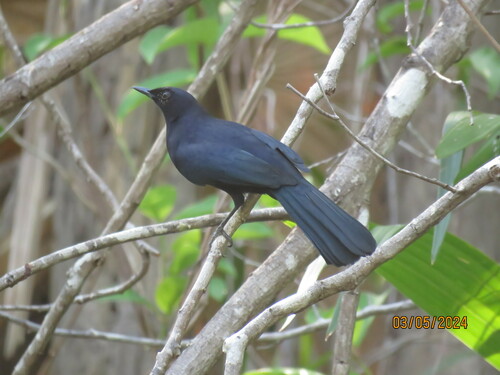 Black Catbird
 Thick-billed Seed-Finch
In short
The most reliable field mark is the bill: Black Catbird has a slim, straight, black bill, while Thick-billed Seed-Finch shows a very deep, thick, conical bill with a rounded culmen. Adult male Black Catbird is glossy black with a purplish or greenish sheen, whereas male Thick-billed Seed-Finch is matte black and lacks iridescence. Juveniles and females are also separable: Black Catbird juveniles are brownish-gray with mottling below, while female and juvenile seed-finches are brown to cinnamon with no mottling. Black Catbird is much larger and longer-tailed, with a more slender, mimid jizz, while the seed-finch is compact and short-tailed. These species rarely overlap in habitat, but where they do, careful attention to bill shape and overall structure is key.
Identification tips
- Bill shape is the quickest check: Black Catbird has a slim, straight, black bill with a generally straight culmen, only slightly decurved at the tip. Thick-billed Seed-Finch has a very deep, conical bill with a rounded culmen, looking thick and stubby from any angle. This is diagnostic at all ages.
- Size and structure: Black Catbird is nearly twice as long and much heavier, with a long tail and a lanky, upright posture. Seed-finch is compact, short-tailed, and round-bodied, often appearing neckless.
- Adult male plumage: Catbird is glossy black with purplish or greenish sheen, especially on tail and wing coverts; seed-finch is matte black with no iridescence. In good light, the sheen is a strong clue for catbird.
- Female/juvenile plumage: Female and juvenile Black Catbird are brownish-gray with mottling below, not uniform brown. Female and juvenile seed-finches are brown to cinnamon, with no mottling and a more uniform appearance. This is most useful in non-adult males.
- Iris color: Adult Black Catbird has a dark reddish iris (can be hard to see), while seed-finch’s iris is always black. Juvenile catbird has a gray iris.
- Leg color: Both have blackish legs, so this is not helpful.
- Tail length: Catbird’s tail is relatively long and often fanned or flicked; seed-finch’s tail is short and square.
- Wing pattern: Seed-finch has white underwing coverts (both sexes) and white bases to flight feathers (males only), but these are rarely visible in the field. Catbird lacks any white in the wing.
- Gloss vs. matte: In bright light, catbird’s plumage shows iridescent sheen, while seed-finch remains flat black or brown.
- Behavior: Catbird perches upright, often sings from exposed spots, and moves with slow confidence. Seed-finch is nervous, flicks wings and tail, and forages low in cover.
- Habitat context: Catbird is tied to dense thickets in the Yucatán and nearby islands; seed-finch is more widespread in Central America, favoring open scrub, grass, and edges.
- Vocalizations: Catbird’s song is complex, varied, and often includes harsh and metallic notes. Seed-finch gives simple, high-pitched calls and short songs, not mimid-like.
- Geographic overlap: Overlap is limited to parts of Belize and Guatemala; elsewhere, range can help, but do not rely on it in overlap zones.
- Sexual dimorphism: Catbird sexes are similar (female less glossy), while seed-finch is strongly dimorphic: males black, females brown/cinnamon.
- Juvenile confusion: If you see a brownish bird with mottling below, think catbird juvenile; a plain brown/cinnamon bird with no mottling is likely a seed-finch female or juvenile.
Size
Black Catbird is substantially larger, at about 19–20.5 cm in length and 35 g in mass [wikidata], making it the smallest mimid but still much bigger than Thick-billed Seed-Finch, which is only 10.7–12.5 cm long and weighs 12.8–13.9 g [wikipedia]. The catbird is lankier, with a longer tail and a proportionally longer body, while the seed-finch is compact and stubby, with a short tail and a noticeably thick, deep bill.
Plumage
- Juveniles: Black Catbird juveniles are brownish-gray above with mottling below, lacking the uniform brown or cinnamon tones of seed-finch juveniles and females. Juvenile and female seed-finches are brown to cinnamon (varying by subspecies), with no mottling and white underwing coverts.
- Adult males: Black Catbird males are glossy black with a purplish or greenish sheen, especially on the tail and wing coverts, and duller blackish-brown remiges. Thick-billed Seed-Finch males are matte black, with white bases to flight feathers and white underwing coverts (the white is rarely visible in the field).
- Females: Female Black Catbird is similar to the male but less glossy, remaining blackish overall. Female seed-finches are brown to cinnamon, with the head and upperparts darker than the underparts, and no gloss. Both species have blackish legs and dark irises, but the catbird’s adult iris is dark reddish, while the seed-finch’s is black.
Behaviour
Black Catbird often sings from exposed perches and moves with the typical mimid confidence, perching upright and using its long tail for balance. It is more likely to be seen alone or in pairs, often in dense thickets. Thick-billed Seed-Finch forages nervously in thick cover, flicking its wings and tail, and is usually seen singly, in pairs, or in small flocks with other seed-eaters. Its movements are more jittery and less upright than the catbird’s.
Habitat
Black Catbird is endemic to the Yucatán Peninsula and nearby islands, favoring dense scrub and thickets. It is absent from most of the mainland Central American range of Thick-billed Seed-Finch, which prefers second-growth scrub, forest edge, tall grass, and weedy areas, sometimes near water. Overlap is possible in northern Belize and Guatemala, but Black Catbird is more tied to dense, low vegetation, while the seed-finch is more often in open or edge habitats.
Voice
Black Catbird has a varied song of repeated phrases, ranging from harsh and scratchy to flute-like, often with metallic clicking buzzes. Its calls can resemble those of Gray Catbird, including harsh 'rriah', nasal 'chrrh', and grating 'tcheeu'. Thick-billed Seed-Finch’s vocalizations are not described in detail here, but as a Sporophila, it typically gives simple, high-pitched calls and short, unmusical songs, quite different from the catbird’s complex and varied repertoire.