

Black Catbird vs Great-tailed Grackle
Melanoptila glabrirostris versus Quiscalus mexicanus
Play a quiz with Black Catbird and Great-tailed Grackle
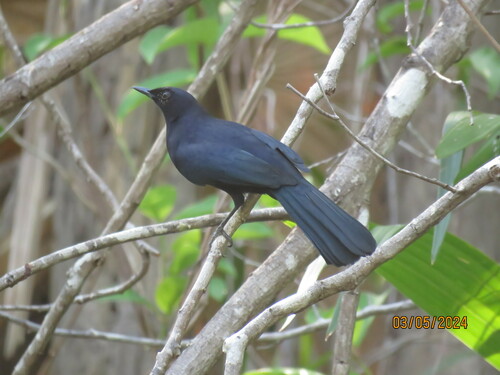 Black Catbird
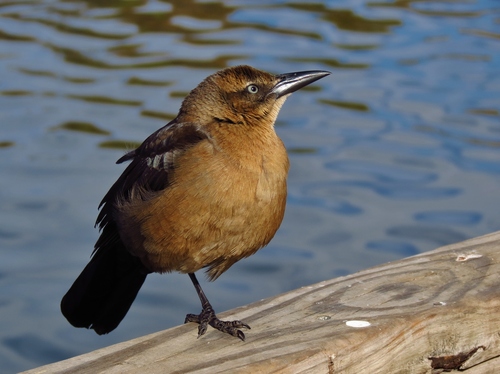 Great-tailed Grackle
In short
The most reliable field mark to separate Black Catbird from Great-tailed Grackle is overall size and structure: the catbird is much smaller and more compact, with a short, rounded wing and medium-length tail, while the grackle is large, lanky, and long-tailed, especially in males. Adult Black Catbirds are uniformly glossy black with a purplish or greenish sheen and dark eyes, while adult male grackles are iridescent black with a blue-purple gloss and striking yellow eyes; female grackles are brown and never all-black. Juvenile Black Catbirds are brownish-gray with mottling, while juvenile grackles resemble brown females. In flight, the grackle's long, keel-shaped tail and larger size are striking. Both species may be found in the Yucatán region, but grackles are more likely in open, urban, or disturbed habitats, while catbirds prefer dense vegetation.
Identification tips
- Size is the first check: If the bird is nearly robin-sized or smaller, it's a Black Catbird; if it's crow-sized or larger than a starling, it's a Great-tailed Grackle. This is true for all ages and sexes.
- Tail shape and length: Grackle males have a very long, keel-shaped tail that is often folded vertically (V-shaped) in flight or display; catbird's tail is medium-length and never shows this shape. Female grackles also have long tails, though less dramatic.
- Bill structure: Black Catbird has a short, straight, black bill with a slightly decurved tip; grackle's bill is longer, more robust, and evenly curved, especially in males.
- Eye color: Adult Black Catbird has dark reddish eyes (never bright yellow); adult grackles have bright yellow eyes. Juvenile catbirds have gray eyes, while juvenile grackles have brown eyes.
- Plumage gloss: Catbird is glossy black with a purplish or greenish sheen, especially on the coverts and tail; grackle males are iridescent with a blue-purple gloss, especially on the head and upperparts. Female grackles are brown, never black.
- Juvenile plumage: Juvenile catbirds are brownish-gray with mottling below; juvenile grackles are brown like females, with some streaking but no all-black phase. Any small, brownish, mottled bird in dense brush is likely a catbird juvenile.
- Sexual dimorphism: Catbird shows little to no sexual dimorphism; both sexes are similar, with females slightly less glossy. Grackle is strongly dimorphic: males are large, glossy black, females are smaller and brown.
- Flight profile: Grackle in flight is long-winged, lanky, and shows a long, V-shaped tail; catbird is compact, with short, rounded wings and a medium tail.
- Behavior: Catbird is secretive, moving through dense vegetation or singing from a hidden perch. Grackle is bold, often in flocks, and forages in open or urban areas.
- Habitat: Dense thicket or forest edge points to catbird; open field, urban park, or parking lot points to grackle.
- Vocalizations: Catbird's song is a mix of harsh, warbled, and flute-like notes with metallic buzzes, not mimicking other species. Grackle is much louder and more varied, with whistles, rattles, and squawks, often in social groups.
- Perched posture: Catbird perches upright, often low and partially hidden; grackle stands tall, often in exposed spots, sometimes with tail fanned or folded.
- Group size: Catbird is usually alone or in pairs; grackle is often in noisy flocks.
- Context: If you see a black bird in a busy, human-dominated area, it's almost certainly a grackle. Catbirds avoid such places.
- Pitfalls: Do not rely on 'black bird' alone—female grackles are brown, and catbirds are never as large or as long-tailed as any grackle. Juvenile confusion is best resolved by looking for mottling (catbird) vs. plain brown (grackle).
Size
Black Catbird is dramatically smaller: about 35 g in mass and 19–20.5 cm long, making it the smallest mimid in its range. Great-tailed Grackle is much larger, with males averaging 168.7 g (and up to 265 g) and 38–46 cm in length, with a wingspan of 48–58 cm. Even female grackles, at 115–142 g, are over three times heavier than a catbird. In the field, this size difference is immediately obvious, especially when seen side-by-side or with familiar birds for scale.
Plumage
- Juveniles: Black Catbird juveniles are brownish-gray with mottling below and gray irises, while juvenile grackles are brown like adult females, with brown eyes and some streaking on the breast. There is no all-black juvenile grackle; any small, brownish, mottled bird is a catbird juvenile.
- Adult males: Black Catbird is glossy black all over with a purplish sheen, greenish gloss on rectrices and coverts, and a duller blackish-brown on flight feathers. The bill and legs are black, and the eye is dark reddish. Great-tailed Grackle males are iridescent black with a blue-purple sheen, especially on the head and upper body, and have a bright yellow eye. Their tail is long and keel-shaped, often held in a V.
- Adult females: Black Catbird females are similar to males but less glossy and still all-black. Female grackles are brown with darker wings and tail, never black overall, and have yellow eyes as adults.
- Flight: Catbird has short, rounded wings and a medium tail, while grackle shows long wings and a dramatically long, keel-shaped tail, especially in males.
Behaviour
Black Catbird is typically solitary or in pairs, often skulking in dense vegetation and singing from low, hidden perches. It is not known for mimicry and tends to be unobtrusive. Great-tailed Grackle is highly social, often seen in noisy flocks, conspicuous in open areas, and frequently perches in exposed locations. Grackles are bold, often foraging in urban settings, parking lots, or open fields, and their behavior is much more gregarious and conspicuous than the secretive catbird.
Habitat
Black Catbird is restricted to dense scrub, thickets, and forest edges in the Yucatán Peninsula and nearby islands, favoring dense, tangled vegetation and lower perches. Great-tailed Grackle is common in open habitats, including urban areas, agricultural fields, parks, and wetlands, and is much more likely to be found in human-modified landscapes. If the bird is in a busy town square, parking lot, or open field, it is almost certainly a grackle; catbirds avoid such habitats.
Voice
Black Catbird's song is a mix of repeated phrases, ranging from harsh and scratchy to warbled and flute-like, with metallic clicking buzzes, but it does not mimic other species. Its calls can be harsh or nasal, sometimes reminiscent of Gray Catbird. Great-tailed Grackle is extremely vocal, with a wide range of harsh, squeaky, and varied calls, often described as whistles, rattles, and squawks. Grackle vocalizations are louder, more varied, and often given in social settings, while catbird is more subdued and less varied.