

Black-browed Albatross vs Pied Cormorant
Thalassarche melanophris versus Phalacrocorax varius
Play a quiz with Black-browed Albatross and Pied Cormorant
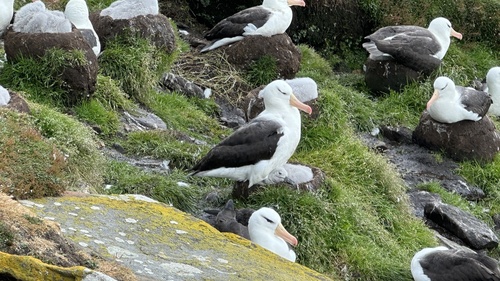 Black-browed Albatross
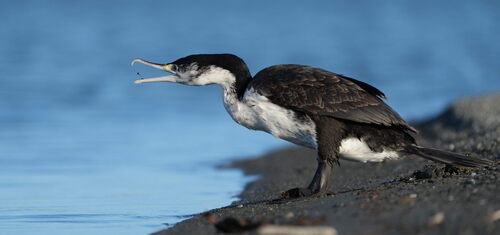 Pied Cormorant
In short
The most reliable field mark separating Black-browed Albatross from Pied Cormorant is the striking underwing pattern: Black-browed Albatross (all ages) shows a broad, irregular black margin to a mostly white underwing, while Pied Cormorant has a plain white underwing without bold black edges. In flight, the albatross is much larger, with long, narrow wings and a gliding, buoyant flight style, contrasting with the cormorant's shorter, broader wings and more labored, direct flight. Perched, the albatross’s orange bill and dark eyebrow stand out, while the cormorant has a hooked bill, green eyes, and a yellow facial patch. Juvenile albatrosses have darker underwings and bills, but still show the distinctive wing pattern. Habitat also helps: albatrosses are oceanic, rarely seen near shore except at colonies or as rare vagrants, while cormorants are common around coasts and inland waters.
Identification tips
- Underwing pattern in flight (all ages): Black-browed Albatross shows a broad, irregular black margin to an otherwise white underwing, visible even in juveniles. Pied Cormorant has a plain white underwing with no bold black edge—this is the single most reliable mark in flight.
- Overall size and shape: Albatross is much larger, with extremely long, narrow wings and a long, tapering body. Cormorant is smaller, with shorter, broader wings and a more compact body.
- Flight style: Albatross glides for long periods with minimal flapping, using wind currents; cormorant flaps steadily and rarely glides far, often flying low over water.
- Bill shape and color: Adult albatross has a long, strong, orange bill with a darker tip; juveniles have a dark horn-colored bill. Cormorant’s bill is shorter, hooked at the tip, and lacks the orange coloration, instead showing a yellow facial patch at the base.
- Facial pattern: Albatross has a distinctive dark eyebrow (the 'black brow') and a white head. Cormorant lacks the eyebrow, instead showing a yellow patch between bill and eye and green eyes with a blue ring.
- Upperwing and back: Albatross has a dark grey saddle and upperwings contrasting with a white rump; cormorant’s back and upperwings are black, but without the sharp contrast to a white rump.
- Perched posture: Albatross stands upright, often on open ground or cliffs; cormorant perches on rocks, posts, or trees, often with wings spread to dry.
- Legs and feet: Cormorant has large, black, webbed feet, often visible when perched or swimming. Albatross’s feet are less conspicuous in the field.
- Habitat context: Albatross is oceanic, rarely seen near shore except at colonies or as a rare vagrant. Cormorant is common on coasts, estuaries, and inland waters.
- Juvenile confusion: Juvenile albatrosses have a darker bill and head, but still show the bold underwing pattern. Juvenile cormorants do not acquire any albatross-like underwing pattern.
- Tail: Albatross tail is short and rounded, used in courtship displays; cormorant tail is longer and wedge-shaped, often fanned when drying wings.
- Voice: Only useful at colonies—albatrosses are noisy, cormorants are generally silent.
- Eye color: Cormorant has green eyes with a blue ring; albatross has dark eyes (except for Campbell Albatross, which is not in this comparison).
- Bill tip: Albatross bill is pointed with a darker tip; cormorant’s bill is hooked at the tip.
- Behavior on water: Cormorant sits low in the water, often diving; albatross rarely sits on water near shore except at colonies or when resting at sea.
Size
Black-browed Albatross is much larger and heavier than Pied Cormorant. The albatross measures 80–95 cm in length with a wingspan of 200–240 cm, and weighs 2.9–4.7 kg (noted in [wikipedia]), while Pied Cormorant is 65–85 cm long, with a wingspan of 110–130 cm and a body mass of about 2 kg ([wikidata]). In the field, the albatross’s wings are exceptionally long and narrow, giving it a much more imposing and graceful appearance both in flight and at rest.
Plumage
- Juvenile/immature Black-browed Albatross: Shows a broad, irregular black margin to the white underwing, a dark eyebrow, and a dark horn-colored bill with a dark tip. The head and collar are greyish, and the upperwings are dark, contrasting with the white rump and underparts. This bold underwing pattern is visible in all ages and is not matched by Pied Cormorant at any age.
- Adult Black-browed Albatross: Retains the black eyebrow, white head, orange bill with a darker tip, and the diagnostic underwing pattern. The upperwing remains dark with a white rump.
- Pied Cormorant (all ages): Has a black back and upperwings, white underparts, and a plain white underwing without bold black margins. The face shows a yellow patch between bill and eye, green eyes with a blue eye ring, and a hooked bill. No age or sex shows the bold black underwing border of the albatross. In perched birds, the cormorant’s black-and-white contrast is sharp but lacks the albatross’s facial pattern.
Behaviour
Black-browed Albatross is a dynamic glider, often seen soaring effortlessly for long periods over open ocean, rarely flapping except when taking off or landing. Its flight is buoyant, with long, stiff-winged arcs. When perched, it stands upright and may use its fanned tail in courtship displays. Pied Cormorant, by contrast, has a more direct, purposeful flight with frequent flapping and less gliding. It is often seen swimming low in the water, diving for fish, and perching with wings spread to dry. The cormorant’s behavior is more typical of nearshore or freshwater birds, while the albatross is almost exclusively pelagic except at breeding sites or as a rare vagrant.
Habitat
Black-browed Albatross is a true seabird, spending most of its life far from land, only coming ashore to breed on remote islands or, rarely, as a vagrant to coastal cliffs. Sightings near land are exceptional outside breeding colonies. Pied Cormorant is common and widespread around Australasian coasts, estuaries, and inland waters, often seen perched on rocks, jetties, or trees near water. If seen inland or on freshwater, it is almost certainly a cormorant. Context of location is a strong clue.
Voice
Black-browed Albatross colonies are noisy, with braying and harsh cackling calls, especially during territorial or courtship displays. Pied Cormorant is generally silent away from the nest and does not produce loud or distinctive calls in the field. Thus, vocalizations are rarely useful for separation except at breeding sites.