

Black-bellied Whistling-Duck vs Red-breasted Goose
Dendrocygna autumnalis versus Branta ruficollis
Play a quiz with Black-bellied Whistling-Duck and Red-breasted Goose
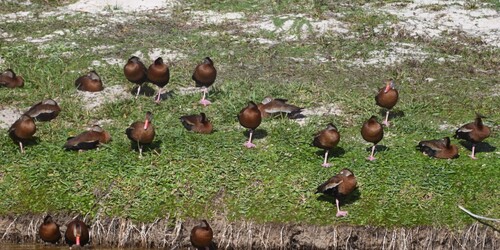 Black-bellied Whistling-Duck
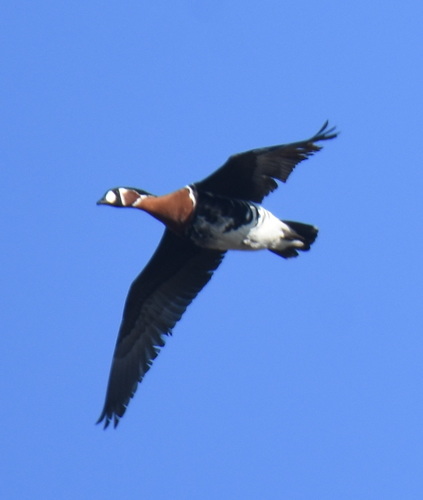 Red-breasted Goose
In short
The most reliable field mark between Black-bellied Whistling-Duck and Red-breasted Goose is the bold white wing patch of the whistling-duck, which is obvious in flight for all ages and absent in the goose. In perched or swimming birds, focus on bill color and face pattern: Black-bellied Whistling-Duck has a long pink bill and pale gray face, while Red-breasted Goose shows a short dark bill and striking tricolor face with white and rufous patches. Juvenile whistling-ducks have a gray bill and less contrast but still show the white wing bar in flight, while the goose is always boldly patterned. Structure and size also differ, with the goose being bulkier and shorter-necked. Use these marks in combination, especially when viewing flocks or distant birds.
Identification tips
- White wing patch in flight (all ages): Black-bellied Whistling-Duck always shows a bold white patch on the upperwing (secondaries) in flight, contrasting with black primaries; Red-breasted Goose never shows this, instead having dark wings with white and rufous body blocks.
- Bill color and shape: Whistling-duck has a long, bright pink bill (gray in juveniles); goose has a short, dark bill. Bill color is visible even at a distance and is a quick separator when birds are swimming or perched.
- Face pattern: Red-breasted Goose has a striking tricolor face: deep rufous cheeks, white stripes, and black crown; whistling-duck has a pale gray face and neck with a thin white eye-ring, lacking any rufous or bold white facial stripes.
- Belly and tail: Whistling-duck has a black belly and tail with chestnut-brown body; goose has a rufous breast and sooty-black flanks, with white side patches.
- Plumage contrast in juveniles: Juvenile whistling-ducks have a gray bill and less distinct belly contrast but retain the white wing patch; juvenile geese are still boldly patterned, with face and breast color present.
- Structural differences: Whistling-duck is long-necked, long-legged, and slim; goose is compact, thick-necked, and deep-chested. In flight, the duck looks stretched and loose, the goose compact and direct.
- Perching behavior: Whistling-ducks often perch in trees or on posts; geese rarely perch and are mostly terrestrial or aquatic.
- Flock structure: Geese are usually in tight, nervous flocks; whistling-ducks are in looser groups or pairs.
- Habitat context: Whistling-ducks are found in warm wetlands with trees; geese are Eurasian, found in tundra, steppe, or agricultural fields. In North America, a Red-breasted Goose is extremely rare and likely an escapee.
- Vocalizations: Whistling-duck gives high, clear whistles; goose honks and hisses. Calls are distinctive when heard.
- White flank/side patches: Goose shows bold white side patches and face stripes; whistling-duck may show pale flanks but never the same blocky white pattern.
- Sexual dimorphism: Both species are similar between sexes, but goose males are slightly larger; this is rarely diagnostic in the field.
- Confusion with other species: Whistling-duck's white wing patch is unique among whistling ducks; goose's face pattern is unique among geese. If you see a white wing patch in flight, it's not a Red-breasted Goose.
- Distant birds: At long range, goose's red breast may look dark, but face pattern remains diagnostic; whistling-duck's pale face and pink bill are still visible with good light.
- Seasonal context: Whistling-duck is resident or locally dispersive in the Americas; Red-breasted Goose is migratory in Eurasia. Out-of-range records should be scrutinized for provenance.
Size
Red-breasted Goose is substantially heavier (mean mass ~1235g) and slightly longer (53–56 cm) than Black-bellied Whistling-Duck (~831g, 47–56 cm), but the difference in body shape is more obvious than length alone. The goose is compact, thick-necked, and deep-chested, while the whistling-duck is slimmer, with a long neck and legs. Wingspan is also greater in the goose (up to 135 cm vs. 94 cm for the duck), making it appear broader-winged in flight. These differences are most apparent when both species are seen together or with familiar waterfowl for scale.
Plumage
For all ages, Black-bellied Whistling-Duck shows a bold white wing patch (formed by the secondaries) in flight, contrasting with black primaries and brown coverts; this is unique among whistling ducks and entirely absent in Red-breasted Goose. Juvenile whistling-ducks have a gray bill and less contrast on the belly, but still retain the white wing patch. On the ground, the duck's plumage is mostly chestnut-brown with a black belly and tail, pale gray face and neck, and a thin white eye-ring. Red-breasted Goose, by contrast, is strikingly patterned at all ages: it has a deep rufous breast and cheeks, sharply bordered by white stripes on the face and neck, and otherwise sooty-black upperparts and flanks with white side patches. The goose's red can look dark at a distance, but the tricolor face pattern is diagnostic up close. The whistling-duck never shows the bold white-and-rufous face or the compact, blocky color blocks of the goose.
Behaviour
Black-bellied Whistling-Duck often perches in trees or on posts, reflecting its long legs and semi-arboreal habits, and is typically seen in small, loose flocks or pairs. It is less wary and can be approachable. Red-breasted Goose is a true goose in behavior: it forages in tight, nervous flocks, rarely perches, and is more likely to be seen on open water or grazing on land. The goose is notably timid and often relies on proximity to raptors for protection during nesting. In flight, the whistling-duck appears long-necked and loose-winged, while the goose is compact, fast, and direct.
Habitat
Black-bellied Whistling-Duck favors warm, freshwater wetlands, ponds, and flooded fields, often with nearby trees or nest boxes; it is common in the southern US and parts of Central and South America. Red-breasted Goose is a Eurasian species, breeding in Arctic tundra near rivers or cliffs, and wintering in large flocks on open steppe or agricultural fields. In North America, any Red-breasted Goose is likely an escape or a rare vagrant, while the whistling-duck is a regular breeder and visitor. Habitat context is thus a strong clue: whistling-ducks rarely stray far from water and are often seen perched, while geese are more terrestrial and flock-oriented.
Voice
Black-bellied Whistling-Duck gives a high-pitched, clear whistling call, often in flight or when alarmed. Red-breasted Goose produces honking and hissing sounds, especially in aggressive or alarmed situations. The duck's whistling is distinctive and unlike any goose, while the goose's calls are more typical of its family.
Black-bellied Whistling-Duck · Red-breasted Goose · My Tricky Birds