

Motmot

Black-bellied Whistling-Duck vs Bar-headed Goose

Dendrocygna autumnalis versus Anser indicus

Play a quiz with Black-bellied Whistling-Duck and Bar-headed Goose
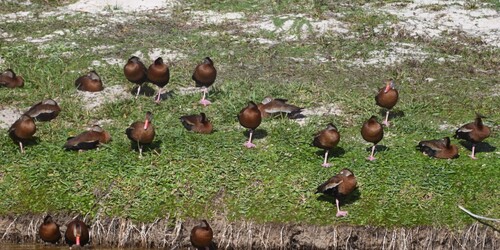
Black-bellied Whistling-Duck (Dendrocygna autumnalis) Black-bellied Whistling-Duck
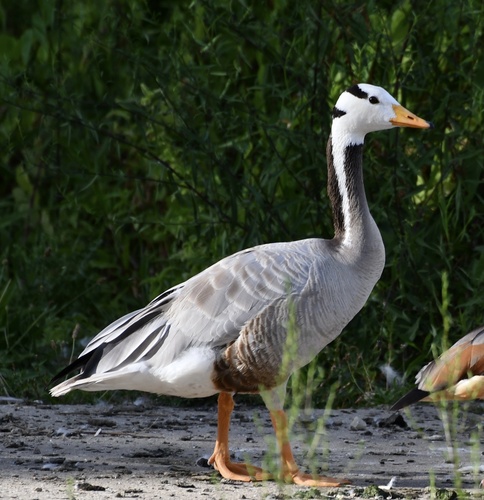
Bar-headed Goose (Anser indicus) Bar-headed Goose

Media

Loading…

In short

The most reliable field mark to separate Black-bellied Whistling-Duck from Bar-headed Goose is the extensive white in the wings of the whistling-duck, visible in flight as a bold white panel formed by the secondaries, contrasting with black primaries—this is unique among whistling ducks and absent in Bar-headed Goose. In all plumages, Black-bellied Whistling-Duck shows a striking combination of a long pink bill, gray face, and chestnut body with a black belly and tail, while Bar-headed Goose is a much larger, pale gray goose with a heavy orange or yellow bill and two bold black bars across the white head. Juvenile Black-bellied Whistling-Ducks have a gray bill and less contrast but still show the white wing panel in flight, whereas Bar-headed Goose juveniles resemble adults but with duller head markings. Structure is also a giveaway: Bar-headed Goose is much bulkier, with a classic goose profile, while Black-bellied Whistling-Duck is more upright and slim. Both species can be seen in open wetland habitats, but their ranges only overlap as vagrants or in captivity.

Identification tips

  1. White wing panel in flight (all ages): Black-bellied Whistling-Duck shows a bold white patch on the upperwing (secondaries) bordered by black primaries, visible from above and below in flight; Bar-headed Goose never shows this mark.
  2. Head pattern: Bar-headed Goose has a white head with two bold black bars across the crown and nape (adults and most juveniles); Black-bellied Whistling-Duck has a pale gray face and crown, with no black bars, and a thin white eye-ring.
  3. Bill color and shape: Black-bellied Whistling-Duck has a long, slender, bright pink bill (gray in juveniles); Bar-headed Goose has a heavy, short, orange or yellow bill.
  4. Body and belly color: Black-bellied Whistling-Duck has a rich chestnut body, black belly and tail; Bar-headed Goose is pale gray overall with paler underparts and no black belly.
  5. Leg color and length: Whistling-duck has long, pinkish legs, often seen standing upright or even perching; Bar-headed Goose has shorter, pinkish legs, rarely perches.
  6. Overall size: Bar-headed Goose is nearly three times heavier and much bulkier than Black-bellied Whistling-Duck; size alone can separate them if seen together.
  7. Posture and behavior: Black-bellied Whistling-Duck often stands upright, sometimes in trees or on posts; Bar-headed Goose is always horizontal, grazing on the ground, never perching.
  8. Juvenile confusion: Juvenile Black-bellied Whistling-Ducks have a gray bill and less contrast on the belly, but still show the white wing patch in flight; juvenile Bar-headed Geese are like adults but with duller head bars—never a white wing panel.
  9. Tail pattern: Black-bellied Whistling-Duck has a black tail contrasting with chestnut back; Bar-headed Goose has a pale tail matching the back.
  10. Voice: Black-bellied Whistling-Duck gives high-pitched whistles; Bar-headed Goose gives deeper honks or gabbling calls.
  11. Habitat clues: In the Americas, Bar-headed Goose is almost always an escapee; in Asia, Black-bellied Whistling-Duck is extremely rare. Context can help, but beware of captive birds.
  12. Group size: Bar-headed Goose is usually in large flocks, especially in winter; Black-bellied Whistling-Duck is often in pairs or small groups.
  13. Flight style: Whistling-duck has a buoyant, direct flight with obvious white in the wings; Bar-headed Goose has steady, powerful wingbeats and uniform gray wings.
  14. Eye-ring: Whistling-duck has a thin white eye-ring; Bar-headed Goose does not.
  15. Nesting behavior: Whistling-duck may be seen near nest boxes or tree cavities; Bar-headed Goose nests on the ground.

Size

Bar-headed Goose is dramatically larger and heavier than Black-bellied Whistling-Duck. Bar-headed Goose averages about 2367.5 g in body mass, compared to 831.0 g for the whistling-duck—nearly three times the weight. In the field, Bar-headed Goose appears as a large, robust goose with a thick neck and heavy bill, while Black-bellied Whistling-Duck is mid-sized, slim, and long-legged, with a much lighter build. Even at a distance, the size difference is striking when seen together.

Plumage

Juvenile and adult Black-bellied Whistling-Ducks both show a bold white wing panel in flight, created by the white secondaries contrasting with black primaries and brown coverts; this mark is visible from above and below and is unique among whistling ducks, present at all ages. On the ground, the white wing panel is less obvious, but the combination of a pale gray face, chestnut body, black belly, and long pink bill is distinctive. Juveniles have a gray bill and less contrast on the belly, but still show the white in the wing. Bar-headed Goose, in all ages, lacks any white wing panel; instead, it is a pale gray goose with a white face and two bold black bars across the crown and nape, a heavy orange or yellow bill, and pinkish legs. The underparts are pale, and the back is light gray. Juveniles are similar to adults but with duller or less distinct head bars. The black belly and tail of the whistling-duck are never matched by the goose, which has uniformly pale underparts.

Behaviour

Black-bellied Whistling-Duck is often seen perched upright on logs, posts, or even in trees, thanks to its long legs and more vertical stance. It is also known for strong pair bonds and may be seen in tight pairs or small family groups. In flight, it has a buoyant, direct style and often calls with a high-pitched whistle. Bar-headed Goose, by contrast, is a classic grazing goose, usually seen walking on the ground in flocks, feeding on grasses or crops, and rarely perching. Its flight is powerful and direct, with steady wingbeats, and it is famous for long-distance, high-altitude migration. The goose is more likely to be seen in large flocks, especially outside the breeding season.

Habitat

Black-bellied Whistling-Duck favors freshwater wetlands, ponds, and lakes, often with emergent vegetation, and is more likely to be seen in southern North America, Central, and South America. It is a cavity nester and may be found perched in trees or on structures near water. Bar-headed Goose breeds at high-altitude lakes in Central Asia and winters in lowland wetlands and agricultural fields in South Asia. It nests on the ground and is rarely found in trees. In North America, Bar-headed Goose is only seen as an escapee from captivity or in collections, while Black-bellied Whistling-Duck is a rare vagrant in Eurasia.

Voice

Black-bellied Whistling-Duck is named for its distinctive, high-pitched whistling calls, which are often heard in flight or when alarmed. Bar-headed Goose has typical goose-like honking or gabbling calls, much deeper and less musical than the whistling-duck. The difference in voice is obvious if heard.

Submit a better description

Use the same sections as the comparison. Your text is published immediately.

The most reliable field mark to separate Black-bellied Whistling-Duck from Bar-headed Goose is the extensive white in the wings of the whistling-duck, visible in flight as a bold white panel formed by the secondaries, contrasting with black primaries—this is unique among whistling ducks and absent in Bar-headed Goose. In all plumages, Black-bellied Whistling-Duck shows a striking combination of a long pink bill, gray face, and chestnut body with a black belly and tail, while Bar-headed Goose is a much larger, pale gray goose with a heavy orange or yellow bill and two bold black bars across the white head. Juvenile Black-bellied Whistling-Ducks have a gray bill and less contrast but still show the white wing panel in flight, whereas Bar-headed Goose juveniles resemble adults but with duller head markings. Structure is also a giveaway: Bar-headed Goose is much bulkier, with a classic goose profile, while Black-bellied Whistling-Duck is more upright and slim. Both species can be seen in open wetland habitats, but their ranges only overlap as vagrants or in captivity.

  1. White wing panel in flight (all ages): Black-bellied Whistling-Duck shows a bold white patch on the upperwing (secondaries) bordered by black primaries, visible from above and below in flight; Bar-headed Goose never shows this mark.
  2. Head pattern: Bar-headed Goose has a white head with two bold black bars across the crown and nape (adults and most juveniles); Black-bellied Whistling-Duck has a pale gray face and crown, with no black bars, and a thin white eye-ring.
  3. Bill color and shape: Black-bellied Whistling-Duck has a long, slender, bright pink bill (gray in juveniles); Bar-headed Goose has a heavy, short, orange or yellow bill.
  4. Body and belly color: Black-bellied Whistling-Duck has a rich chestnut body, black belly and tail; Bar-headed Goose is pale gray overall with paler underparts and no black belly.
  5. Leg color and length: Whistling-duck has long, pinkish legs, often seen standing upright or even perching; Bar-headed Goose has shorter, pinkish legs, rarely perches.
  6. Overall size: Bar-headed Goose is nearly three times heavier and much bulkier than Black-bellied Whistling-Duck; size alone can separate them if seen together.
  7. Posture and behavior: Black-bellied Whistling-Duck often stands upright, sometimes in trees or on posts; Bar-headed Goose is always horizontal, grazing on the ground, never perching.
  8. Juvenile confusion: Juvenile Black-bellied Whistling-Ducks have a gray bill and less contrast on the belly, but still show the white wing patch in flight; juvenile Bar-headed Geese are like adults but with duller head bars—never a white wing panel.
  9. Tail pattern: Black-bellied Whistling-Duck has a black tail contrasting with chestnut back; Bar-headed Goose has a pale tail matching the back.
  10. Voice: Black-bellied Whistling-Duck gives high-pitched whistles; Bar-headed Goose gives deeper honks or gabbling calls.
  11. Habitat clues: In the Americas, Bar-headed Goose is almost always an escapee; in Asia, Black-bellied Whistling-Duck is extremely rare. Context can help, but beware of captive birds.
  12. Group size: Bar-headed Goose is usually in large flocks, especially in winter; Black-bellied Whistling-Duck is often in pairs or small groups.
  13. Flight style: Whistling-duck has a buoyant, direct flight with obvious white in the wings; Bar-headed Goose has steady, powerful wingbeats and uniform gray wings.
  14. Eye-ring: Whistling-duck has a thin white eye-ring; Bar-headed Goose does not.
  15. Nesting behavior: Whistling-duck may be seen near nest boxes or tree cavities; Bar-headed Goose nests on the ground.

Bar-headed Goose is dramatically larger and heavier than Black-bellied Whistling-Duck. Bar-headed Goose averages about 2367.5 g in body mass, compared to 831.0 g for the whistling-duck—nearly three times the weight. In the field, Bar-headed Goose appears as a large, robust goose with a thick neck and heavy bill, while Black-bellied Whistling-Duck is mid-sized, slim, and long-legged, with a much lighter build. Even at a distance, the size difference is striking when seen together.

Juvenile and adult Black-bellied Whistling-Ducks both show a bold white wing panel in flight, created by the white secondaries contrasting with black primaries and brown coverts; this mark is visible from above and below and is unique among whistling ducks, present at all ages. On the ground, the white wing panel is less obvious, but the combination of a pale gray face, chestnut body, black belly, and long pink bill is distinctive. Juveniles have a gray bill and less contrast on the belly, but still show the white in the wing. Bar-headed Goose, in all ages, lacks any white wing panel; instead, it is a pale gray goose with a white face and two bold black bars across the crown and nape, a heavy orange or yellow bill, and pinkish legs. The underparts are pale, and the back is light gray. Juveniles are similar to adults but with duller or less distinct head bars. The black belly and tail of the whistling-duck are never matched by the goose, which has uniformly pale underparts.

Black-bellied Whistling-Duck is often seen perched upright on logs, posts, or even in trees, thanks to its long legs and more vertical stance. It is also known for strong pair bonds and may be seen in tight pairs or small family groups. In flight, it has a buoyant, direct style and often calls with a high-pitched whistle. Bar-headed Goose, by contrast, is a classic grazing goose, usually seen walking on the ground in flocks, feeding on grasses or crops, and rarely perching. Its flight is powerful and direct, with steady wingbeats, and it is famous for long-distance, high-altitude migration. The goose is more likely to be seen in large flocks, especially outside the breeding season.

Black-bellied Whistling-Duck favors freshwater wetlands, ponds, and lakes, often with emergent vegetation, and is more likely to be seen in southern North America, Central, and South America. It is a cavity nester and may be found perched in trees or on structures near water. Bar-headed Goose breeds at high-altitude lakes in Central Asia and winters in lowland wetlands and agricultural fields in South Asia. It nests on the ground and is rarely found in trees. In North America, Bar-headed Goose is only seen as an escapee from captivity or in collections, while Black-bellied Whistling-Duck is a rare vagrant in Eurasia.

Black-bellied Whistling-Duck is named for its distinctive, high-pitched whistling calls, which are often heard in flight or when alarmed. Bar-headed Goose has typical goose-like honking or gabbling calls, much deeper and less musical than the whistling-duck. The difference in voice is obvious if heard.

Discard your changes?

You have unsaved edits. If you leave now, those changes will be lost.

Black-bellied Whistling-Duck · Bar-headed Goose · My Tricky Birds