

Bearded Woodpecker vs Cardinal Woodpecker
Chloropicus namaquus versus Dendropicos fuscescens
Play a quiz with Bearded Woodpecker and Cardinal Woodpecker
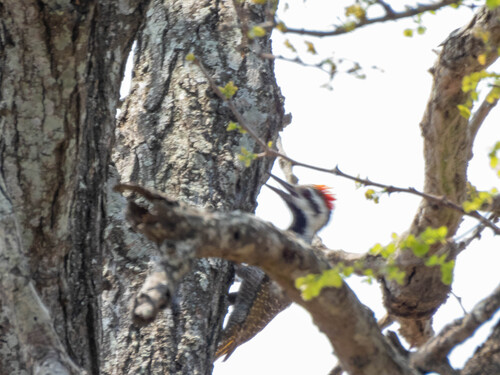 Bearded Woodpecker
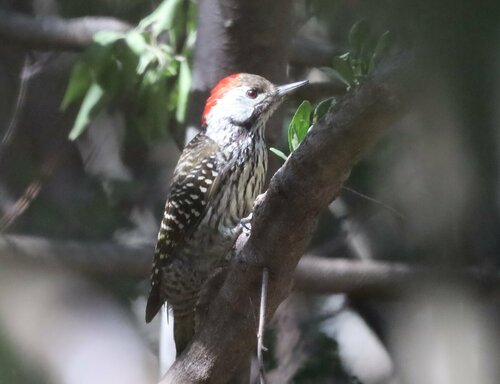 Cardinal Woodpecker
In short
The most reliable field mark is size: Bearded Woodpecker is nearly twice as long as Cardinal Woodpecker and appears much bulkier, with a massive bill and heavy, barred plumage. Juvenile Bearded Woodpecker can show a greenish tinge and diffuse barring above, while juvenile Cardinal Woodpecker is much smaller and lacks this coloration. In all ages, Bearded Woodpecker has a bold black-and-white head with a broad black eye-stripe and moustache, while Cardinal Woodpecker has a more muted olive-brown crown and less dramatic facial pattern. If you see the bird perched, focus on the head pattern and overall size; in flight, Bearded Woodpecker’s larger build and slower, more forceful flight are also clues.
Identification tips
- Size is the most immediate clue: Bearded Woodpecker is nearly twice as long and much bulkier than Cardinal. If the bird looks large and robust, especially compared to familiar species or branch size, lean toward Bearded.
- Bill structure: Bearded has a large, heavy, greyish-black bill; Cardinal’s bill is much finer and proportionally shorter. This is especially visible when the bird is side-on or hammering.
- Head pattern (adults): Bearded shows a striking black-and-white head with a broad black eye-stripe, black moustache, and white supercilium, face, chin, and throat. Cardinal’s head is less contrasting, with an olive-brown fore crown, white face and throat, and a single black malar stripe.
- Red crown/nape (sex/age): Adult male Bearded has a red hind crown; female lacks red. Juvenile Bearded (both sexes) show some red on crown and nape. Cardinal male has a red hind crown and nape (juvenile male: red hind crown, black nape); female has a dark hind crown and black nape. Both can show red, but the context and head pattern differ.
- Upperparts and barring: Bearded’s upperparts are yellowish-brown with narrow white barring; tail brown, barred white, with yellowish shafts. Cardinal’s back is dull olive with pale dots and bands, rump tawny, tail less boldly barred.
- Underparts: Bearded has grey underparts with narrow white barring; Cardinal is white below, heavily streaked with black.
- Juvenile marks: Juvenile Bearded has a greenish tinge and diffuse barring above, with some red on the crown/nape. Cardinal juveniles lack the greenish tinge and are much smaller.
- Facial contrast: Bearded’s facial pattern is bold and crisp; Cardinal’s is softer, with a single black malar stripe and less contrast.
- Perching behavior: Bearded is often seen on large trunks or high branches, sometimes in pairs. Cardinal is more likely in lower tree levels, shrubs, or reeds, and may join mixed flocks.
- Drumming: Loud, forceful drumming ending with four taps is typical of Bearded; soft, rapid drumming is more Cardinal.
- Vocalization: High-pitched 'krrrek-krrrek-krrrek' calls are diagnostic of Cardinal. Bearded is less vocal but may communicate with calls while foraging in pairs.
- Flight style: Bearded’s flight is likely slower and heavier due to size, while Cardinal is quick and agile.
- Habitat context: In thick bush or low vegetation, Cardinal is more likely; in mature woodland or at higher elevations, Bearded is favored.
- Eye color: Bearded has red eyes, which may be visible at close range; Cardinal’s eye color is not specified but is not a key mark.
- When in doubt: If you cannot judge size, focus on head pattern and bill structure. If you hear a call, use vocalization as a secondary clue.
Size
Bearded Woodpecker is one of Africa’s largest woodpeckers, reaching about 25 cm (10 in) in length, with a large, heavy bill and robust frame. Cardinal Woodpecker is much smaller, only 14–15 cm (5.5–5.9 in) long, with a proportionally smaller, finer bill and a more delicate build. Even at a distance or in poor light, the difference in size and bulk is usually apparent if you have a sense of scale (e.g., compared to branch thickness or nearby birds).
Plumage
- Juveniles: Juvenile Bearded Woodpecker resembles the adult but has a greenish tinge to the upperparts and more diffuse barring; both sexes show some red on the crown and nape. Juvenile Cardinal Woodpecker is similar to the adult but smaller, with a red hind crown and black nape in males, and lacks the greenish tinge or heavy barring of Bearded.
- Adults (all seasons): Bearded Woodpecker has a striking black-and-white head: black moustache, broad black eye-stripe, black crown (red hind crown in male), and crisp white supercilium, face, chin, and throat. The upperparts are yellowish-brown with narrow white barring, and the underparts are grey with narrow white barring. Cardinal Woodpecker is much duller: olive-brown fore crown, white face and throat separated by a black malar stripe, dull olive back with pale dots and bands, white underparts heavily streaked with black, and a tawny rump. The male Cardinal has a red hind crown and nape, but the rest of the head is less boldly patterned than Bearded. Both species have some barring above and below, but Bearded’s barring is broader and more extensive.
- In flight: No distinctive upperwing pattern is described for either species, but Bearded’s larger size and heavier barring may be apparent, while Cardinal appears smaller and more lightly marked.
Behaviour
Bearded Woodpecker often forages in pairs, spending long periods hammering, probing, and gleaning on large trunks or branches, and frequently moves between widely spaced trees. It drums loudly, ending with four taps. Cardinal Woodpecker is more likely to be seen in small family groups or mixed flocks, foraging in lower tree levels, shrubs, or even on maize stalks and reeds, and is more active and agile, often hanging from small twigs. Its drumming is softer and it pecks rapidly, moving quickly through dense vegetation.
Habitat
Both species have wide ranges in sub-Saharan Africa and overlap broadly, but Bearded Woodpecker prefers woodland with sizeable trees, Brachystegia woodland, Acacia woodland, gallery forest edges, and brushland, often at higher elevations (up to 3,000 m). Cardinal Woodpecker is more of a habitat generalist, found from dense forest to thorn bush, and is often more common in disturbed or open habitats, including lower tree levels and even reeds. If you see a woodpecker in thick bush or low in a shrub, Cardinal is more likely; if it’s on a large trunk high in a mature woodland, consider Bearded.
Voice
Bearded Woodpecker is known for loud drumming on branches, ending with four taps, but no specific call is described. Cardinal Woodpecker is fairly vocal, with a high-pitched 'krrrek-krrrek-krrrek' call and soft drumming. If you hear a high-pitched, repeated call, it likely points to Cardinal; loud, forceful drumming with a distinctive ending is more typical of Bearded.