

Bearded Vulture vs Griffon Vulture
Gypaetus barbatus versus Gyps fulvus
Play a quiz with Bearded Vulture and Griffon Vulture
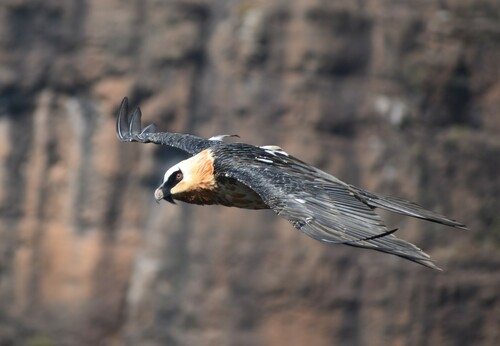 Bearded Vulture
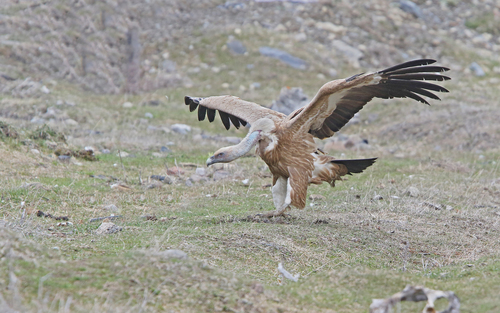 Griffon Vulture
In short
The most reliable field mark between Bearded Vulture and Griffon Vulture is the tail: Bearded Vulture has a long, wedge-shaped tail that is noticeably longer than the width of its wing, while Griffon Vulture has a short, squared-off tail. In flight, Bearded Vulture appears more slender and falcon-like, with long, narrow wings and a small head, whereas Griffon Vulture looks bulkier, with broad wings and a large, pale head. Juvenile Bearded Vultures are dark overall, while Griffon Vulture juveniles already show pale heads and contrasting wing coverts. These differences hold at all ages, but are especially apparent in flight. Both species are huge, but Griffon Vulture is heavier and bulkier.
Identification tips
- Tail shape and length: Bearded Vulture has a long, wedge-shaped tail that extends well beyond the width of the wing; Griffon Vulture's tail is short and square. This is the single most reliable field mark in flight for all ages.
- Overall silhouette in flight: Bearded Vulture appears slender and elongated, with long, narrow wings and a small head, reminiscent of a giant falcon. Griffon Vulture is bulkier, with broad wings and a large, pale head that protrudes more in flight.
- Head and neck: Bearded Vulture has a feathered head with a pale (creamy) forehead and a black eye-stripe and beard. Griffon Vulture has a bald, white head and a conspicuous white neck ruff, visible even at some distance.
- Plumage color (adults): Adult Bearded Vultures are dark grey above, with rusty or creamy underparts (often stained orange from mud or dust-bathing), and a black beard. Adult Griffon Vultures are pale-headed, with buff body and wing coverts contrasting with dark flight feathers.
- Juvenile plumage: Juvenile Bearded Vultures are dark all over, with a grey-brown breast and no pale head. Juvenile Griffon Vultures already show a pale head and neck ruff, with buffy body and contrasting dark wings.
- Bill and face: Bearded Vulture has a relatively small, dark bill and a black 'beard' of bristles under the chin. Griffon Vulture has a larger, yellowish bill and lacks any beard.
- Size and bulk: Griffon Vulture is heavier and bulkier, both in flight and on the ground. Bearded Vulture is large but more slender and elongated.
- Flight behavior: Bearded Vulture often soars alone or in pairs and may be seen carrying bones. Griffon Vulture is more likely to be seen in large soaring flocks.
- Ground behavior: Bearded Vulture has a waddling gait and appears long-tailed and hunched. Griffon Vulture is more upright and massive.
- Habitat context: Bearded Vulture is more restricted to high mountains and rugged terrain, often solitary. Griffon Vulture can be found in a wider range of open habitats and is more social.
- Voice: Not a reliable field mark; both are mostly silent, but Bearded Vulture may give shrill whistles or a falcon-like call near the nest.
- Cosmetic coloration: Bearded Vulture may appear orange or rust-colored on the head, breast, and legs due to iron-rich mud staining. Griffon Vulture never shows this coloration.
- Sex and season: No significant seasonal or sexual dimorphism in field marks for either species; structural and plumage differences are consistent year-round.
- Pitfalls: At great distance, both species can appear huge and dark, but the long, wedge-shaped tail of Bearded Vulture and the pale head/neck ruff of Griffon Vulture are reliable even in poor light.
- When marks fail: In silhouette, focus on tail length and shape first; if the head appears pale and the tail is short, it's Griffon Vulture. If the bird is dark-headed with a long tail, it's Bearded Vulture.
Size
Griffon Vulture is significantly heavier than Bearded Vulture, with an average adult mass of 8328 g versus 5544 g for Bearded Vulture [wikidata]. Both species have similar wingspans (about 2.3–2.8 m), but Bearded Vulture is more slender and elongated, while Griffon Vulture is bulkier and broader-winged. On the ground, Bearded Vulture appears more elongated with a longer tail, while Griffon Vulture is more massive and has a stouter build.
Plumage
- Juvenile/Immature birds: Juvenile Bearded Vultures are dark black-brown over most of the body, with a grey-brown breast, and lack the pale head and neck ruff of Griffon Vulture. Juvenile Griffon Vultures, by contrast, already have a pale (white) head and neck ruff, with buff body and wing coverts contrasting with dark flight feathers. This contrast in head and body color is a key separation at all ages.
- Adults: Adult Bearded Vultures are mostly dark grey above with creamy or rusty underparts, a pale forehead, and a distinctive black eye-stripe and beard. The head is never bald. Adult Griffon Vultures have a white, bald head, a conspicuous white neck ruff, and a yellow bill, with buff body and wing coverts and dark flight feathers. The tail remains short and square in Griffon Vulture, long and wedge-shaped in Bearded Vulture.
- Wing and tail pattern in flight: Bearded Vulture's wings are long and narrow, and the tail is long and wedge-shaped, while Griffon Vulture's wings are broad and the tail is short and square. No distinctive upperwing pattern is described for either species, but overall shape and tail length are diagnostic.
Behaviour
Bearded Vulture is specialized in feeding on bones and is often seen carrying bones aloft to drop them on rocks to crack them open. Its flight is more falcon-like, with a slender, elongated profile and long tail. Griffon Vulture is a typical scavenger, feeding on carrion, and is often seen soaring in large groups. On the ground, Bearded Vulture has a waddling gait and appears more elongated, while Griffon Vulture is bulkier and more upright.
Habitat
Both species are found in mountainous regions, but Bearded Vulture is more specialized for high-altitude, rugged terrain where it can find bones to feed on. Griffon Vulture is more widespread and can be found in a variety of open habitats, including cliffs, gorges, and sometimes lower elevations. In Europe, Griffon Vulture is more likely to be seen in larger groups, while Bearded Vulture is usually solitary or in pairs.
Voice
Bearded Vulture is generally silent, except for shrill whistles during breeding displays and a falcon-like 'cheek-acheek' call near the nest. Griffon Vulture's vocalizations are not described in the notes, but neither species is likely to be identified by voice in the field.