

Bay Wren vs White-breasted Wood-Wren
Cantorchilus nigricapillus versus Henicorhina leucosticta
Play a quiz with Bay Wren and White-breasted Wood-Wren
 Bay Wren
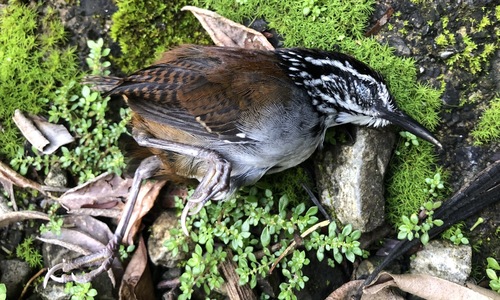 White-breasted Wood-Wren
In short
The most reliable field mark to separate Bay Wren from White-breasted Wood-Wren is the bold black barring across the underparts and tail of the Bay Wren, which is absent or much less extensive in the Wood-Wren. Bay Wren also shows a striking black face with a narrow white supercilium, while the Wood-Wren has a more finely streaked face and a generally paler, less contrasting appearance. Juveniles of both species are duller, but the Bay Wren still shows more barring and contrast than the Wood-Wren. Structure and size differ subtly, with Bay Wren being bulkier and longer-tailed. Habitat overlap is common, but Bay Wren is more tied to dense thickets near water.
Identification tips
- Underpart barring (all ages): Bay Wren shows bold black barring across the white underparts from breast to vent, even in juveniles (though paler). White-breasted Wood-Wren lacks this barring; its underparts are clean white to buff, sometimes with faint shading but never barred.
- Tail barring: Bay Wren's tail is rich brown with bold black bars, obvious in both perched and flight views. Wood-Wren's very short tail is also barred, but the bars are finer, less extensive, and the tail itself is much shorter and less conspicuous.
- Face pattern: Bay Wren has a striking black face with a narrow white supercilium and a white cheek patch, giving a masked look. Wood-Wren has a paler supercilium, but the face is more finely streaked black-and-white and lacks the bold mask and cheek patch.
- Crown and nape: Bay Wren's crown and nape are black, contrasting with the chestnut back. Wood-Wren has a darker crown but not as sharply defined from the back.
- Upperparts color: Bay Wren's upperparts are rich chestnut, while Wood-Wren's are chestnut brown but less saturated and more uniform.
- Underparts color: Bay Wren's white throat and breast transition to rufous brown on the lower belly and flanks, with black barring throughout. Wood-Wren's underparts are white, becoming buff on the lower belly, with no barring.
- Juvenile plumage: Both are duller than adults, but Bay Wren juveniles retain the barred pattern (though paler), while Wood-Wren juveniles have greyish, unbarred underparts.
- Tail length and structure: Bay Wren has a longer, more expressive tail, often cocked and fanned, while Wood-Wren's tail is very short and less likely to be fanned.
- Size and bulk: Bay Wren is larger and heavier (23.9 g vs. 16 g), appearing bulkier and longer-tailed in the field. Wood-Wren is smaller, more compact, and rounder.
- Habitat preference: Bay Wren is almost always in dense, low vegetation near water; if you are far from water or in drier forest, Wood-Wren is more likely.
- Behavior: Both skulk in dense cover, but Bay Wren may seem more deliberate and less active than the quick, mouse-like Wood-Wren.
- Song: Listen for Bay Wren's loud, ringing, rapid whistles and trills, often antiphonal. Wood-Wren's song (not described here) is typically softer and more intricate; if you hear a very loud, rich, ringing song, suspect Bay Wren.
- Supercilium: Bay Wren's supercilium is narrow and white, while Wood-Wren's is pale but broader and less sharply defined.
- Cheek patch: Only Bay Wren shows a distinct white patch at the back of the cheek.
- Confusion risk: In poor light or quick views, focus on underpart barring and tail length/barring first. Face pattern is next most reliable; habitat and song can help clinch the ID if plumage is obscured.
Size
Bay Wren is noticeably larger and heavier, averaging about 23.9 g [wikidata], and measuring 12.6–15.6 cm in length [wikipedia]. White-breasted Wood-Wren is smaller and lighter, at about 10 cm and 16 g [wikipedia]. In the field, Bay Wren often appears bulkier and longer-tailed, while Wood-Wren is more compact with a shorter tail. These differences may be subtle at a distance or in dense vegetation, but are apparent with good views.
Plumage
- Juveniles: Both species are duller than adults, but Bay Wren juveniles still show a paler version of the strong barring on the underparts and tail, while Wood-Wren juveniles have greyish underparts and lack strong barring.
- Adults: Bay Wren has a black face, narrow white supercilium, and a white cheek patch, with a black crown/nape and rich chestnut upperparts. Its tail is boldly barred black, and the underparts are white with black bars from breast to vent, blending to rufous on the flanks. White-breasted Wood-Wren has chestnut brown upperparts, a darker crown, pale supercilium, and black-and-white streaked sides of the head/neck. Its underparts are white, becoming buff on the lower belly, and the wings and very short tail are barred with black, but the barring is less extensive and not present across the underparts. The face pattern is more finely streaked and less contrasting than Bay Wren's bold mask.
- In flight: Both species show some wing and tail barring, but the Bay Wren's tail barring is broader and more obvious, and its underpart barring is visible even in brief views.
Behaviour
Both species are skulking and favor dense vegetation, often moving low in tangled thickets. Bay Wren is especially tied to dense, low vegetation near water and may be more likely to be seen foraging in vine tangles and overgrown clearings. White-breasted Wood-Wren is also secretive but may be found in a wider range of forest undergrowth, including drier areas. Both forage for invertebrates by gleaning and probing, but Bay Wren may appear bulkier and more deliberate in movement.
Habitat
Bay Wren is closely associated with dense, low vegetation near water—such as thickets along streams, overgrown clearings, and roadsides with lush undergrowth. It can occur in forest interiors if there is sufficient undergrowth, but is less likely in dry or open habitats. White-breasted Wood-Wren is more flexible, occurring in a wider range of forest undergrowth, including drier areas and away from water. Both can be found in secondary growth, but Bay Wren is more restricted to wetter, denser habitats.
Voice
Bay Wren's song is a loud, rapid series of clear, rich-toned, slurred whistles, trills, and warbles, sometimes given antiphonally. White-breasted Wood-Wren's song is not described in the notes, but both are known for complex, musical songs. In the field, Bay Wren's song is often louder and more ringing, while Wood-Wren's is typically softer and more intricate. Calls may overlap, but Bay Wren tends to be more forceful and less high-pitched.