

Bay Wren vs Grey-breasted Wood-Wren
Cantorchilus nigricapillus versus Henicorhina leucophrys
Play a quiz with Bay Wren and Grey-breasted Wood-Wren
 Bay Wren
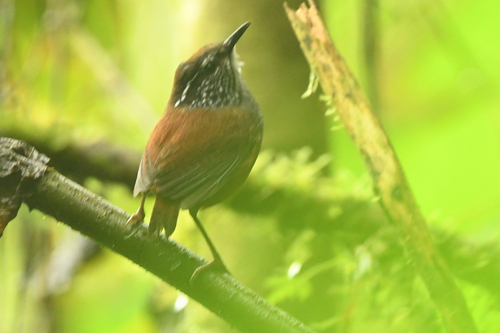 Grey-breasted Wood-Wren
In short
The most reliable field mark to separate Bay Wren from Grey-breasted Wood-Wren is the Bay Wren’s bold, high-contrast black-and-white face pattern and rich chestnut upperparts, compared to the Wood-Wren’s more muted gray and olive tones and less sharply defined facial markings. Juvenile Bay Wrens are paler but still show the same face pattern, while juvenile Wood-Wrens lack such strong contrasts. In the field, Bay Wren appears larger and stockier, with a heavier build and more extensive rufous on the flanks and belly. Both species can be secretive in dense vegetation, but their structure and plumage differences are usually visible with a good look.
Identification tips
- Face Pattern (all ages): Bay Wren has a bold black face with a narrow white supercilium, partial eyering, and a white patch at the rear of the cheek. Grey-breasted Wood-Wren has a long gray-white supercilium, but the face is less sharply marked, with black cheeks streaked pale gray and a wide black stripe behind the eye.
- Crown and Nape: Bay Wren shows a black crown and nape, contrasting with rich chestnut upperparts. Wood-Wren’s crown is dull black with dark brown tips, blending into dark olive brown nape and shoulders.
- Upperparts Color: Bay Wren’s back and upperparts are rich chestnut, while Wood-Wren’s are dark olive brown (nape/shoulders) and chestnut only on the lower back, rump, and tail.
- Tail Pattern: Both have barred tails, but Bay Wren’s is richer brown with bolder black bars; Wood-Wren’s tail is chestnut brown with blackish bars, less contrasting.
- Underparts: Bay Wren has white throat and breast, grading to rufous brown on the belly and flanks, with black bars from breast to vent. Wood-Wren’s underparts are pale gray on the chin/throat, darker gray on chest/belly, and dark buff on the lower flanks, without rufous or extensive barring.
- Juvenile Plumage: Juvenile Bay Wrens are paler but retain the adult’s face pattern and chestnut tones; Wood-Wren juveniles are not described but are unlikely to show such bold contrasts.
- Size and Structure: Bay Wren is larger and heavier (23.9 g, 12.6–15.6 cm) with a bulkier, more robust appearance. Wood-Wren is smaller and lighter (13.5–17.7 g, 10–11.5 cm), often appearing more delicate.
- Behavior: Bay Wren often forages in tangled, dense vegetation near water, sometimes in pairs or small groups. Wood-Wren forages singly or in small groups, usually low in vegetation, and may follow army ants.
- Habitat: Bay Wren is closely tied to water and dense riparian thickets; Wood-Wren is found in dense undergrowth but not specifically near water.
- Voice: Bay Wren’s song is loud, rich, and ringing; Wood-Wren’s is generally more musical and less resonant (not detailed here).
- Supercilium: Bay Wren’s supercilium is narrow and white; Wood-Wren’s is long, gray-white, and more diffuse.
- Cheek Patch: Bay Wren shows a distinctive white patch at the rear of the cheek, absent in Wood-Wren.
- Flank Color: Bay Wren’s flanks are rufous brown; Wood-Wren’s are dark buff.
- Barring: Bay Wren has black barring on underparts from breast to vent; Wood-Wren lacks this feature.
- Pitfall: In poor light or brief views, the chestnut tones of Bay Wren and Wood-Wren’s rump/tail can look similar, but the face pattern and underpart color are reliable separators.
Size
Bay Wren is distinctly larger and heavier, averaging about 23.9 g in body mass and measuring 12.6–15.6 cm in length. In contrast, Grey-breasted Wood-Wren is smaller and lighter, at 10–11.5 cm long and 13.5–17.7 g. This size difference is often noticeable in direct comparison or when both species are seen in the same habitat. Bay Wren’s bulkier build and longer body can be apparent even in brief views.
Plumage
- Juveniles: Juvenile Bay Wrens resemble adults but are paler with less sharply defined markings; however, they still show the black-and-white facial pattern and chestnut upperparts. Juvenile Grey-breasted Wood-Wrens are not described in detail, but the species overall lacks the Bay Wren’s bold face and has more muted, blended colors.
- Adults: Bay Wren has a striking black face with a narrow white supercilium, partial eyering, and a white patch at the rear of the cheek. The crown and nape are black, upperparts rich chestnut, and the tail is brown with bold black bars. Underparts are white on the throat and breast, grading to rufous brown on the belly and flanks, with black barring from breast to vent. Grey-breasted Wood-Wren has a dull black crown with dark brown tips, dark olive brown nape/shoulders, and chestnut brown lower back, rump, and tail (also with blackish bars). Its supercilium is long and gray-white, cheeks are black streaked with pale gray, and underparts are pale to darker gray with dark buff flanks. The Wood-Wren’s face is less sharply patterned, and its underparts lack the Bay Wren’s rufous and barring.
- Tail: Both species have barred tails, but Bay Wren’s is richer brown and more boldly marked.
Behaviour
Both species forage for invertebrates in dense, low vegetation. Bay Wren tends to stay close to water and is often found in tangled thickets, overgrown clearings, or dense roadside vegetation, sometimes venturing into forest understory if cover is thick. Grey-breasted Wood-Wren forages singly or in small groups, usually from the ground up to 2 meters high, and is known to follow army ant swarms. Bay Wren may appear more robust and deliberate in movement, while Wood-Wren is smaller and may seem more active and agile.
Habitat
Bay Wren is closely tied to dense, low vegetation near watercourses, overgrown clearings, and secondary forest understory, but can also be found in drier thickets in Nicaragua. It is generally absent from open areas unless there is sufficient cover. Grey-breasted Wood-Wren has a broader range (Mexico to Bolivia) and is typically found in dense undergrowth, but is not specifically tied to water. Both species require thick cover, but Bay Wren’s preference for riparian or wet habitats is a useful clue.
Voice
Bay Wren’s song is loud, rapid, and rich-toned, with slurred, ringing whistles, trills, and warbles, often given antiphonally. Grey-breasted Wood-Wren’s song is not described here, but is generally less ringing and more musical or tinkling in tone. Both have a variety of calls, but Bay Wren’s voice is typically stronger and more resonant.