

Motmot

Bay-capped Wren-Spinetail vs Rufous Cacholote

Spartonoica maluroides versus Pseudoseisura unirufa

Play a quiz with Bay-capped Wren-Spinetail and Rufous Cacholote
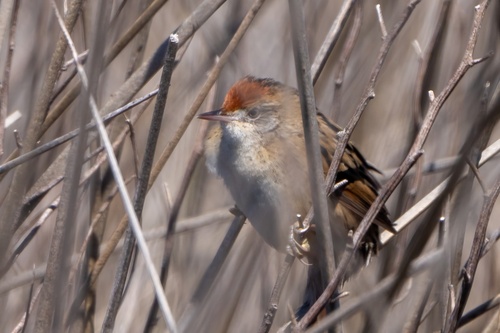
Bay-capped Wren-Spinetail (Spartonoica maluroides) Bay-capped Wren-Spinetail
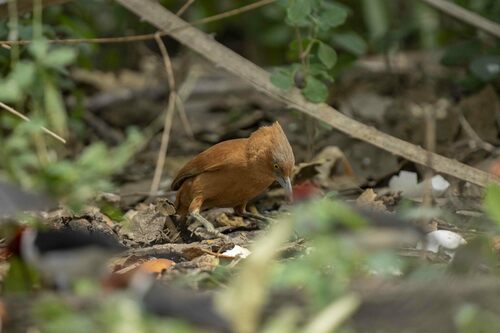
Rufous Cacholote (Pseudoseisura unirufa) Rufous Cacholote

Media

Loading…

In short

The most reliable field mark to separate Bay-capped Wren-Spinetail from Rufous Cacholote is overall size and structure: the cacholote is much larger, bulkier, and sports a prominent crest, while the wren-spinetail is small, slim, and lacks a crest. In plumage, the wren-spinetail shows a rufous crown with a contrasting whitish supercilium and boldly streaked upperparts, whereas the cacholote is a uniform bright reddish-rufous with a variable grayish or rufous crest and little patterning. The wren-spinetail favors dense marsh vegetation, while the cacholote is found in more open, wooded habitats. If you see a small, streaky, marsh-dwelling bird with a rufous cap, it's the wren-spinetail; a large, crested, uniformly rufous bird in trees is the cacholote.

Identification tips

  1. Size is decisive: If the bird appears small, delicate, and wren-like, it's Bay-capped Wren-Spinetail; if large, bulky, and thrush-sized, it's Rufous Cacholote. This applies to all ages and seasons.
  2. Crest presence: Cacholote always shows a prominent crest (rufous to grayish), even in juveniles (though shorter), while wren-spinetail never has a crest. In perched or alert birds, this is a quick check.
  3. Facial pattern: Wren-spinetail has a bold whitish supercilium and sandy face with a rufous crown, creating a strong contrast. Cacholote's face is uniform reddish-rufous, lacking a supercilium or sharp facial pattern.
  4. Back and nape streaking: Wren-spinetail shows bold black streaks on the nape and upper back, visible in good light or close views. Cacholote's back is plain, lacking any streaks or patterning.
  5. Overall plumage tone: Cacholote is a rich, uniform reddish-rufous above and below (paler below), while wren-spinetail is sandy to olive-brown above with a rufous crown and paler, buff-washed underparts.
  6. Tail structure: Wren-spinetail has a graduated, pointed tail with some black on the central feathers; cacholote's tail is broad, lacks barbs at the tips, and is uniformly rufous.
  7. Bill color and shape: Wren-spinetail has a fine, blackish maxilla and pale mandible, suited for gleaning insects in grasses. Cacholote's bill is heavier, blue-gray to gray with a paler mandible, reflecting its more generalist feeding.
  8. Iris color: Wren-spinetail has a dull white to pale bluish iris; cacholote's iris is yellow to buff-yellow. This is subtle but can help in close views.
  9. Habitat context: If the bird is in dense marsh or reedbed, especially low in vegetation, expect wren-spinetail. If in open woodland, scrub, or perched high in trees, it's almost certainly cacholote.
  10. Behavior: Wren-spinetail is secretive, foraging low and alone; cacholote is conspicuous, often vocal, and perches openly.
  11. Nest type: Wren-spinetail builds a low, open cup nest in marshes; cacholote constructs a large, stick nest high in trees. Nest structure and placement can be a clue if observed.
  12. Juvenile confusion: Even juvenile cacholotes, though less uniform and with a shorter crest, are much larger and lack the wren-spinetail's streaked back and facial contrast.
  13. Flight views: No unique wing or flight patterns are described for either species, so rely on size, structure, and tail shape in flight.
  14. Voice: Wren-spinetail's song is a long, insect-like buzz; cacholote is much louder and more varied. Use with caution unless familiar.
  15. Geographic overlap: Both species can occur in Paraguay and southern Brazil, but their habitat preferences sharply reduce confusion in the field.

Size

Size is a major separator: the Bay-capped Wren-Spinetail is much smaller (body mass ~11 g, length 13–14.5 cm) than the Rufous Cacholote (body mass ~49 g, length 20–21 cm). The cacholote is nearly four times heavier and noticeably longer, appearing robust and heavy-billed, while the wren-spinetail is small, slim, and delicate. In the field, this difference is immediately apparent if both species are seen in similar context.

Plumage

No age-specific upperwing or flight marks are described for either species, so focus is on adult and juvenile plumage. Adult Bay-capped Wren-Spinetail has a distinctive rufous crown, bold whitish supercilium, sandy to olive-brown upperparts with strong black streaks on the nape and upper back, and brown wings with cinnamon at the base of the flight feathers. The underparts are whitish with buff or cinnamon wash on the sides. The tail is brown, graduated, and pointed, with some black on the central feathers. In contrast, adult Rufous Cacholote is almost entirely bright reddish-rufous, paler below, with a variable crest (rufous to grayish), orange-tinged throat, and uniform plumage lacking strong streaking or facial contrast. Its wings have fuscous tips, and the tail feathers lack barbs at the ends. Juvenile cacholotes have a shorter crest and less uniform color but are still much larger and lack the wren-spinetail's facial pattern and streaked back. Both sexes are similar in each species.

Behaviour

The wren-spinetail is typically seen foraging alone, low in dense marsh grasses and sedges, often remaining hidden and moving mouse-like through vegetation. It is rarely seen perched high or in open areas. The cacholote, on the other hand, is more conspicuous, often seen perched in trees or shrubs, sometimes in pairs, and is more arboreal and vocal. Its large stick nests are built high above ground, while the wren-spinetail nests low in marsh vegetation.

Habitat

Bay-capped Wren-Spinetail is a specialist of reedbeds and sedges in freshwater, brackish, or saltwater marshes, rarely venturing far from dense wetland vegetation. Rufous Cacholote prefers open woodlands, savannas, and scrubby areas, often away from marshes, and is typically found in drier, more wooded habitats. Overlap is minimal; habitat alone is often a strong clue.

Voice

The wren-spinetail's song is described as a long, grasshopper-like buzz, which is quite different from the cacholote's typical loud, varied, and often harsh calls. However, detailed vocal comparisons are limited in the notes, so voice should be used with caution unless familiar with both species.

Submit a better description

Use the same sections as the comparison. Your text is published immediately.

The most reliable field mark to separate Bay-capped Wren-Spinetail from Rufous Cacholote is overall size and structure: the cacholote is much larger, bulkier, and sports a prominent crest, while the wren-spinetail is small, slim, and lacks a crest. In plumage, the wren-spinetail shows a rufous crown with a contrasting whitish supercilium and boldly streaked upperparts, whereas the cacholote is a uniform bright reddish-rufous with a variable grayish or rufous crest and little patterning. The wren-spinetail favors dense marsh vegetation, while the cacholote is found in more open, wooded habitats. If you see a small, streaky, marsh-dwelling bird with a rufous cap, it's the wren-spinetail; a large, crested, uniformly rufous bird in trees is the cacholote.

  1. Size is decisive: If the bird appears small, delicate, and wren-like, it's Bay-capped Wren-Spinetail; if large, bulky, and thrush-sized, it's Rufous Cacholote. This applies to all ages and seasons.
  2. Crest presence: Cacholote always shows a prominent crest (rufous to grayish), even in juveniles (though shorter), while wren-spinetail never has a crest. In perched or alert birds, this is a quick check.
  3. Facial pattern: Wren-spinetail has a bold whitish supercilium and sandy face with a rufous crown, creating a strong contrast. Cacholote's face is uniform reddish-rufous, lacking a supercilium or sharp facial pattern.
  4. Back and nape streaking: Wren-spinetail shows bold black streaks on the nape and upper back, visible in good light or close views. Cacholote's back is plain, lacking any streaks or patterning.
  5. Overall plumage tone: Cacholote is a rich, uniform reddish-rufous above and below (paler below), while wren-spinetail is sandy to olive-brown above with a rufous crown and paler, buff-washed underparts.
  6. Tail structure: Wren-spinetail has a graduated, pointed tail with some black on the central feathers; cacholote's tail is broad, lacks barbs at the tips, and is uniformly rufous.
  7. Bill color and shape: Wren-spinetail has a fine, blackish maxilla and pale mandible, suited for gleaning insects in grasses. Cacholote's bill is heavier, blue-gray to gray with a paler mandible, reflecting its more generalist feeding.
  8. Iris color: Wren-spinetail has a dull white to pale bluish iris; cacholote's iris is yellow to buff-yellow. This is subtle but can help in close views.
  9. Habitat context: If the bird is in dense marsh or reedbed, especially low in vegetation, expect wren-spinetail. If in open woodland, scrub, or perched high in trees, it's almost certainly cacholote.
  10. Behavior: Wren-spinetail is secretive, foraging low and alone; cacholote is conspicuous, often vocal, and perches openly.
  11. Nest type: Wren-spinetail builds a low, open cup nest in marshes; cacholote constructs a large, stick nest high in trees. Nest structure and placement can be a clue if observed.
  12. Juvenile confusion: Even juvenile cacholotes, though less uniform and with a shorter crest, are much larger and lack the wren-spinetail's streaked back and facial contrast.
  13. Flight views: No unique wing or flight patterns are described for either species, so rely on size, structure, and tail shape in flight.
  14. Voice: Wren-spinetail's song is a long, insect-like buzz; cacholote is much louder and more varied. Use with caution unless familiar.
  15. Geographic overlap: Both species can occur in Paraguay and southern Brazil, but their habitat preferences sharply reduce confusion in the field.

Size is a major separator: the Bay-capped Wren-Spinetail is much smaller (body mass ~11 g, length 13–14.5 cm) than the Rufous Cacholote (body mass ~49 g, length 20–21 cm). The cacholote is nearly four times heavier and noticeably longer, appearing robust and heavy-billed, while the wren-spinetail is small, slim, and delicate. In the field, this difference is immediately apparent if both species are seen in similar context.

No age-specific upperwing or flight marks are described for either species, so focus is on adult and juvenile plumage. Adult Bay-capped Wren-Spinetail has a distinctive rufous crown, bold whitish supercilium, sandy to olive-brown upperparts with strong black streaks on the nape and upper back, and brown wings with cinnamon at the base of the flight feathers. The underparts are whitish with buff or cinnamon wash on the sides. The tail is brown, graduated, and pointed, with some black on the central feathers. In contrast, adult Rufous Cacholote is almost entirely bright reddish-rufous, paler below, with a variable crest (rufous to grayish), orange-tinged throat, and uniform plumage lacking strong streaking or facial contrast. Its wings have fuscous tips, and the tail feathers lack barbs at the ends. Juvenile cacholotes have a shorter crest and less uniform color but are still much larger and lack the wren-spinetail's facial pattern and streaked back. Both sexes are similar in each species.

The wren-spinetail is typically seen foraging alone, low in dense marsh grasses and sedges, often remaining hidden and moving mouse-like through vegetation. It is rarely seen perched high or in open areas. The cacholote, on the other hand, is more conspicuous, often seen perched in trees or shrubs, sometimes in pairs, and is more arboreal and vocal. Its large stick nests are built high above ground, while the wren-spinetail nests low in marsh vegetation.

Bay-capped Wren-Spinetail is a specialist of reedbeds and sedges in freshwater, brackish, or saltwater marshes, rarely venturing far from dense wetland vegetation. Rufous Cacholote prefers open woodlands, savannas, and scrubby areas, often away from marshes, and is typically found in drier, more wooded habitats. Overlap is minimal; habitat alone is often a strong clue.

The wren-spinetail's song is described as a long, grasshopper-like buzz, which is quite different from the cacholote's typical loud, varied, and often harsh calls. However, detailed vocal comparisons are limited in the notes, so voice should be used with caution unless familiar with both species.

Discard your changes?

You have unsaved edits. If you leave now, those changes will be lost.

Bay-capped Wren-Spinetail · Rufous Cacholote · My Tricky Birds