

Motmot

Barred Eagle Owl vs Brown Wood-Owl

Ketupa sumatrana versus Strix leptogrammica

Play a quiz with Barred Eagle Owl and Brown Wood-Owl
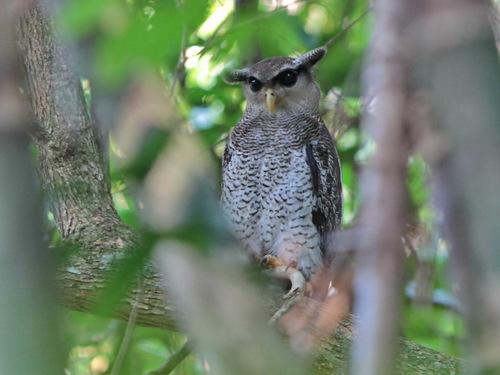
Barred Eagle Owl (Ketupa sumatrana) Barred Eagle Owl
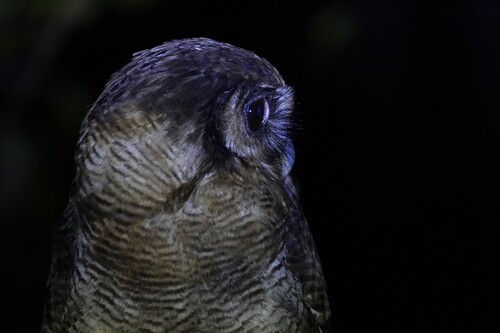
Brown Wood-Owl (Strix leptogrammica) Brown Wood-Owl

Media

Loading…

In short

The most reliable field mark to separate Barred Eagle Owl from Brown Wood-Owl is the presence of prominent, sideways-slanting ear tufts on the Barred Eagle Owl—completely absent in the earless Brown Wood-Owl. In perched or flight views, Barred Eagle Owl shows a heavily barred breast and a distinctive white bar running from the eyebrows through the front of the ear tufts, while Brown Wood-Owl has a more uniform rufous or brown facial disc and streaked, not barred, underparts. Juvenile Barred Eagle Owls are pure white in natal down, transitioning to dirty white with brown wing and tail bands, while young Brown Wood-Owls resemble adults but lack ear tufts. Both are large, brownish owls, but careful attention to head shape, underpart pattern, and facial markings will reliably separate them in the field.

Identification tips

  1. Ear Tufts: Barred Eagle Owl always shows large, sideways-slanting ear tufts; Brown Wood-Owl never has ear tufts. This is the single most reliable field mark for all ages and seasons.
  2. Facial Disc: Barred Eagle Owl has a dirty grayish-white face and lores, with a conspicuous white bar running above the eyes and through the ear tufts. Brown Wood-Owl has a brown or rufous facial disc, edged with white, and lacks the white bar or any ear tuft structure.
  3. Underpart Pattern: Barred Eagle Owl shows strong, broad barring on the breast (especially in the Javan race), with the belly less marked. Brown Wood-Owl has buff underparts with brown streaking, never barring. Check the pattern carefully on perched birds or in good flight views.
  4. Upperparts: Barred Eagle Owl's upperparts are grey-brown with zigzag rufous-tawny bars, and the upper tail is dark brown with pale bars. Brown Wood-Owl's upperparts are uniformly dark brown with faint white spotting on the shoulders and lack the zigzag barring.
  5. Tarsi and Feet: Barred Eagle Owl has tarsi feathered to the toe joint; Brown Wood-Owl has even more extensive feathering, often covering the feet entirely except for the talons. This can be seen when the bird is perched and feet are visible.
  6. Juvenile Plumage: Barred Eagle Owl juveniles are pure white in natal down, then dirty white with brown banding on wings and tail and very short ear tufts. Brown Wood-Owl juveniles look like adults, lacking ear tufts and showing the same streaked underparts and brown facial disc.
  7. Eye Color: Both species usually have dark brown eyes, but Barred Eagle Owl can rarely show yellow eyes. Do not rely on this mark alone.
  8. Bill and Cere: Barred Eagle Owl has a pale yellow bill and cere, sometimes with a greenish tinge. Brown Wood-Owl's bill color is less distinctive in the field.
  9. Size: Brown Wood-Owl is typically larger and bulkier (45–57 cm) than Barred Eagle Owl (40–48 cm), but size overlap and posture can make this unreliable except in direct comparison.
  10. Perched Posture: Barred Eagle Owl often appears more upright and alert, partly due to its ear tufts. Brown Wood-Owl looks rounder-headed and more compact.
  11. Flight Silhouette: In flight, Barred Eagle Owl may show more contrast on the upperwing due to barred patterning, while Brown Wood-Owl appears more uniformly brown. This is subtle and best used in combination with other marks.
  12. Facial Contrast: The white bar above the eyes and through the ear tufts of Barred Eagle Owl is unique and visible even at some distance with good light.
  13. Geographic Range: If you are outside the Malay Peninsula or the larger Southeast Asian islands, Brown Wood-Owl is far more likely. In overlap zones, use plumage and structure.
  14. Habitat: Both prefer dense forest, but Brown Wood-Owl is more adaptable and widespread. Habitat alone is not diagnostic.
  15. Feet Visibility: If you see the feet clearly, check for the extent of feathering—almost fully covered in Brown Wood-Owl, less so in Barred Eagle Owl.

Size

Barred Eagle Owl is a fairly large owl, but on average is slightly smaller than Brown Wood-Owl. Barred Eagle Owl ranges from 40–48 cm in length, with some subspecies (e.g., Javan) reaching higher weights (up to 1,600 g) but typically lighter than Brown Wood-Owl. Brown Wood-Owl is medium-large, 45–57 cm long, and generally appears bulkier and longer, especially in the largest individuals. There is minimal sexual dimorphism in both species, but Barred Eagle Owl shows more variation between island subspecies. In the field, size alone is not a safe separator due to overlap.

Plumage

For immatures and juveniles: Barred Eagle Owl chicks are pure white in natal down, then transition to dirty white with brown banding on wings and tail, and have very short ear tufts at this stage. Brown Wood-Owl juveniles resemble adults, lacking ear tufts entirely, and show the same brown or rufous facial disc and streaked underparts. In adults, Barred Eagle Owl is marked by strong, broad barring on the breast (especially in Javan birds), with the belly less marked, and a white bar above the eyes extending through the ear tufts. The upperparts are grey-brown with zigzag rufous-tawny bars and a dark brown tail with pale bars. Brown Wood-Owl has uniformly dark brown upperparts with faint white spotting on the shoulders, buff underparts with brown streaking (not barring), and a facial disc that is brown or rufous, edged with white, lacking concentric barring. The eyes of both are dark brown, but Barred Eagle Owl can rarely show yellow eyes. The tarsi of Barred Eagle Owl are feathered to the toe joint, while Brown Wood-Owl has even more extensive feathering, often covering the feet almost entirely.

Behaviour

Both species are primarily nocturnal and perch quietly during the day, but Barred Eagle Owl may appear more upright and alert due to its prominent ear tufts. In flight, Barred Eagle Owl may look slightly more compact and show more contrast in the upperwing pattern due to its barred plumage, while Brown Wood-Owl appears bulkier and more uniformly brown. Both are secretive and often detected by voice or silhouette at dusk.

Habitat

Barred Eagle Owl is found from the southern Malay Peninsula through several large Southeast Asian islands, including Borneo, Sumatra, Java, and Bali, favoring dense forests. Brown Wood-Owl has a broader range across South and Southeast Asia, including India, Bangladesh, Sri Lanka, Indonesia, Taiwan, and southern China, and is a resident breeder in these areas. In regions where both occur (e.g., parts of Indonesia), habitat overlap is possible, but Brown Wood-Owl is more widespread and can be found in a wider range of forest types.

Submit a better description

Use the same sections as the comparison. Your text is published immediately.

The most reliable field mark to separate Barred Eagle Owl from Brown Wood-Owl is the presence of prominent, sideways-slanting ear tufts on the Barred Eagle Owl—completely absent in the earless Brown Wood-Owl. In perched or flight views, Barred Eagle Owl shows a heavily barred breast and a distinctive white bar running from the eyebrows through the front of the ear tufts, while Brown Wood-Owl has a more uniform rufous or brown facial disc and streaked, not barred, underparts. Juvenile Barred Eagle Owls are pure white in natal down, transitioning to dirty white with brown wing and tail bands, while young Brown Wood-Owls resemble adults but lack ear tufts. Both are large, brownish owls, but careful attention to head shape, underpart pattern, and facial markings will reliably separate them in the field.

  1. Ear Tufts: Barred Eagle Owl always shows large, sideways-slanting ear tufts; Brown Wood-Owl never has ear tufts. This is the single most reliable field mark for all ages and seasons.
  2. Facial Disc: Barred Eagle Owl has a dirty grayish-white face and lores, with a conspicuous white bar running above the eyes and through the ear tufts. Brown Wood-Owl has a brown or rufous facial disc, edged with white, and lacks the white bar or any ear tuft structure.
  3. Underpart Pattern: Barred Eagle Owl shows strong, broad barring on the breast (especially in the Javan race), with the belly less marked. Brown Wood-Owl has buff underparts with brown streaking, never barring. Check the pattern carefully on perched birds or in good flight views.
  4. Upperparts: Barred Eagle Owl's upperparts are grey-brown with zigzag rufous-tawny bars, and the upper tail is dark brown with pale bars. Brown Wood-Owl's upperparts are uniformly dark brown with faint white spotting on the shoulders and lack the zigzag barring.
  5. Tarsi and Feet: Barred Eagle Owl has tarsi feathered to the toe joint; Brown Wood-Owl has even more extensive feathering, often covering the feet entirely except for the talons. This can be seen when the bird is perched and feet are visible.
  6. Juvenile Plumage: Barred Eagle Owl juveniles are pure white in natal down, then dirty white with brown banding on wings and tail and very short ear tufts. Brown Wood-Owl juveniles look like adults, lacking ear tufts and showing the same streaked underparts and brown facial disc.
  7. Eye Color: Both species usually have dark brown eyes, but Barred Eagle Owl can rarely show yellow eyes. Do not rely on this mark alone.
  8. Bill and Cere: Barred Eagle Owl has a pale yellow bill and cere, sometimes with a greenish tinge. Brown Wood-Owl's bill color is less distinctive in the field.
  9. Size: Brown Wood-Owl is typically larger and bulkier (45–57 cm) than Barred Eagle Owl (40–48 cm), but size overlap and posture can make this unreliable except in direct comparison.
  10. Perched Posture: Barred Eagle Owl often appears more upright and alert, partly due to its ear tufts. Brown Wood-Owl looks rounder-headed and more compact.
  11. Flight Silhouette: In flight, Barred Eagle Owl may show more contrast on the upperwing due to barred patterning, while Brown Wood-Owl appears more uniformly brown. This is subtle and best used in combination with other marks.
  12. Facial Contrast: The white bar above the eyes and through the ear tufts of Barred Eagle Owl is unique and visible even at some distance with good light.
  13. Geographic Range: If you are outside the Malay Peninsula or the larger Southeast Asian islands, Brown Wood-Owl is far more likely. In overlap zones, use plumage and structure.
  14. Habitat: Both prefer dense forest, but Brown Wood-Owl is more adaptable and widespread. Habitat alone is not diagnostic.
  15. Feet Visibility: If you see the feet clearly, check for the extent of feathering—almost fully covered in Brown Wood-Owl, less so in Barred Eagle Owl.

Barred Eagle Owl is a fairly large owl, but on average is slightly smaller than Brown Wood-Owl. Barred Eagle Owl ranges from 40–48 cm in length, with some subspecies (e.g., Javan) reaching higher weights (up to 1,600 g) but typically lighter than Brown Wood-Owl. Brown Wood-Owl is medium-large, 45–57 cm long, and generally appears bulkier and longer, especially in the largest individuals. There is minimal sexual dimorphism in both species, but Barred Eagle Owl shows more variation between island subspecies. In the field, size alone is not a safe separator due to overlap.

For immatures and juveniles: Barred Eagle Owl chicks are pure white in natal down, then transition to dirty white with brown banding on wings and tail, and have very short ear tufts at this stage. Brown Wood-Owl juveniles resemble adults, lacking ear tufts entirely, and show the same brown or rufous facial disc and streaked underparts. In adults, Barred Eagle Owl is marked by strong, broad barring on the breast (especially in Javan birds), with the belly less marked, and a white bar above the eyes extending through the ear tufts. The upperparts are grey-brown with zigzag rufous-tawny bars and a dark brown tail with pale bars. Brown Wood-Owl has uniformly dark brown upperparts with faint white spotting on the shoulders, buff underparts with brown streaking (not barring), and a facial disc that is brown or rufous, edged with white, lacking concentric barring. The eyes of both are dark brown, but Barred Eagle Owl can rarely show yellow eyes. The tarsi of Barred Eagle Owl are feathered to the toe joint, while Brown Wood-Owl has even more extensive feathering, often covering the feet almost entirely.

Both species are primarily nocturnal and perch quietly during the day, but Barred Eagle Owl may appear more upright and alert due to its prominent ear tufts. In flight, Barred Eagle Owl may look slightly more compact and show more contrast in the upperwing pattern due to its barred plumage, while Brown Wood-Owl appears bulkier and more uniformly brown. Both are secretive and often detected by voice or silhouette at dusk.

Barred Eagle Owl is found from the southern Malay Peninsula through several large Southeast Asian islands, including Borneo, Sumatra, Java, and Bali, favoring dense forests. Brown Wood-Owl has a broader range across South and Southeast Asia, including India, Bangladesh, Sri Lanka, Indonesia, Taiwan, and southern China, and is a resident breeder in these areas. In regions where both occur (e.g., parts of Indonesia), habitat overlap is possible, but Brown Wood-Owl is more widespread and can be found in a wider range of forest types.

Discard your changes?

You have unsaved edits. If you leave now, those changes will be lost.

Barred Eagle Owl · Brown Wood-Owl · My Tricky Birds