

Bar-tailed Godwit vs Marbled Godwit
Limosa lapponica versus Limosa fedoa
Play a quiz with Bar-tailed Godwit and Marbled Godwit
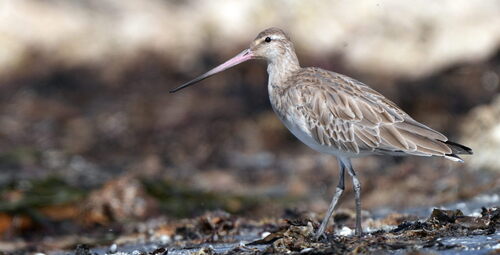 Bar-tailed Godwit
 Marbled Godwit
In short
The most reliable field mark between Bar-tailed and Marbled Godwit is the underwing and wing pattern in flight: Marbled Godwit shows rich cinnamon underwing coverts and a uniform upperwing, while Bar-tailed Godwit lacks this color and instead appears plainer or more streaked above, especially in juveniles and non-breeding birds. Bar-tailed Godwit also has a slightly upturned, bicolored bill and shorter legs, while Marbled Godwit is bulkier with a very long, slightly upturned pink-based bill. Breeding Bar-tailed Godwits are brick red below, but non-breeding and juvenile birds can be confusingly similar to Marbled Godwit, so structure and flight views are key. Both are large, long-legged shorebirds, but Marbled is the largest godwit and tends to look longer-necked and heavier overall.
Identification tips
- Check the underwing in flight: Marbled Godwit shows rich cinnamon underwing coverts, visible in flight or when stretching; Bar-tailed Godwit lacks this color and appears paler or plain underneath. This is the single most reliable mark for all ages.
- Look for brick red below (breeding only): Bar-tailed Godwit males in breeding plumage are brick red on the neck, breast, and belly; females are duller but still reddish. Marbled Godwit never shows this red, remaining pale brown with barring. This mark is only useful in spring/summer on breeding grounds or during migration.
- Bill structure and color: Both have long, slightly upturned bills, but Marbled's is longer and more robust, with a pink base and dark tip. Bar-tailed's bill is also pink-based but averages shorter and more finely tapered. Bill color is not always obvious at distance, but the length and bulk can be compared in direct views.
- Leg length and stance: Marbled Godwit is longer-legged and stands taller, with a heavier, bulkier look. Bar-tailed Godwit is relatively short-legged for a godwit and appears more compact.
- Upperwing pattern (juveniles and non-breeding): Juvenile and non-breeding Bar-tailed Godwits are plain grey-brown above with subtle striping, while Marbled Godwits are more mottled and have a warmer brown tone. In flight, neither shows a bold wingbar, but Marbled's uniform upperwing and cinnamon underwing stand out.
- Barring and streaking below: Marbled Godwit shows dark barring on the breast and flanks, while Bar-tailed Godwit (outside breeding) is whiter below with streaking or buff on the flanks and breast, especially in juveniles.
- Tail pattern: Not diagnostic between these two; neither shows the bold white tail of Black-tailed Godwit.
- Neck length: Marbled Godwit has a longer neck, contributing to its lanky, upright posture. Bar-tailed appears shorter-necked and more compact.
- Habitat context: In North America, Marbled Godwit is far more likely inland or on prairie wetlands, while Bar-tailed is a rare vagrant except on the Pacific coast. In Eurasia/Australasia, Bar-tailed is the default godwit on coastal mudflats.
- Seasonal context: Breeding plumage (red below) is only seen in Bar-tailed Godwit and only at the right season. Most confusion occurs in non-breeding or juvenile plumages.
- Group composition: Flocks of Marbled Godwit may be more uniform in size and color, while Bar-tailed Godwit flocks can show more variation due to sexual dimorphism and age.
- Feeding behavior: Both probe mud, but Marbled may also pick at insects in grass; this is subtle and not a primary field mark.
- Flight style: Bar-tailed Godwit's ceremonial flights are more ordered and less erratic than Black-tailed Godwit, but not distinctive compared to Marbled Godwit.
- Voice: Not diagnostic between these two based on available notes.
- Pitfalls: Non-breeding and juvenile Bar-tailed Godwits can be very similar to Marbled Godwit, especially at a distance. Always try for a flight view to check the underwing color, and use multiple marks together for best accuracy.
Size
Marbled Godwit is, on average, the largest of the godwits, with a total length of 40–50 cm and a wingspan of 70–88 cm, compared to Bar-tailed Godwit's 37–41 cm length and 70–80 cm wingspan. Average body mass for Bar-tailed Godwit is about 333.5 g ([wikidata]), while Marbled Godwit males average 326 g and females 391 g ([wikipedia]), so there is overlap but Marbled tends to be heavier, especially among females. Marbled Godwit also has a notably longer bill (up to 13 cm) and appears bulkier and longer-legged in direct comparison.
Plumage
- Juveniles and non-breeding birds: Bar-tailed Godwit juveniles and non-breeding adults are plain grey-brown above with darker feather centers, giving a subtly striped look, and are whitish below with some buff and streaking on the flanks and breast. Marbled Godwit, by contrast, is pale brown below with dark barring on the breast and flanks, and has a mottled dark back. In flight, Marbled Godwit shows rich cinnamon underwing coverts, a key difference from the Bar-tailed, which lacks this color and appears plainer underneath.
- Breeding plumage: Bar-tailed Godwit in breeding plumage is brick red on the neck, breast, and belly (males), with females duller and more cinnamon. Marbled Godwit does not show this red; instead, it remains pale brown with dark barring.
- Wing pattern in flight: Marbled Godwit shows rich cinnamon underwings and uniform upperwings, while Bar-tailed Godwit lacks this and may show more streaking or a plainer look, especially in immatures. Neither species shows the bold white wingbar of Black-tailed Godwit, but the underwing color is a strong separator.
- Bill color: Both have long, slightly upturned bills, but Bar-tailed's is pink at the base and black at the tip, while Marbled's is longer, pink-based, and slightly upturned with a dark tip.
Behaviour
Both species forage by probing mudflats and marshes with their long bills, but Marbled Godwit may also pick insects by sight in short grass. Bar-tailed Godwit is famous for extremely long, nonstop migratory flights, sometimes over 10,000 km, and is less territorial, with ceremonial flights that are more ordered and less erratic than Black-tailed Godwit. Marbled Godwit is not noted for such extreme migration in these notes, but both species are highly migratory and often found in flocks. Roosting behavior is similar, with birds often standing on one leg and tucking the bill into the body.
Habitat
Bar-tailed Godwit breeds on Arctic coasts and tundra from Scandinavia to Alaska, wintering on temperate and tropical coasts of Australia and New Zealand. Marbled Godwit breeds in central and western North America (including Alaska and central Canada) and winters in the southern US to northwest South America. Both are found on coastal mudflats, estuaries, and beaches during migration and winter, but Bar-tailed is more strictly coastal outside the breeding season, while Marbled can be found in both coastal and inland wetlands.