

Bar-tailed Godwit vs Common Sandpiper
Limosa lapponica versus Actitis hypoleucos
Play a quiz with Bar-tailed Godwit and Common Sandpiper
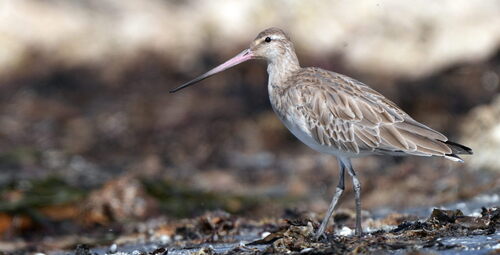 Bar-tailed Godwit
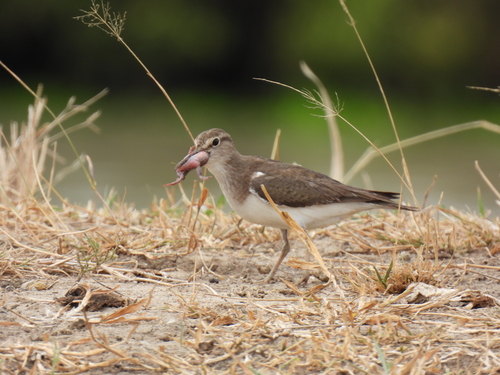 Common Sandpiper
In short
The most reliable field mark to separate Bar-tailed Godwit from Common Sandpiper is overall size and structure: Bar-tailed Godwit is a much larger, heavier bird with a long, slightly upturned bill and long legs, while Common Sandpiper is small, compact, with a short, straight bill and short yellowish legs. In flight, Bar-tailed Godwit lacks the strong wing patterning of many waders, while juvenile and non-breeding Common Sandpipers show more barring on the upperwing and a crisper wing pattern at close range. Bar-tailed Godwit in breeding plumage shows rich red underparts (especially males), which Common Sandpiper never shows. If you see a medium-to-large wader with a long, slightly upturned bill and blue-grey legs, it's a Bar-tailed Godwit; a small, short-billed, tail-bobbing bird with a stiff, low flight is a Common Sandpiper.
Identification tips
- Size is the quickest separator: Bar-tailed Godwit is more than twice the length and bulk of Common Sandpiper; if you see a large wader, it's not a Common Sandpiper.
- Bill shape and length: Bar-tailed Godwit has a long, slightly upturned bill (pink at base, black at tip); Common Sandpiper's bill is short, straight, and only slightly bicolored. This is visible even at medium range.
- Leg color and length: Bar-tailed Godwit has blue-grey, long legs; Common Sandpiper has short, dark yellowish legs. Leg color is especially useful on perched birds.
- Breeding plumage: Only Bar-tailed Godwit males (and to a lesser extent females) show brick-red to chestnut underparts in spring/summer. Common Sandpiper is always brown above, white below.
- Non-breeding plumage: Both species become plainer, but Bar-tailed Godwit remains larger, with a more uniform grey-brown above and subtle striping; Common Sandpiper is smaller, with more obvious (but fine) barring on the wings at close range.
- Juvenile/immature pattern: Juvenile Common Sandpiper shows more barring above and buff-edged wing feathers, giving a crisper upperwing pattern than juvenile Bar-tailed Godwit, which is more uniformly buff and streaked below.
- Flight style: Bar-tailed Godwit flies strongly and directly, often high and in flocks; Common Sandpiper flies low over water with stiff, rapid wingbeats and a distinctive undulating path.
- Tail and rump: Bar-tailed Godwit lacks the strong white rump and black tail band of Black-tailed Godwit, but has a plain back and tail; Common Sandpiper has a plain brown tail and back, with no striking rump pattern.
- Behavior on ground: Common Sandpiper is constantly bobbing its tail and foraging with a pumping motion; Bar-tailed Godwit stands and walks more steadily, probing mud with its long bill.
- Habitat context: Bar-tailed Godwit is almost always on open tidal flats or estuaries; Common Sandpiper is more often on the edges of freshwater or sheltered coastal areas.
- Social behavior: Bar-tailed Godwit is often in loose flocks, especially on migration or wintering grounds; Common Sandpiper is usually solitary or in small groups.
- Sexual dimorphism: Bar-tailed Godwit males in breeding plumage are much brighter red below; females are duller but still show some chestnut. Common Sandpiper shows little sexual dimorphism.
- Seasonal timing: If you see a red-bellied godwit in spring or early summer, it's a Bar-tailed Godwit male; Common Sandpiper never shows this.
- Confusion risk: Distant, lone Bar-tailed Godwits in non-breeding plumage can look plain and might be mistaken for a larger sandpiper, but size and bill shape should clarify. Juvenile Common Sandpipers might look patterned above, but are always much smaller and shorter-billed.
- No strong vocal clues in notes: Calls are not described here, so rely on visual marks.
Size
Bar-tailed Godwit is dramatically larger: body mass averages about 333.5 g, with a length of 37–41 cm and a wingspan of 70–80 cm. Common Sandpiper is much smaller, at 18–20 cm in length and a 32–35 cm wingspan (less than half the mass and bulk). Even at a distance, the godwit’s size and long-legged, long-billed proportions stand out compared to the sandpiper’s compact, short-legged look. If you see both together, confusion is almost impossible.
Plumage
- Juveniles/immatures in flight: Juvenile Common Sandpiper shows more extensive barring above and buff edges to wing feathers, giving a crisper, more patterned look on the upperwing than Bar-tailed Godwit juveniles, which are more uniformly buff and streaked below but lack strong wing patterning.
- Non-breeding (winter) plumage: Bar-tailed Godwit is plain grey-brown above with darker feather centers and whitish below, appearing rather uniform and subtly striped. Common Sandpiper is greyish-brown above and white below, but in winter shows more obvious barring on the wings (though only at close range).
- Breeding plumage: Male Bar-tailed Godwit is strikingly brick-red below and dark brown above; females are duller but still show chestnut to cinnamon tones on the belly. Common Sandpiper never shows any red or chestnut tones, remaining brown above and white below year-round.
- Bill and leg color: Bar-tailed Godwit has blue-grey legs and a long, slightly upturned, bi-colored bill (pink at base, black at tip); Common Sandpiper has short, dark yellowish legs and a short, straight bill with a pale base and dark tip.
Behaviour
Bar-tailed Godwit is usually seen probing mudflats or estuaries, often in loose flocks, and may perform ceremonial or pursuit flights but lacks the tumbling, erratic flight of Black-tailed Godwit. Its flight is strong and direct, befitting a long-distance migrant. Common Sandpiper is typically solitary or in small groups, rarely in mixed flocks, and is famous for its distinctive tail-bobbing and stiff-winged, low, undulating flight over water. On the ground, Common Sandpiper walks with a characteristic pumping tail and thrusting head movement, which Bar-tailed Godwit does not do.
Habitat
Bar-tailed Godwit favors open coastal mudflats and estuaries, especially during migration and winter, and breeds on Arctic tundra. Common Sandpiper is more often found along the edges of freshwater lakes, rivers, and streams, but also occurs on muddy or sandy shores, especially on passage. Overlap can occur on migration, but Bar-tailed Godwit is much more tied to open, tidal habitats, while Common Sandpiper prefers smaller, more sheltered water bodies.