

Bar-headed Goose vs Snow Goose
Anser indicus versus Anser caerulescens
Play a quiz with Bar-headed Goose and Snow Goose
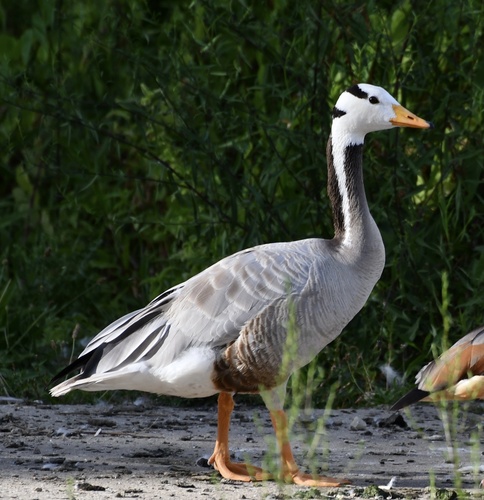 Bar-headed Goose
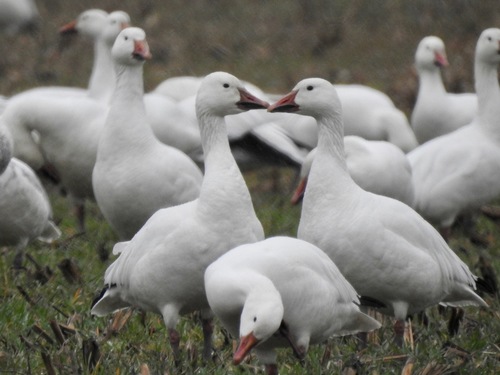 Snow Goose
In short
The most reliable way to separate Bar-headed Goose from Snow Goose is by plumage: Bar-headed Goose always shows two bold black bars across the pale grayish-white head, while Snow Goose (in white morph) has a plain white head, and blue morphs are never barred. Immature Snow Geese can be drab grayish overall, but they never show the distinct head bars of Bar-headed Goose. In flight, Snow Goose (white morph) shows black wingtips contrasting with otherwise white wings, while Bar-headed Goose has pale upperwings with no strong black primaries. Structurally, Snow Goose is a bit heavier and stockier, with a stubbier pink bill and a pronounced 'grin patch', unlike the Bar-headed's longer, more slender bill. Habitat and context are also helpful: Bar-headed Goose is an Old World species of high-altitude Asia, while Snow Goose is North American, often in huge flocks.
Identification tips
- Head pattern is key: Bar-headed Goose always shows two bold black bars across a white head, visible at all ages. Snow Goose (both morphs, all ages) never shows head bars.
- Bill color and shape: Snow Goose has a pink bill with a distinctive black 'grin patch' (the cutting edge of the bill), while Bar-headed Goose has a more slender, orange-yellow bill without a grin patch.
- Leg color: Both have pinkish or reddish legs, but this is not diagnostic between the two.
- Plumage morphs: Snow Goose comes in two morphs: white (all white with black wingtips) and blue (bluish-gray body with white head). Bar-headed Goose is always pale gray with a white face and black head bars.
- Juvenile confusion: Immature Snow Geese (especially blue morphs) are grayish, but never show head bars. Immature Bar-headed Geese already show the beginnings of the head bars. If you see a barred head, it's a Bar-headed Goose.
- Flight pattern: In flight, Snow Goose (white morph) shows striking black primaries contrasting with white wings. Bar-headed Goose has pale gray wings with no strong black wingtips; the head bars can be visible in flight.
- Body structure: Snow Goose is a bit stockier and shorter-necked, especially in the larger 'Greater' subspecies. Bar-headed Goose is more slender and elongated, particularly in the neck and bill.
- Vocalization: Snow Goose is much noisier, with loud honking calls, especially in flocks. Bar-headed Goose is quieter and less raucous.
- Habitat and range: Bar-headed Goose is an Old World species, found in Asia; Snow Goose is strictly North American in the wild. If seen outside these ranges, consider the possibility of escapes or vagrancy, but default to the expected species.
- Flock size: Snow Goose often occurs in massive, dense flocks, sometimes numbering in the thousands. Bar-headed Goose flocks are usually smaller, though still social.
- Bill 'grin patch': The black 'grin patch' is a strong mark for Snow Goose, absent in Bar-headed Goose.
- Head staining: Snow Goose can show rusty staining on the head from feeding, but this is diffuse and never forms bars.
- Tail and wing shape: Not strongly diagnostic between these two, but Snow Goose may appear a bit shorter-tailed and broader-winged in flight.
- Sex and season: There is little sexual dimorphism in either species; all field marks above apply to both sexes and all seasons.
- When in doubt: If you see a goose with a white head and two black bars, it's a Bar-headed Goose. If the head is plain white (or blue-gray in blue morphs) and the bill has a black grin patch, it's a Snow Goose.
Size
Snow Goose is slightly heavier on average (2630 g vs. 2367.5 g for Bar-headed Goose [wikidata]), but this difference is subtle in the field. Both are medium-large geese, but Snow Goose can appear bulkier and more compact, especially in the larger 'Greater' subspecies. Bar-headed Goose is a touch more elongated and slender, especially in the neck and bill. Size overlap is considerable, so size alone is not diagnostic.
Plumage
- Juvenile/immature contrast: Immature Snow Geese (especially blue morphs) are drab or slate-gray with little to no white on the head, neck, or belly, and never show head bars. Immature Bar-headed Geese already show the beginnings of the characteristic black head bars, even if less crisp than adults.
- Adult contrast: Bar-headed Goose has a pale gray body, white face, and two bold black bars across the back of the head. Snow Goose (white morph) is pure white with black wingtips, lacking any head markings. Blue morph Snow Geese are mostly bluish-gray with a white head, but again, no bars. Both morphs have pink bills and legs, but Snow Goose shows a black 'grin patch' on the bill, absent in Bar-headed Goose.
- Flight: Snow Goose (white morph) shows a striking black-and-white pattern in flight: black primaries contrasting with white secondaries and coverts. Bar-headed Goose has pale upperwings with no strong black wingtips, and the head bars remain visible in flight.
Behaviour
Bar-headed Goose is famous for its high-altitude migratory flights over the Himalayas, often flying at night or early morning to exploit denser, colder air. Snow Goose migrates in huge, noisy flocks across North America, often feeding in agricultural fields. Both species graze in open habitats and can be seen in large groups, but Snow Goose flocks are typically much larger and more raucous. Bar-headed Goose tends to be more reserved and less vocal in comparison.
Habitat
Bar-headed Goose breeds at high-altitude lakes in Central Asia and winters in South Asia, often in cultivated fields. Snow Goose is native to North America, breeding in Arctic tundra and wintering in southern fields and wetlands. Bar-headed Goose is never naturally found in North America, and Snow Goose is not native to Asia. Thus, geographic context is a strong clue: wild Bar-headed Goose in North America or Snow Goose in Asia is extremely unlikely outside of escapes.
Voice
Snow Goose is very vocal, with loud, honking calls that can be heard from a mile away, especially in flight. Bar-headed Goose is generally quieter and less raucous. Voice is a useful clue in large flocks, but less so at close range or with lone birds.