

Band-rumped Swift vs Short-tailed Swift
Chaetura spinicaudus versus Chaetura brachyura
Play a quiz with Band-rumped Swift and Short-tailed Swift
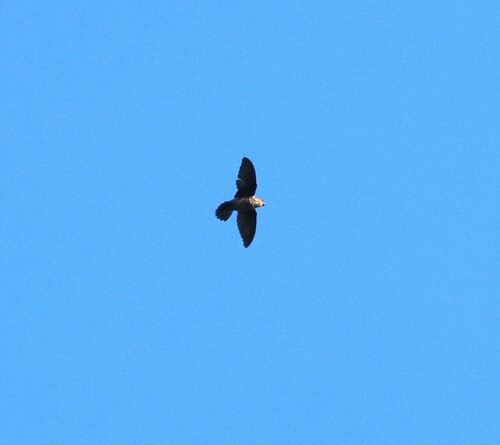 Band-rumped Swift
 Short-tailed Swift
In short
The most reliable field mark between Band-rumped Swift and Short-tailed Swift is the contrast between the rump and tail: Band-rumped shows a distinct pale or white rump band sharply set off from a much darker tail, while Short-tailed Swift’s rump is pale but blends smoothly into the tail, lacking strong contrast. Juvenile Band-rumped Swifts also show white-tipped wing feathers, a feature not present in Short-tailed. Both are similar in size and structure, but subtle differences in tail shape and wing proportions can help. Careful attention to the rump/tail contrast and, for juveniles, wing feather tips, is key for separation in the field.
Identification tips
- Juvenile Band-rumped Swifts show white tips on some wing feathers—look for these in flight or when the bird banks in good light. Short-tailed Swifts never show this feature at any age.
- Rump-to-tail contrast is the single most important field mark: Band-rumped Swift has a bright, sharply defined white or pale rump band that stands out against a much darker tail. Short-tailed Swift’s rump is pale but merges smoothly into the tail, which is not much darker—no sharp contrast.
- Tail shape: Band-rumped’s tail is short and square, sometimes appearing slightly more squared-off than Short-tailed’s, but both are short and differences are subtle; use with caution.
- Wing shape: Band-rumped Swift’s wings bulge in the middle and hook at the end, while Short-tailed’s wings are long and narrow. This is a subtle difference and best seen in direct comparison or with experience.
- Underpart color: Both are dark below, but Band-rumped may show a slightly paler throat, especially in the subspecies C. s. aetherodroma. This is a minor mark and not always visible.
- Subspecies variation: C. s. aetherodroma (Band-rumped) is smaller, with a grayer rump and paler throat, but the rump/tail contrast remains the best mark.
- Size and bulk: Short-tailed Swift is slightly heavier and may look chunkier, but size overlap is extensive and this is not a safe field mark.
- Feeding behavior: Both species feed in flight, but Band-rumped may be seen higher in the air or over water at dawn/dusk. Not reliable for separation.
- Vocalizations: If you hear a bisyllabic 'pseee-trr' or burry 'prrrree-trtr', Band-rumped Swift is likely. Short-tailed’s calls are not described, so only positive Band-rumped calls are useful.
- Sexes are similar in both species: Do not use sex for identification.
- Context and range: Both species overlap widely in range and habitat; do not rely on location alone.
- Flock composition: Band-rumped may feed higher or lower depending on flock composition, but this is subtle and not diagnostic.
- Lighting and viewing angle: The rump/tail contrast on Band-rumped is best seen in good light and when the bird is banking or flying away. Poor light can obscure this mark, so multiple views are helpful.
- Pitfalls: Beware of confusing pale rumps in poor light or at distance—always look for the sharpness of the contrast with the tail, not just the presence of a pale rump.
- Age caution: If you see white-tipped wing feathers, you are looking at a juvenile Band-rumped Swift; absence of this does not rule out Band-rumped, but presence is diagnostic.
Size
Both species are very close in length, with Band-rumped Swift ranging from 10.5–12.6 cm and Short-tailed Swift about 10.5 cm. However, Short-tailed Swift is heavier on average (about 20 g vs. 13.8–18.5 g for Band-rumped), giving it a slightly more robust appearance. In practice, size alone is not a reliable separator, but Short-tailed may appear chunkier in direct comparison.
Plumage
- Juvenile Band-rumped Swift: Shows white tips on some wing feathers, visible in good light and especially in flight. This feature is absent in Short-tailed Swift of any age.
- Adults: Band-rumped Swift has a sharply defined white or pale rump band that stands out against a much darker tail and upperparts. Short-tailed Swift has a pale rump as well, but the transition to the tail is gradual, with little contrast—the tail is not markedly darker than the rump.
- Underparts: Both are dark below, but Band-rumped may show a slightly paler throat. Subspecies variation exists (e.g., C. s. aetherodroma has a grayer rump and paler throat), but the rump/tail contrast remains the key mark.
- Tail: Both have short tails, but Band-rumped’s is square and may look slightly more squared-off, while Short-tailed’s is also short but not as distinctly squared.
Behaviour
Both species are aerial insectivores, feeding on the wing. Band-rumped Swift often forages in single-species flocks at higher altitudes but will stay lower when mixed with other swifts, and is often seen over water at dawn and dusk. Short-tailed Swift also feeds in flight, often on flying ants and termites. Behavior is broadly similar and not reliably diagnostic in the field.
Habitat
Both species overlap widely in range and habitat, occurring from Panama through northern South America and Trinidad. Both are found over open areas, near water, and in lowland forests. Habitat is not a reliable separator where their ranges overlap.
Voice
Band-rumped Swift gives a diagnostic bisyllabic 'pseee-trr' or a burry 'prrrree-trtr', and sometimes a series of repeated 'tsee-tsee-tsee' notes. Vocalizations of Short-tailed Swift are not described in the sources, so voice is only useful if Band-rumped’s distinctive calls are heard. Otherwise, vocalization is not a strong separator.