

Motmot

シロオビハリオアマツバメ 対 タンビハリオアマツバメ

Chaetura spinicaudus 対 Chaetura brachyura

シロオビハリオアマツバメとタンビハリオアマツバメのクイズ
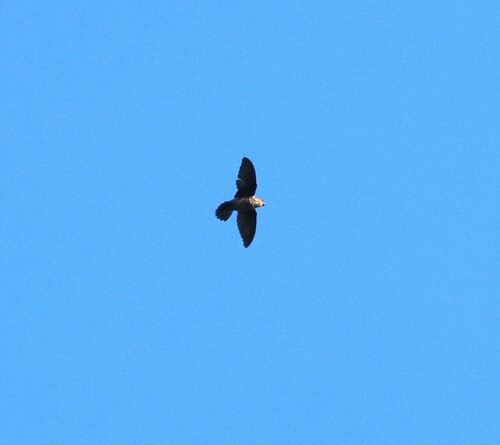
シロオビハリオアマツバメ (Chaetura spinicaudus) シロオビハリオアマツバメ

タンビハリオアマツバメ (Chaetura brachyura) タンビハリオアマツバメ

メディア

読み込み中…

要点

バンドルンプトアマツバメとタンビハリオアマツバメの最も信頼できるフィールドマークは、尾と尻のコントラストです:バンドルンプトは、はっきりとした淡いまたは白い尻のバンドが、はるかに暗い尾と鮮明に区別されているのに対し、タンビハリオアマツバメの尻は淡いですが、尾にスムーズに溶け込んでおり、強いコントラストがありません。幼鳥のバンドルンプトアマツバメは、白い先端の翼羽を示し、この特徴はタンビには見られません。両者はサイズと構造が似ていますが、尾の形状や翼の比率に微妙な違いがあり、これが助けになります。尻/尾のコントラストと、幼鳥の場合は翼羽の先端に注意を払うことが、フィールドでの識別の鍵です。

識別のコツ

  1. 幼鳥のバンドルンプトアマツバメは、いくつかの翼羽に白い先端を示します—飛行中や良い光の中で鳥がバンクする時にこれを探してください。タンビハリオアマツバメは、どの年齢でもこの特徴を示しません。
  2. 尻から尾へのコントラストは、最も重要なフィールドマークです:バンドルンプトアマツバメは、はっきりと定義された明るい白または淡い尻のバンドが、はるかに暗い尾に対して際立っています。タンビハリオアマツバメの尻は淡いですが、尾にスムーズに溶け込み、あまり暗くありません—鋭いコントラストはありません。
  3. 尾の形状:バンドルンプトの尾は短くて四角いですが、時々タンビの尾よりもわずかに四角く見えることがありますが、両者とも短く、違いは微妙です;注意して使用してください。
  4. 翼の形状:バンドルンプトアマツバメの翼は中央で膨らみ、先端でフック状になっていますが、タンビの翼は長くて細いです。これは微妙な違いで、直接比較または経験が必要です。
  5. 腹部の色:両者とも下側は暗いですが、バンドルンプトはわずかに淡い喉を示すことがあります、特に亜種C. s. aetherodromaでは。このマークは小さなもので、常に見えるわけではありません。
  6. 亜種の変異:C. s. aetherodroma(バンドルンプト)は小さく、尻は灰色で喉は淡いですが、尻/尾のコントラストが最良のマークです。
  7. サイズと体格:タンビハリオアマツバメはわずかに重く、よりずんぐりした外観に見えることがありますが、サイズの重なりが広範囲にわたるため、これは安全なフィールドマークではありません。
  8. 採餌行動:両種は飛行中に餌を取りますが、バンドルンプトは夜明けや夕暮れに空高くまたは水上で見られることがあります。これは識別には信頼できません。
  9. 鳴き声:もし二音節の「pseee-trr」またはぼやけた「prrrree-trtr」を聞いたら、バンドルンプトアマツバメの可能性が高いです。タンビの鳴き声は記載されていないため、バンドルンプトの鳴き声のみが有用です。
  10. 両種の性別は似ています:識別に性別を使用しないでください。
  11. 文脈と範囲:両種は範囲と生息地で広く重なっています;位置だけに頼らないでください。
  12. 群れの構成:バンドルンプトは群れの構成に応じて高くまたは低く餌を取ることがありますが、これは微妙で診断的ではありません。
  13. 照明と視角:バンドルンプトの尻/尾のコントラストは、良い光の中で、鳥がバンクするか飛び去るときに最もよく見えます。悪い光ではこのマークが隠れることがあるため、複数の視点が役立ちます。
  14. 落とし穴:悪い光や距離で淡い尻を混同しないように注意してください—常に尾とのコントラストの鋭さを探し、単に淡い尻の存在だけを見ないでください。
  15. 年齢の注意:白い先端の翼羽が見えたら、幼鳥のバンドルンプトアマツバメを見ていることになります;これがないからといってバンドルンプトを除外することはできませんが、存在は診断的です。

大きさ

両種は長さが非常に近く、バンドルンプトアマツバメは10.5〜12.6 cm、タンビハリオアマツバメは約10.5 cmです。しかし、タンビハリオアマツバメは平均して重く(約20 g対バンドルンプトの13.8〜18.5 g)、わずかにより頑丈な外観を与えます。実際には、サイズだけでは信頼できる識別はできませんが、タンビは直接比較でずんぐりして見えることがあります。

羽色

行動

両種は空中の昆虫食者で、翼で餌を取ります。バンドルンプトアマツバメは、しばしば単一種の群れで高い高度で採餌しますが、他のアマツバメと混ざると低く留まります。また、夜明けや夕暮れに水上で見られることがよくあります。タンビハリオアマツバメも飛行中に餌を取り、しばしば飛んでいるアリやシロアリを食べます。行動は広く似ており、フィールドでの診断には信頼できません。

生息環境

両種は範囲と生息地で広く重なり、パナマから南アメリカ北部およびトリニダードにかけて生息しています。両者は開けた地域、水の近く、低地の森林に見られます。生息地は、範囲が重なる場所では信頼できる識別要因ではありません。

声

バンドルンプトアマツバメは、診断的な二音節の「pseee-trr」またはぼやけた「prrrree-trtr」を発し、時には繰り返される「tsee-tsee-tsee」の音を出します。タンビハリオアマツバメの鳴き声は、情報源には記載されていないため、バンドルンプトの独特の鳴き声が聞かれた場合のみ有用です。そうでなければ、鳴き声は強い識別要因ではありません。

より良い説明を送る

比較と同じ項目を使ってください。文章はすぐに公開されます。

The most reliable field mark between Band-rumped Swift and Short-tailed Swift is the contrast between the rump and tail: Band-rumped shows a distinct pale or white rump band sharply set off from a much darker tail, while Short-tailed Swift’s rump is pale but blends smoothly into the tail, lacking strong contrast. Juvenile Band-rumped Swifts also show white-tipped wing feathers, a feature not present in Short-tailed. Both are similar in size and structure, but subtle differences in tail shape and wing proportions can help. Careful attention to the rump/tail contrast and, for juveniles, wing feather tips, is key for separation in the field.

  1. Juvenile Band-rumped Swifts show white tips on some wing feathers—look for these in flight or when the bird banks in good light. Short-tailed Swifts never show this feature at any age.
  2. Rump-to-tail contrast is the single most important field mark: Band-rumped Swift has a bright, sharply defined white or pale rump band that stands out against a much darker tail. Short-tailed Swift’s rump is pale but merges smoothly into the tail, which is not much darker—no sharp contrast.
  3. Tail shape: Band-rumped’s tail is short and square, sometimes appearing slightly more squared-off than Short-tailed’s, but both are short and differences are subtle; use with caution.
  4. Wing shape: Band-rumped Swift’s wings bulge in the middle and hook at the end, while Short-tailed’s wings are long and narrow. This is a subtle difference and best seen in direct comparison or with experience.
  5. Underpart color: Both are dark below, but Band-rumped may show a slightly paler throat, especially in the subspecies C. s. aetherodroma. This is a minor mark and not always visible.
  6. Subspecies variation: C. s. aetherodroma (Band-rumped) is smaller, with a grayer rump and paler throat, but the rump/tail contrast remains the best mark.
  7. Size and bulk: Short-tailed Swift is slightly heavier and may look chunkier, but size overlap is extensive and this is not a safe field mark.
  8. Feeding behavior: Both species feed in flight, but Band-rumped may be seen higher in the air or over water at dawn/dusk. Not reliable for separation.
  9. Vocalizations: If you hear a bisyllabic 'pseee-trr' or burry 'prrrree-trtr', Band-rumped Swift is likely. Short-tailed’s calls are not described, so only positive Band-rumped calls are useful.
  10. Sexes are similar in both species: Do not use sex for identification.
  11. Context and range: Both species overlap widely in range and habitat; do not rely on location alone.
  12. Flock composition: Band-rumped may feed higher or lower depending on flock composition, but this is subtle and not diagnostic.
  13. Lighting and viewing angle: The rump/tail contrast on Band-rumped is best seen in good light and when the bird is banking or flying away. Poor light can obscure this mark, so multiple views are helpful.
  14. Pitfalls: Beware of confusing pale rumps in poor light or at distance—always look for the sharpness of the contrast with the tail, not just the presence of a pale rump.
  15. Age caution: If you see white-tipped wing feathers, you are looking at a juvenile Band-rumped Swift; absence of this does not rule out Band-rumped, but presence is diagnostic.

Both species are very close in length, with Band-rumped Swift ranging from 10.5–12.6 cm and Short-tailed Swift about 10.5 cm. However, Short-tailed Swift is heavier on average (about 20 g vs. 13.8–18.5 g for Band-rumped), giving it a slightly more robust appearance. In practice, size alone is not a reliable separator, but Short-tailed may appear chunkier in direct comparison.

  • Juvenile Band-rumped Swift: Shows white tips on some wing feathers, visible in good light and especially in flight. This feature is absent in Short-tailed Swift of any age.
  • Adults: Band-rumped Swift has a sharply defined white or pale rump band that stands out against a much darker tail and upperparts. Short-tailed Swift has a pale rump as well, but the transition to the tail is gradual, with little contrast—the tail is not markedly darker than the rump.
  • Underparts: Both are dark below, but Band-rumped may show a slightly paler throat. Subspecies variation exists (e.g., C. s. aetherodroma has a grayer rump and paler throat), but the rump/tail contrast remains the key mark.
  • Tail: Both have short tails, but Band-rumped’s is square and may look slightly more squared-off, while Short-tailed’s is also short but not as distinctly squared.

Both species are aerial insectivores, feeding on the wing. Band-rumped Swift often forages in single-species flocks at higher altitudes but will stay lower when mixed with other swifts, and is often seen over water at dawn and dusk. Short-tailed Swift also feeds in flight, often on flying ants and termites. Behavior is broadly similar and not reliably diagnostic in the field.

Both species overlap widely in range and habitat, occurring from Panama through northern South America and Trinidad. Both are found over open areas, near water, and in lowland forests. Habitat is not a reliable separator where their ranges overlap.

Band-rumped Swift gives a diagnostic bisyllabic 'pseee-trr' or a burry 'prrrree-trtr', and sometimes a series of repeated 'tsee-tsee-tsee' notes. Vocalizations of Short-tailed Swift are not described in the sources, so voice is only useful if Band-rumped’s distinctive calls are heard. Otherwise, vocalization is not a strong separator.

変更を破棄しますか?

保存していない編集があります。今離れると失われます。

シロオビハリオアマツバメ · タンビハリオアマツバメ · 苦手な鳥