

Bananaquit vs Lesser Antillean Bullfinch
Coereba flaveola versus Loxigilla noctis
Play a quiz with Bananaquit and Lesser Antillean Bullfinch
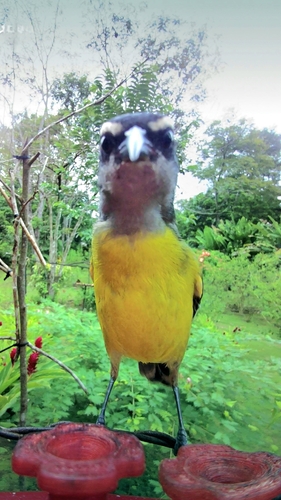 Bananaquit
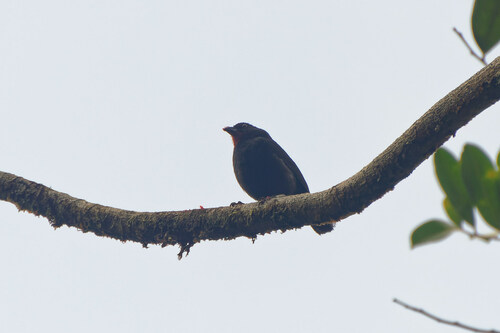 Lesser Antillean Bullfinch
In short
The most reliable field mark to separate Bananaquit from Lesser Antillean Bullfinch is the Bananaquit's bold white eyestripe and yellow underparts, which are never present on the bullfinch. Lesser Antillean Bullfinch males are mostly black with a short red supercilium and orangish red throat, while females are warm brown with rusty tones—neither sex shows the Bananaquit's combination of dark upperparts, white facial stripe, and yellow below. Juvenile Bananaquits are duller but still show yellow and a pale eyebrow, while all bullfinches lack yellow entirely. Bill shape is also key: Bananaquit has a slender, strongly curved bill for nectar feeding, while the bullfinch's bill is thick and finch-like. Both species can be active in gardens, but their structure and plumage are distinct in good views.
Identification tips
- White eyestripe (Bananaquit only): Look for a bold white stripe above the eye; present in all Bananaquit ages and sexes, never in bullfinch.
- Yellow underparts (Bananaquit only): Bananaquit always shows yellow on the chest, belly, and rump (except in a few all-blackish insular forms); bullfinch never has yellow below.
- Bill shape: Bananaquit has a slender, strongly decurved bill adapted for nectar feeding; bullfinch's bill is thick, conical, and finch-like, suited for seeds and fruit.
- Male bullfinch plumage: Adult male Lesser Antillean Bullfinch is mostly black with a short red supercilium and orangish red throat—never yellow or white below, and no white eyestripe.
- Female bullfinch plumage: Female bullfinch is warm brown overall with rusty lores and rusty-edged greater coverts, lacking any white facial markings or yellow below.
- Juvenile Bananaquit: Duller than adults, but still shows yellow below and a pale eyebrow; never uniform brown or black like bullfinch.
- Undertail coverts: Bullfinch may show rufous or chestnut undertail coverts in some subspecies, but these are never yellow or white as in Bananaquit.
- Size and structure: Bananaquit is smaller, slimmer, and more delicate; bullfinch is larger, heavier, and more robust.
- Feeding behavior: Bananaquit is often seen probing flowers or feeders for nectar, sometimes 'robbing' nectar; bullfinch feeds more like a typical finch, eating seeds and fruit.
- Flight and jizz: Bananaquit is quick, agile, and often flits among flowers; bullfinch is more deliberate and less acrobatic.
- Habitat overlap: Both can occur in gardens and open areas, so do not rely on habitat alone for ID.
- Subspecies variation: Some insular Bananaquit forms are blackish, but still have a curved bill and lack the bullfinch's thick bill and overall structure.
- No yellow in bullfinch: At no age or sex does Lesser Antillean Bullfinch show yellow plumage.
- No white eyestripe in bullfinch: At no age or sex does bullfinch show a white eyestripe.
- Bill color: Bullfinch males have a black or dark brown bill; females have a blackish upper and brownish or horn lower mandible. Bananaquit's bill is dark and slender in all ages.
Size
Lesser Antillean Bullfinch is noticeably larger and heavier than Bananaquit. Bullfinch measures 14–15.5 cm in length and averages 18.4 g in mass [wikidata], while Bananaquit is smaller at 10–13 cm and 5.5–19 g (most at the lower end) [wikipedia]. In the field, Bananaquit appears more delicate and lightweight, with a finer build, compared to the bullfinch's stockier, more robust impression.
Plumage
Juvenile and adult Bananaquits of most subspecies show a striking combination of dark (almost black) upperparts, a prominent white eyestripe, and yellow underparts (chest, belly, and rump). Juveniles are duller but still show yellow and a pale eyebrow. Some insular Bananaquit subspecies are overall blackish or have paler throats, but even these forms retain a slender, curved bill and lack the bullfinch's thick bill and overall structure. Lesser Antillean Bullfinch males are mostly black with a short red supercilium and orangish red throat; females are warm brown with rusty lores, brown upperparts, and rusty-edged greater coverts. No bullfinch of any age or sex shows yellow underparts or a white eyestripe. The bullfinch's undertail coverts can be rufous-chestnut in some subspecies, but never yellow or white. In flight, neither species shows distinctive upperwing patterns that are diagnostic, but perched views of the face and underparts are highly reliable.
Behaviour
Bananaquit is an active, agile nectar feeder, often seen flitting among flowers and sometimes 'nectar robbing' by piercing flowers from the side. It must perch to feed and does not hover like a hummingbird. Bananaquit frequently visits gardens and feeders, sometimes becoming quite tame. Lesser Antillean Bullfinch is also found in gardens and open habitats but behaves more like a typical finch, feeding on seeds and fruits with a heavier, slower jizz. It is less likely to be seen probing flowers and more likely to be seen foraging on or near the ground or in shrubs. Both species can be confiding, but their feeding behaviors differ markedly.
Habitat
Both species are common in gardens, parks, and open to semi-open habitats in the Lesser Antilles, but Bananaquit is more widespread, occurring throughout the West Indies (except Cuba), southern Mexico, and tropical South America. Bullfinch is restricted to the Lesser Antilles island chain. Neither species is typical of dense forest or high elevations. In overlapping areas, both may be seen in similar suburban or edge habitats, so habitat alone is not diagnostic.