

Babbling Starling vs Burchell's Starling
Neocichla gutturalis versus Lamprotornis australis
Play a quiz with Babbling Starling and Burchell's Starling
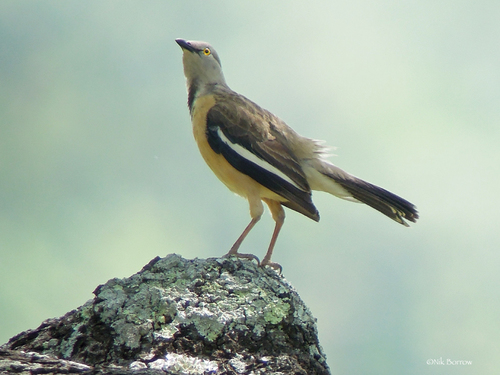 Babbling Starling
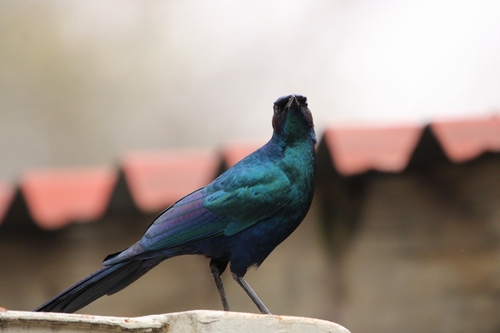 Burchell's Starling
In short
The most reliable field mark to separate Babbling Starling from Burchell's Starling is the Babbling's distinctive yellow chest with a black wedge on the breast, combined with its off-white head and a clear white wing band visible on the folded wing. Burchell's Starling lacks these features and instead shows a uniform glossy plumage. Both species are similar in overall structure, but Babbling Starling is slightly smaller and paler, with a more contrasting head and underparts. If you see a starling with a pale head and a strong white wing band, it's Babbling; if it's all dark and glossy, it's Burchell's.
Identification tips
- Yellow chest with black wedge (Babbling only): Look for a bright yellow breast with a black wedge-shaped mark in the center. Burchell's never shows this. Works for all ages and sexes.
- Off-white head (Babbling only): Babbling Starling has a noticeably pale, off-white head contrasting with the rest of the body. Burchell's is uniformly dark and glossy.
- White wing band (Babbling only): On perched or folded-wing birds, Babbling shows a white band across the wing. This is absent in Burchell's, which has unmarked wings.
- Bright yellow eye (Babbling): Babbling Starling has a striking yellow iris, while Burchell's eye color is not specified but is not noted as diagnostic.
- Glossy, uniform plumage (Burchell's only): If the bird is all-over glossy blue-green or purple with no strong color contrast between head, breast, and wings, it's Burchell's.
- No pale head or yellow chest (Burchell's): Absence of pale or yellow tones on the head or chest points to Burchell's.
- Size and build: Babbling is smaller and lighter (17 cm, 64–72 g) than Burchell's (80 g), but this is subtle and best used as supporting evidence.
- Tail color: Babbling has a dark brown tail; Burchell's tail is not described as contrasting, so look for a uniform glossy tail in Burchell's.
- Voice: If you hear a slurred, squealing, or raspy scolding call, suspect Babbling Starling. Lack of vocal description for Burchell's means silence is not diagnostic.
- Range: If you are in southern Africa's dry woodlands, Burchell's is more likely; in Angola, Malawi, Tanzania, or Zambia, check for Babbling.
- Habitat: Both occur in open woodland and savannah, so habitat alone is not reliable where ranges overlap.
- Sexes alike: Both species show little or no sexual dimorphism, so do not rely on sex differences.
- No known age-specific flight marks: Neither species is reported to show distinctive juvenile or immature upperwing patterns, so focus on body and head pattern.
- No seasonal change: Both species retain their key field marks year-round, so these tips apply in all seasons.
- Pitfall: In poor light, Babbling's pale head and yellow chest may look washed out; always check for the white wing band and black breast wedge to confirm.
Size
Babbling Starling is somewhat smaller and lighter (17 cm, 64–72 g [wikipedia]) than Burchell's Starling (80 g [wikidata]). This difference may be subtle in the field, but Babbling Starling can look more delicate and less bulky, especially when perched. Both are medium-sized starlings, but Burchell's is the heavier and more robust of the two.
Plumage
Babbling Starling of all ages shows a distinctive combination of a yellow chest with a black wedge in the center, an off-white head, and a light brown crown fading into dark greyish-brown wings. The folded wing has a clear white band, and the tail is dark brown. The eye is bright yellow. Sexes are alike. In contrast, Burchell's Starling is uniform and glossy, lacking any pale head, yellow chest, or white wing band. Its plumage is an even iridescent blue-green or purple, with no strong color contrast between head, breast, and wings. No age-specific or seasonal plumage differences are noted for either species in the sources, so these marks apply year-round.
Behaviour
No diagnostic behavioral differences are noted in the sources. Both species are typical starlings in posture and movement.
Habitat
Babbling Starling is found in Angola, Malawi, Tanzania, and Zambia [wikipedia], while Burchell's Starling is native to dry and mesic woodlands and savannahs of southern Africa [wikipedia]. If you are outside the overlapping range, this may help, but both can occur in similar open woodland and savannah habitats where their ranges meet.
Voice
Babbling Starling is described as giving slurred, squealing, or raspy scolding calls [wikipedia]. No vocal description is provided for Burchell's Starling in the sources, so voice is only helpful if you hear the Babbling's distinctive harsh calls.