

Ayres's Hawk-Eagle vs Verreaux's Eagle
Hieraaetus ayresii versus Aquila verreauxii
Play a quiz with Ayres's Hawk-Eagle and Verreaux's Eagle
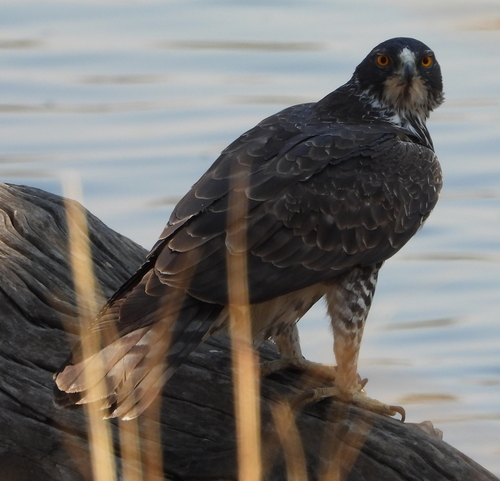 Ayres's Hawk-Eagle
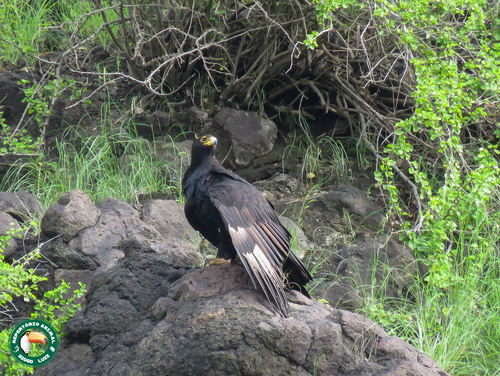 Verreaux's Eagle
In short
The most reliable field mark between Ayres's Hawk-Eagle and Verreaux's Eagle is overall size and structure: Verreaux's is a massive, heavy-bodied eagle, while Ayres's is much smaller and more lightly built. In flight, juvenile Verreaux's Eagles show extensive white patches on the underwing and a contrasting golden nape, while Ayres's juveniles lack these features and are more uniformly dark above with sparser markings below. Adult Verreaux's Eagles are almost entirely black with bold white on the rump and back, whereas Ayres's adults are blackish above but heavily spotted and barred below, with a white supercilium and forehead. Even at a distance, the sheer bulk and paddle-shaped wings of Verreaux's Eagle stand out against the more compact, buzzard-like Ayres's Hawk-Eagle.
Identification tips
- Size is the first check: If the bird is truly massive, with a wingspan and bulk rivaling the largest eagles, it's Verreaux's. Ayres's is much smaller, only buzzard-sized. Use nearby birds or landscape features for scale.
- Flight shape: Verreaux's soars with wings in a strong dihedral (V-shape), wings broad and paddle-shaped, and primaries upturned. Ayres's has a flatter, more buzzard-like wing profile and appears lighter and more agile.
- Juvenile underwing pattern: Juvenile Verreaux's Eagles show extensive white patches on the underwing and a golden nape—unique in the region. Ayres's juveniles have dark, heavily barred underwings without large white patches, and lack the golden nape.
- Adult plumage: Adult Verreaux's is almost entirely black with a bold white V on the back and rump, and white at the base of the primaries. Ayres's adult is blackish above, but with white mottling, a white supercilium, and heavily spotted white underparts.
- Head pattern: Ayres's Hawk-Eagle has a white forehead and supercilium, often visible even at a distance. Verreaux's lacks this, being uniformly dark-headed as an adult.
- Crest: Ayres's sometimes shows a small, pointed crest when perched or alert; Verreaux's does not.
- Leg feathering: Both species have feathered legs, but Ayres's has pure white, well-feathered legs, often visible in good views. Verreaux's legs are creamy to yellowish in immatures, less contrasting in adults.
- Tail pattern: Ayres's has an ashy grey tail with a broad black tip and narrow dark bars; Verreaux's tail is darker and less distinctly barred, often appearing blackish in adults.
- Perched jizz: Perched Verreaux's Eagle looks huge, deep-chested, and long-winged, often dwarfing other raptors. Ayres's is more slender and upright, with a proportionally shorter tail and wings.
- Habitat context: If seen over rocky hills or cliffs, especially near hyrax colonies, Verreaux's is likely. Over woodland or forest edge, Ayres's is more probable.
- Sexual dimorphism: Only Ayres's shows marked size and spotting differences between sexes; Verreaux's sexes are similar in plumage.
- Melanistic Ayres's: Rare dark morph Ayres's can appear very dark, but still lacks the massive size and white rump of Verreaux's.
- Immature confusion: Immature Verreaux's can be brownish, but still show golden nape and extensive underwing white; Ayres's immatures are browner with less contrast and lack these features.
- Wing coverts in flight: Verreaux's has white at the base of the primaries and on the back; Ayres's lacks these, with more uniform dark upperwings.
- Bill and feet: Verreaux's has a massive bill and feet appropriate for large prey; Ayres's bill and feet are much smaller and more delicate.
Size
Verreaux's Eagle is dramatically larger, averaging over 4 kg in body mass, compared to Ayres's Hawk-Eagle at under 1 kg [wikidata]. Verreaux's is one of Africa's largest raptors, with a wingspan and length rivaling Golden Eagle, and appears huge and powerful both perched and in flight. Ayres's Hawk-Eagle is only about the size of a large buzzard or small eagle, with a much lighter frame and shorter wings and tail. This size difference is obvious in any direct comparison or when seen near other large raptors.
Plumage
-
Juvenile/immature: Juvenile Verreaux's Eagles are dark brown with a golden crown and rufous nape, plus extensive white patches on the underwing in flight—a key field mark. Their underparts are brown with rufous to cream blotches, and the upperwing coverts show white streaks. Ayres's Hawk-Eagle juveniles are dark brown above, with a paler neck, and largely white below with sparse dark markings. They lack the golden nape and extensive underwing white of Verreaux's, and their underwing is more uniformly barred and dark, without a pale panel or window.
-
Adult: Adult Verreaux's Eagles are strikingly black with a bold white V on the back and rump, and white patches at the base of the primaries visible in flight. Ayres's adults are blackish above with white mottling, a white forehead and supercilium, and heavily spotted white underparts. The underwing of Ayres's is dark and heavily barred, lacking the white patches of Verreaux's. Ayres's also has a small crest, sometimes visible when perched.
-
Both species show sexual dimorphism, but only Ayres's Hawk-Eagle has a notable difference in size and spotting between males and females.
Behaviour
Verreaux's Eagle soars with wings in a pronounced dihedral (V-shape), often high over mountainous terrain, and has a slow, powerful flight with broad, paddle-shaped wings. It is often seen hunting or patrolling cliffs and rocky slopes. Ayres's Hawk-Eagle is more agile and buoyant in flight, with a jizz closer to a buzzard or small eagle, and is typically seen over woodland or forest edge, often flying lower and with quicker, more flexible wingbeats. When perched, Verreaux's appears massive and imposing, while Ayres's is more compact and upright.
Habitat
Verreaux's Eagle is strongly associated with rocky hills, cliffs, and mountainous regions, rarely venturing far from these habitats. It is a specialist predator of rock hyrax and is seldom found in dense woodland or lowland forest. Ayres's Hawk-Eagle, by contrast, is a bird of African woodlands and forest edges, avoiding open rocky areas. Thus, context and habitat can be a strong clue: a large black eagle over cliffs is almost certainly Verreaux's, while a medium-sized eagle over woodland is more likely Ayres's.