
Ayres's Hawk-Eagle vs Tawny Eagle
Hieraaetus ayresii versus Aquila rapax
Play a quiz with Ayres's Hawk-Eagle and Tawny Eagle
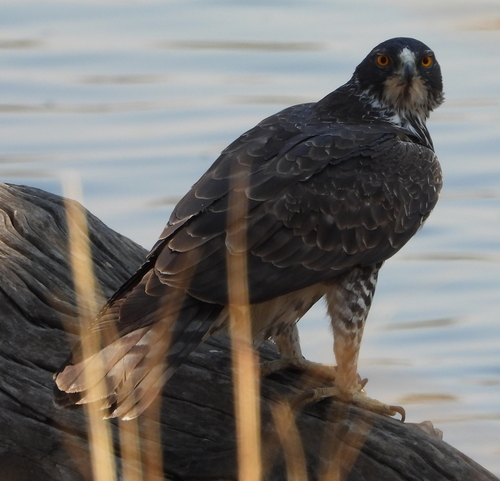 Ayres's Hawk-Eagle
 Tawny Eagle
In short
The most reliable field mark between Ayres's Hawk-Eagle and Tawny Eagle is size: Tawny Eagle is much larger and bulkier, with a heavier build and longer, broader wings, while Ayres's Hawk-Eagle is notably lighter and more compact. In flight, Ayres's Hawk-Eagle shows a more agile, accipiter-like silhouette and heavily barred underwings without pale panels, while Tawny Eagle appears broader-winged and often shows a more uniform or subtly banded underwing. Juvenile Ayres's Hawk-Eagle is dark above and mostly white below with sparse markings, whereas Tawny Eagle juveniles are overall brownish and lack strong contrast. Perched, Ayres's Hawk-Eagle is smaller, often crested, and more patterned, while Tawny Eagle is larger, with a longer neck, baggy feathered legs, and a generally plain or uniformly colored appearance. These differences are most obvious when both species are seen in similar settings, such as open woodland or perched on exposed branches.
Identification tips
- Size is the most immediate clue: Tawny Eagle is much larger and bulkier than Ayres's Hawk-Eagle; if the bird looks small for an eagle, suspect Ayres's.
- Flight silhouette: Ayres's Hawk-Eagle has a compact, agile, accipiter-like shape with relatively short, rounded wings and a proportionally longer tail; Tawny Eagle has broad, long wings with pronounced 'fingers' and a shorter, more square-ended tail.
- Crest: Ayres's Hawk-Eagle often shows a small but noticeable crest, especially when perched; Tawny Eagle never shows a crest.
- Underwing pattern (all ages): Ayres's Hawk-Eagle has dark, heavily barred underwings with no pale panels; Tawny Eagle's underwing is more uniform or subtly banded, and pale morphs may show contrast between pale coverts and dark flight feathers.
- Juvenile plumage: Juvenile Ayres's Hawk-Eagle is dark above, white below with sparse brown markings; juvenile Tawny Eagle is brown above and below, lacking strong contrast.
- Adult underparts: Adult Ayres's Hawk-Eagle is white below with heavy dark spotting; Tawny Eagle adults are plain or streaky brown to rufous below, never heavily spotted.
- Tail pattern: Ayres's Hawk-Eagle has an ashy grey tail with a broad black tip and 3–4 narrow bars; Tawny Eagle's tail is plain or subtly banded (about 7 indistinct bands), often appearing uniform from a distance.
- Leg feathering: Both have feathered legs, but Tawny Eagle's are especially baggy and obvious, contributing to its heavy-legged look.
- Bill and head: Tawny Eagle has a longer, deeper bill and a longer neck, giving a vulture-like profile; Ayres's Hawk-Eagle has a smaller bill and a more compact head.
- Perched posture: Ayres's Hawk-Eagle perches more upright and compact, often with crest raised; Tawny Eagle sits upright but appears larger, with a longer neck and often a scruffy, heavy look.
- Color morphs: Both species can show dark morphs, but Ayres's Hawk-Eagle's melanistic phase retains some white markings and is smaller; Tawny Eagle's dark morph is all dark brown and much larger.
- Supercilium and forehead: Ayres's Hawk-Eagle adults often show a white forehead and supercilium; Tawny Eagle lacks this feature.
- Habitat context: In dense woodland, Ayres's Hawk-Eagle is more likely; in open country or perched on exposed posts, Tawny Eagle is more likely.
- Behavior: Ayres's Hawk-Eagle is more likely to be seen hunting actively in woodland or making agile flights; Tawny Eagle is often seen soaring or sitting for long periods in open areas.
- Sexual dimorphism: Female Ayres's Hawk-Eagle is larger and less densely spotted than the male, but both sexes remain much smaller than any Tawny Eagle.
Size
Tawny Eagle is more than twice as heavy as Ayres's Hawk-Eagle (average adult mass: 1996 g vs 839.5 g) and appears much larger and more robust in all respects. Ayres's Hawk-Eagle is a medium-sized raptor, about the weight of a peregrine falcon, while Tawny Eagle is a large eagle with a bulkier body, longer wings, and a proportionally larger head and bill. In the field, this size difference is usually obvious, especially if both species are seen in the same area or near familiar raptors for scale.
Plumage
- Juvenile/immature Ayres's Hawk-Eagle: Dark brown above, white below with sparse brown markings; upperwing coverts dark, underwing heavily barred and dark, lacking pale panels. As they mature, the underparts become duskier with a rufous cast before acquiring the adult's heavily spotted white underparts.
- Juvenile/immature Tawny Eagle: Uniformly brown to tawny above and below, lacking strong contrast; underwing generally plain or subtly banded, not heavily barred, and no sharp pale panels.
- Adult Ayres's Hawk-Eagle: Blackish upperparts with white mottling, white forehead and supercilium, ashy grey tail with broad black tip and narrow bars, white underparts with heavy dark spotting, brown underwing coverts, and dark, heavily barred flight feathers. Small but sometimes pronounced crest.
- Adult Tawny Eagle: Highly variable but usually plain grey-brown to rufous-tawny overall, with darker flight feathers and tail; head often matches body, sometimes with darker eyebrows or chin; tail is plain or subtly banded. Pale morphs have a contrast between pale body/wing coverts and darker flight feathers/tail. No crest.
- Melanistic Ayres's Hawk-Eagle: Mostly black with white markings, but still smaller and more patterned than the uniformly dark morph Tawny Eagle.
Behaviour
Ayres's Hawk-Eagle is agile and often accipiter-like in flight, with quick wingbeats and rapid, maneuverable movements, especially when hunting in woodland. It perches more upright and may show a small crest. Tawny Eagle is more likely to be seen soaring on broad wings, often holding a more horizontal posture when walking on the ground, and perches upright for long periods on exposed posts or treetops. Its flight is steadier and less agile, befitting its larger size.
Habitat
Both species can occur in African woodlands, but Ayres's Hawk-Eagle is more strictly associated with wooded habitats, while Tawny Eagle is more adaptable and often found in open country, savanna, and semi-arid areas as well as woodland. Tawny Eagle is more likely to be seen in open or edge habitats, sometimes scavenging or walking on the ground, whereas Ayres's Hawk-Eagle is more typically a woodland hunter.